
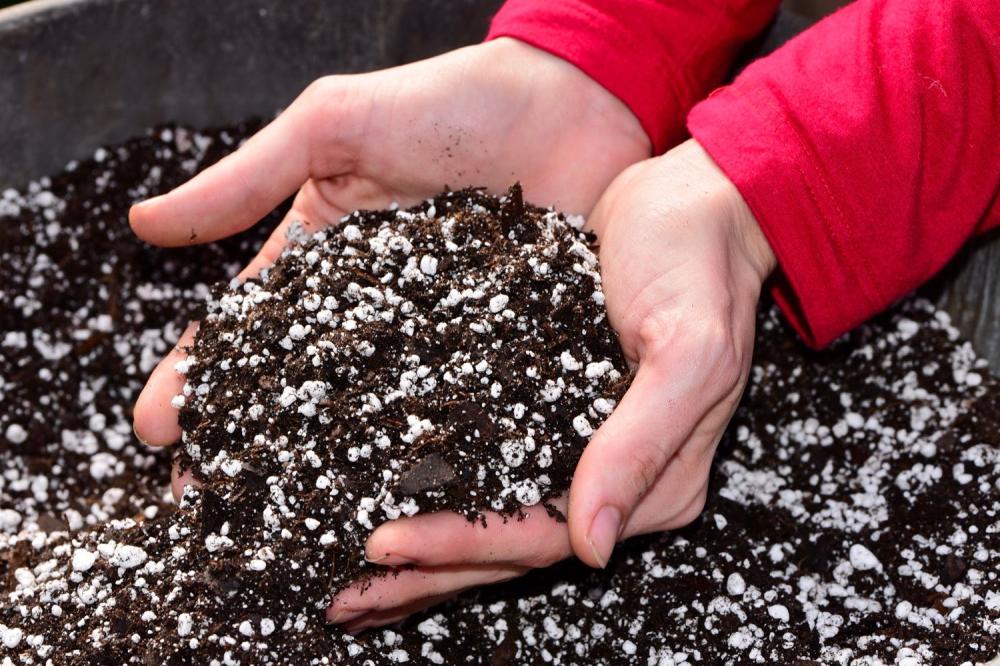

Agricultural perlite is the light white granules you see in ready-made potting mixes. Its job is simple but important: it keeps the soil light and airy so it does not compact, roots can breathe and excess water drains away.
This article explains what perlite is, its benefits, how to mix it with peat moss and soil at clear ratios for each type of growing, and how it differs from vermiculite.
What is perlite?
- Perlite is a natural volcanic rock that holds a small amount of water.
- When heated to a high temperature it expands like popcorn into very light white granules full of air pockets.
- It is sterile, with no weed seeds or diseases.
- It is roughly neutral, so it does not change soil pH.
- It does not break down over time and stays in the soil for years.
Benefits of perlite for soil and plants
- Better aeration: the spaces between granules let air reach the roots.
- Better drainage: excess water drains quickly, reducing root rot.
- Prevents compaction: especially in clay soils and in peat moss that settles over time.
- Lighter pots: useful on rooftops, balconies and in large containers.
- Helps rooting: an excellent medium for rooting cuttings and young seedlings.
Does perlite contain fertilizer?
No. Perlite has no nutrients and does not feed the plant; its role is physical only. Nutrition comes from the soil, enriched peat moss or the fertilizer you add.
How to mix perlite with peat moss and soil
Ratios depend on the plant and the base soil. These are practical starting points:
- Common houseplants: 20 to 30% perlite with peat moss or potting mix.
- Cacti and succulents: 40 to 50% perlite, as they need fast drainage.
- Vegetables in pots: about 20 to 25% perlite with enriched peat moss.
- Rooting cuttings: 50% perlite and 50% peat moss.
- Seedling trays: 10 to 20% perlite with fine peat moss.
- Heavy clay garden soil: work perlite into the top 15 to 20 cm of soil.
Method: moisten the peat moss slightly first, then add perlite and mix well until it is evenly spread.
Step-by-step use
- Wear a mask when opening the bag, because dry perlite releases fine dust.
- Spray the perlite with water to reduce dust.
- Measure the ratio by volume, using a bucket or container.
- Mix it with peat moss or soil until the mix is even.
- Fill the pot without pressing the soil down hard.
- Water thoroughly until water runs out of the drainage holes.
Perlite or vermiculite?
- Perlite: improves drainage and aeration, suitable for plants that dislike excess moisture.
- Vermiculite: holds more water and nutrients, suitable for plants that like steady moisture and for seed germination.
- Many mixes use both with peat moss as needed.
Agricultural vs construction perlite
Construction perlite is used in plaster, thermal insulation and lightweight concrete. Agricultural perlite has graded, sterile granules prepared for growing, so buy the one labelled horticultural or agricultural.
Common mistakes with perlite
- Using so much that the soil dries out quickly and needs constant watering.
- Using it instead of fertilizer, assuming it feeds the plant.
- Mixing it dry without a mask.
- Putting it as a top layer instead of mixing it in, so it floats when watered.
Products from Orkida
- Agrolite agricultural perlite 100 L
- Klasmann TS3 enriched peat moss 210 L
- Stender raw peat moss
- Green Peat raw peat moss 210 L
- 105-cell seedling tray
Perlite FAQs
Does perlite float to the surface?
If it is placed on top of the soil it floats when watered. When it is mixed well into the soil, floating is greatly reduced.
Can I reuse perlite?
Yes, because it does not break down. Rinse off old soil and roots and use it again.
Does perlite change soil pH?
No, perlite is roughly neutral and does not affect soil pH.
How much mix does a 100 L bag make?
About 300 to 500 litres of potting mix when used at 20 to 30%.