
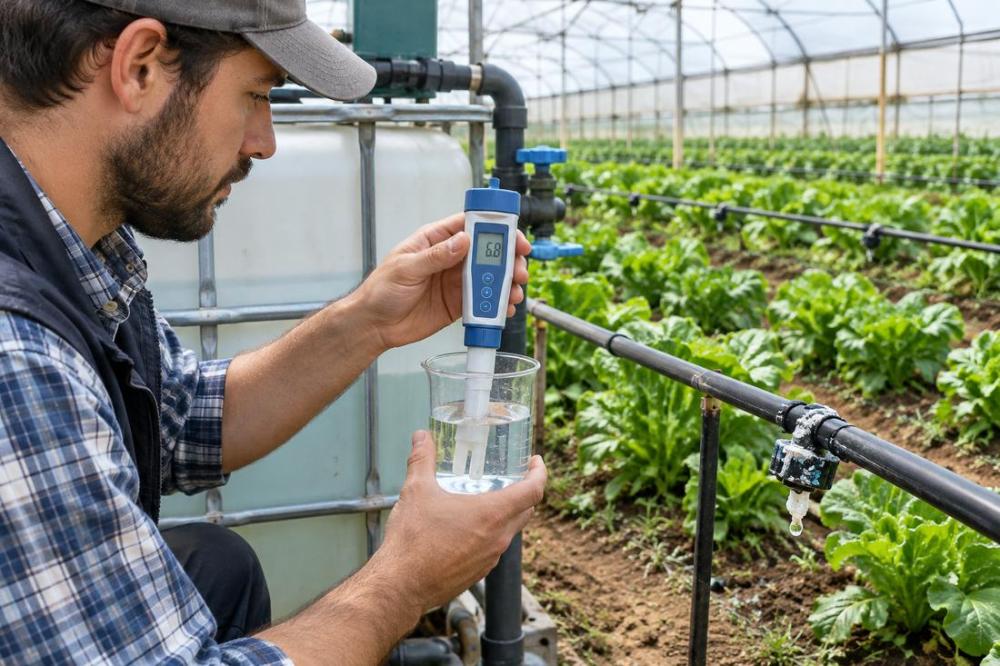

In alkaline and calcareous soils and with hard irrigation water high in bicarbonates, much of the fertiliser you apply never reaches the plant: phosphorus binds to calcium, iron, zinc and manganese become unavailable, and drippers clog with deposits. This is where an acidic fertiliser comes in, lowering the pH of the feed solution and keeping nutrients available to the plant.
In this article we explain when you need an acidic fertiliser, how to choose the formula by plant stage, the correct rates, and what it must not be mixed with.
When do you need an acidic fertiliser?
- If the soil is alkaline or calcareous (pH above roughly 7.5).
- If the irrigation water is hard or high in bicarbonates.
- If new leaves turn yellow even though you are feeding, which is usually poor iron availability.
- If drippers and filters clog with white deposits.
What does an acidic fertiliser do?
- It lowers the pH of the feed solution so phosphorus stays available and does not precipitate with calcium.
- It raises the availability of micronutrients such as iron, zinc and manganese.
- It reduces deposits inside the irrigation network and drippers.
- It makes every kilo of fertiliser work harder because the plant uses more of it.
Choosing the formula by stage
Vegetative growth
- High nitrogen such as 30-10-10: boosts leafy growth and branching early in the season.
- Not for: just before flowering or during fruit set.
Establishment, rooting and pre-flowering
- High phosphorus such as 10-52-10, 15-30-15 and 16-35-10: stimulates new roots and encourages flowering and fruit set.
- Best timing: after transplanting and before flowering.
All stages
- Balanced 20-20-20: for general feeding through the season.
Fruit sizing and quality
- High potassium such as 15-15-30 and 14-5-40: after fruit set and during fruit fill to improve size, colour and taste.
Date palms
- Optifert Date Palm 15-17-27 (pH 2): designed for date palms on calcareous and alkaline soils.
Rates
- Libro acidic (10-52-10, 30-10-10, 20-20-20 and 15-15-30): foliar 1 to 2 g per litre of water repeated every 10 to 14 days, and through irrigation 2 to 4 kg per hectare per irrigation.
- Libro 15-30-15 acidic: foliar 1 to 2 g per litre, and through irrigation 3 to 5 kg per hectare for vegetables and 4 to 6 kg per hectare for trees at flowering and fruit set.
- Optifert 16-35-10 and 14-5-40: by drip 0.5 to 0.8 g per litre early in growth and 0.8 to 2 g per litre at flowering, and foliar 2 to 4 kg per 1,000 L of water.
- Optifert 20-20-20: foliar 60 to 75 g per 15 L of water, repeated every 2 to 3 weeks.
- Optifert Date Palm 15-17-27: about 6 kg per fruiting palm per year in 4 to 6 splits, including 0.5 kg at flowering, 1 kg at hababouk, 1.5 kg at the green khalal (kimri) stage and 1 kg at the coloured khalal and rutab stage.
Important precautions
- Do not mix acidic fertiliser with calcium nitrate or any calcium-containing fertiliser in the same tank, as it precipitates.
- Do not mix it with alkaline materials.
- Avoid spraying in the heat or under direct sun so the leaves do not scorch.
- Test on a small area before spraying the whole crop, and do not exceed the rate.
- Monitor the pH of the feed solution if you also use phosphoric acid or other acids.
Products from Orkida
- Libro 10-52-10 Acidic, 25 kg: for establishment and pre-flowering.
- Libro 15-30-15 Acidic, 25 kg: to stimulate roots and flowering.
- Libro 30-10-10 Acidic, 25 kg: for vegetative growth.
- Libro 20-20-20 Acidic, 25 kg: balanced for all stages.
- Libro 15-15-30 Acidic, 25 kg: for fruit sizing and quality.
- Optifert 16-35-10 Acidic, 25 kg: high phosphorus.
- Optifert Potassium 14-5-40 Acidic, 25 kg: high potassium.
- Optifert 20-20-20 Acidic, 25 kg: balanced.
- Optifert Date Palm 15-17-27 Acidic, 25 kg: for date palms on calcareous soils.
Frequently Asked Questions
What is the difference between acidic and ordinary fertiliser?
Acidic fertiliser lowers the pH of the feed solution, keeping phosphorus and micronutrients available in alkaline soil and water.
Do I need an acidic fertiliser if my soil is normal?
The biggest benefit is in alkaline and calcareous soils and hard water; elsewhere ordinary soluble fertiliser is enough.
Does acidic fertiliser burn plants?
No, as long as you stick to the rate and avoid spraying in the heat.
Can I mix it with calcium nitrate?
No, keep each in its own tank or irrigation.
Which formula should I use after transplanting?
A high-phosphorus formula such as 10-52-10 or 15-30-15.