
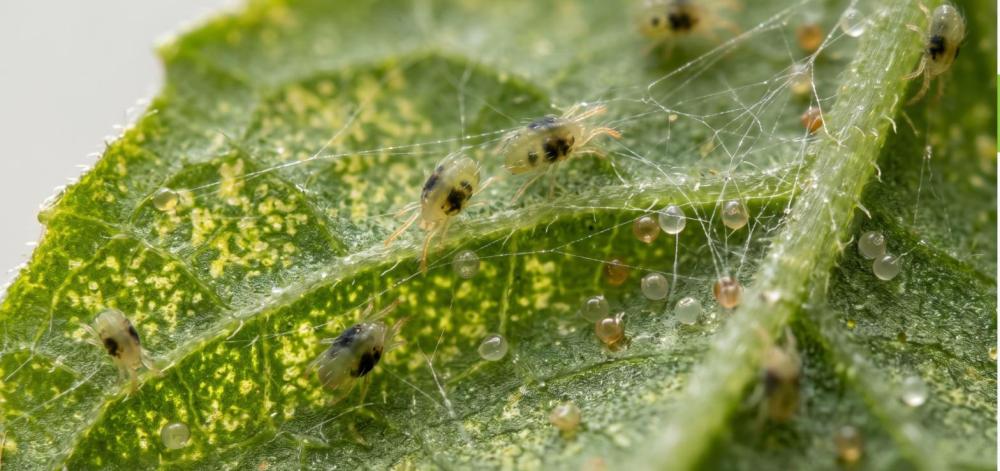

Abamectin is one of the best-known materials growers reach for when they see spider mites on tomato, cucumber or strawberry leaves. It is strong at small doses, but it needs understanding: when to spray it, how to cover the leaf properly, and why mites come back if you rely on it alone.
This article explains what abamectin is, how it works, which pests it controls, and how to spray it to get the best result and delay resistance.
- Group: avermectins (IRAC group 6).
- Origin: a natural compound produced by a soil bacterium and made by fermentation.
- Targets: spider mites and other mites, leafminers, and some sucking insects.
- Common forms: emulsifiable concentrate at 1.8% and 5%, suspension concentrate at 8.4%, and mixtures with other actives.
How does abamectin work?
Abamectin acts on the nervous system of insects and mites. It opens channels in nerves and muscles so signals can no longer pass, which causes paralysis. The pest stops feeding within hours, and death takes one to three days.
It works in two ways:
- By contact: when the spray hits the pest directly.
- By ingestion: when the pest sucks sap from the leaf or feeds on it.
The key feature: it moves into the leaf
Abamectin breaks down quickly on the leaf surface in sunlight, but part of it moves into the leaf tissue and is held there. This is called translaminar movement. It means:
- Mites on the underside are affected even if the spray did not fully reach them.
- Leafminers inside the leaf are reached while they are in their tunnels.
- The effect lasts longer inside the leaf than on the surface.
That does not mean you can be careless with coverage. The better the coverage, the stronger the result.
Which pests does it control?
- Two-spotted spider mite on vegetables, strawberries, cotton and ornamentals.
- Broad mite and russet mite, which distort growing tips and turn fruit brown.
- Leafminers on tomato, cucumber and squash.
- Some sucking insects such as thrips and whitefly, as a side effect rather than the main solution.
- Root-knot nematodes, using special formulations applied to the soil.
How to spray it
1. Start early
As soon as you see tiny yellow speckles on the leaf or fine webbing underneath, start. Mites multiply fast in the heat, and delay means large numbers and lots of eggs.
2. Spray in the late afternoon or early morning
Because abamectin breaks down in sunlight, spraying in the hottest part of the day loses some of it before it enters the leaf.
3. Focus on the leaf underside
Mites live under the leaf. Point the nozzle upward from below, and use enough water to wet both sides of the leaf.
4. Repeat after about a week
Abamectin is weak on eggs. Eggs that survive hatch after a few days, so you need a second spray as the label directs to catch the new generation.
5. Stick to the dose
A 1.8% product is not the same as an 8.4% product. Read the label and calculate by the volume of water, and do not raise the dose hoping for a stronger result.
Resistance: why do mites come back?
Spider mites are among the fastest pests to develop resistance, because their generations are short and their numbers are huge. If you spray abamectin every time, after a season or two you will notice it no longer works as it did.
- Rotate groups: after two abamectin sprays, switch to a miticide from another group.
- Do not mix at random: ready-made mixtures are designed, but tank-mixing without understanding does not solve resistance.
- Reduce dust and water stress: thirsty, dusty plants encourage mites.
Abamectin alone or in a mixture?
- Abamectin alone: for spider mites, other mites and leafminers.
- Abamectin with a diamide: when you have leafminers or Tuta absoluta together with mites.
- Abamectin with a pyrethroid: when you want to hit sucking insects and mites together.
- Soil formulations: for nematodes, applied at the roots rather than on the leaves.
Safety
- Do not spray while bees are working the flowers. Abamectin is toxic to bees at the time of spraying, so choose a time with no activity.
- Keep it away from ponds and watercourses.
- Wear gloves, a mask and goggles when preparing the mix and spraying.
- Respect the pre-harvest interval stated on the label.
Products from Orkida
- Vertimec 1.8% EC, 1 litre: abamectin 1.8% for spider mites and leafminers.
- Vertimec 1.8% EC, 250 ml: the same product in a small pack for limited areas.
- Agrimec Gold 8.4%, 100 ml: high-strength abamectin 8.4%, a small amount per tank.
- Voliam Targo 063 SC, 250 ml: abamectin with chlorantraniliprole for Tuta absoluta, leafminers and mites.
- Athena 118 EW, 500 ml: abamectin with bifenthrin for mites and sucking insects.
- Trans Act 18 EC, 500 ml: abamectin 1.8% for spider mites, whitefly and leafminers.
- Abamec Gold 8.4% SC, 250 ml: concentrated abamectin 8.4% for spider mites and other mites.
- Laminar 18 EC, 1 litre: abamectin 1.8% for spider mites and other mites.
- Acaris 50 EC, 1 litre: abamectin 5% for mites, whitefly and aphids.
- Nemax 20 SC, 1 litre: abamectin 2% applied to the soil against root-knot nematodes.
Frequently asked questions
I sprayed abamectin and the mites are still there. Why?
Usually because the eggs were not affected, coverage under the leaf was poor, or the mites have become resistant from overuse. Spray again after a week, and if things do not improve, switch to another group.
Is abamectin systemic?
No, not fully. It enters the leaf and moves from the upper surface to the underside, but it does not travel in the sap to new leaves.
What is the difference between 1.8% and 8.4%?
It is the same active ingredient at a different strength. With 8.4% you need a smaller amount per litre of water. What matters is following the dose written for each product.
Does it work on aphids?
It affects some sucking insects, but it is not the best choice for aphids. There are better-suited insecticides for aphids.