
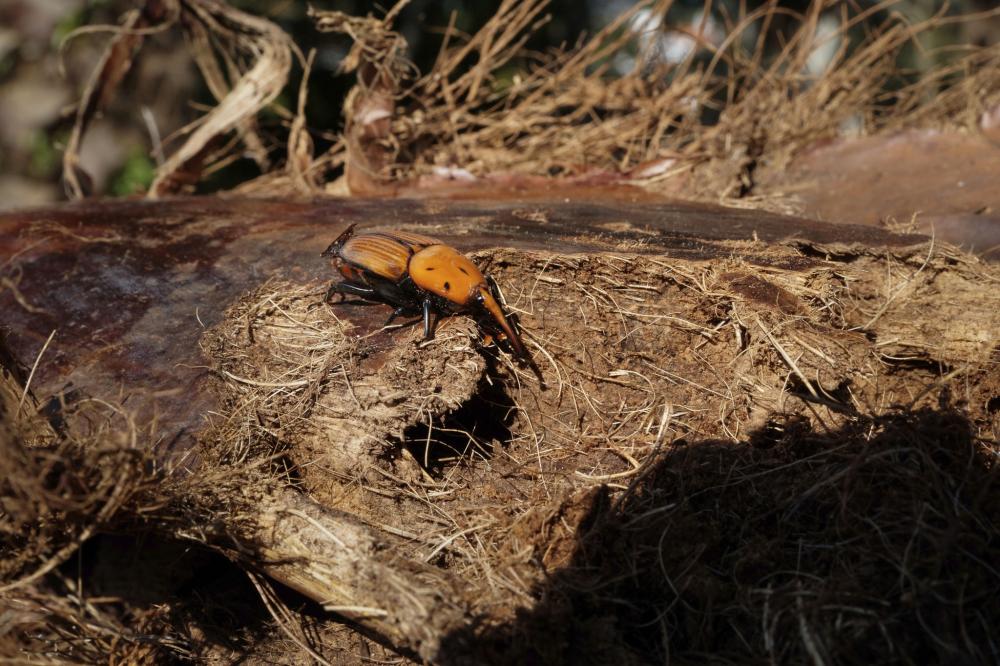

You pass by a palm that is years old and notice its central fronds begin to wilt and lean, and a brown liquid with a fermenting smell may come from the trunk. Often the red palm weevil has spent weeks inside the trunk before any symptom appears. The red palm weevil is among the most dangerous palm pests because the female lays eggs in trunk wounds and the larvae feed in the heart of the palm out of sight, so damage is found only when the palm is badly weakened. So a successful programme rests on regular inspection, pheromone traps, hygiene after pruning and early treatment. In this guide we explain the first signs, its life cycle and what to do at each stage.
In short: The red palm weevil bores into the trunk and eats it from the inside, and the first signs are holes oozing brown liquid with a fermenting smell. The effective treatment for an infested palm is trunk injection with Aretor at 48 ml per palm, and prevention is dipping offshoots and spraying the trunk base after pruning with fipronil 5% at 1 to 1.5 ml per litre of water.
Its scientific name is Rhynchophorus ferrugineus, and it is recognized by its reddish-brown color and a length of 2.5 to 3.5 cm. It has a long snout that the female uses to drill holes in the trunk to lay eggs, and this is where the infestation begins. The larvae hatch and live inside the trunk, feeding on the soft tissues unseen, which is why it is considered one of the most dangerous hidden pests of palms.
- Pest: A reddish-brown beetle with a long snout, considered one of the most dangerous palm pests in the region.
- Damage: Its larvae dig tunnels inside the palm trunk and feed on its tissues until the trunk weakens and the palm dies.
- Sign: A brown liquid oozing from the trunk, a fermenting odor, compacted fibrous waste, and sudden wilting of the heart of the palm.
- Difficulty: The infestation hides inside the trunk and appears only late, so regular inspection is necessary.
- Rule: Report to the competent agricultural authority when in doubt, and combine pheromone traps, early treatment, and continuous sanitation.
Severity of the Infestation
- A single female lays large numbers of eggs inside the trunk.
- The larvae feed inside the palm and weaken it from within, with no obvious symptoms at first.
- It spreads between farms through infested offshoots or contaminated pruning tools.
- It is active in hot and humid weather, especially in coastal areas and oases.
Symptoms of Infestation
- A sticky brown or yellow sap oozing from holes in the trunk.
- A foul fermenting odor coming from inside the trunk.
- Wilting and easy dropping of the central fronds.
- Noticing brown sawdust or insect droppings beneath the palm.
- Hearing digging or gnawing sounds from inside the trunk when you put your ear close.
- Leaning or breaking of the trunk in severe infestations.
Red Palm Weevil Life Cycle
- The insect passes through four main stages:
- Eggs: Laid inside wounds and hatch within 2–5 days.
- Larva: The most dangerous stage, feeding on internal tissues for 25–60 days.
- Pupa: Forms inside cocoons of palm fibers for 10–20 days.
- Adult: Lives up to 3 months and starts a new breeding cycle.
- The full cycle takes 60 to 90 days, which allows many generations in a single year.
Damage to Palms
- Erosion of the trunk’s internal tissues and general weakness of the tree.
- Stunted growth, a dry crown, and falling fronds.
- Death of young offshoots within weeks.
- A sharp drop in date production on infested farms.
Early Detection
- Install pheromone traps (Ferrolure) to detect the first appearance of the insect.
- Inspect the bases of fronds and new offshoots weekly.
- Use acoustic detection devices on large projects.
- Monitor the sap coming out of the trunk for any change in color or smell.
Prevention and Control Methods
First: Prevention
- Inspect offshoots carefully before planting, and never buy offshoots from an infested farm.
- Dip offshoots before planting in fipronil 5% at 1 to 1.5 ml per litre of water (1 to 1.5 L per 1000 L) for 30 minutes, and plant them within 72 hours.
- After pruning or removing offshoots, spray the trunk base up to 50 cm with the same solution (1 to 1.5 ml per litre), because fresh wounds are where the weevil most often enters.
- Disinfect pruning tools after each palm.
- Remove dead or heavily infested palms by cutting and burning or deep burial, and never leave them in the farm.
- Install pheromone traps at about one trap per hectare to monitor the weevil, and refresh the lure and water regularly.
Second: Treating an Infested Palm by Injection
- Spraying the trunk does not reach the larvae feeding inside, so the main treatment for an infested palm is trunk injection with a systemic insecticide.
- Aretor 9.7% ME (emamectin benzoate): drill 4 holes around the trunk base, 6 mm wide at a 10 to 20 degree angle, no deeper than one third of the trunk diameter.
- Inject 12 ml per hole, which is 48 ml per palm per year, then seal the holes with wooden plugs.
- One injection protects for up to 12 months, and the pre-harvest interval is 90 days.
- Use approved injection equipment only; it is not for spraying or soil application.
- A palm whose crown (heart) has collapsed will not recover with injection, so remove and destroy it before it spreads the infestation.
Third: Precautions During Treatment
- Seal injection holes immediately with agricultural putty or paraffin wax.
- Do not mix different insecticides without technical advice.
- Prepare insecticides with fresh water only.
- Carry out injection or spraying in the early morning or before sunset to reduce evaporation.
Tips for Farmers
- Inspect palms regularly and do not ignore the first signs.
- Do not move offshoots from infested areas.
- Keep a continuous record of inspection and treatment dates.
- Consult a specialist engineer or technician when you suspect an infestation.
- Regular prevention is cheaper and better than treatment after it is too late.
Pruning and Wounds: Where Infestation Often Begins
The female is attracted to the smell of sap from wounds, so pruning cuts, frond removal and trunk breaks are the most exposed spots. Prune in a season when the insect is less active, leave a suitable distance from the trunk when cutting fronds, sterilise tools, and treat cut spots with a protective material immediately so sap does not leak and attract the female.
What to Do When You Suspect an Infestation
Do not delay. Check holes, the brown liquid and the fermenting smell, and report to your regional agriculture office when you suspect infestation in more than one palm or a neighbouring farm, because control is a shared effort, then start trunk injection as described above. Visit one of our branches with photos of the palm and trunk and we will guide you to the right product and application method.
Browse all agricultural pesticides at Orkida.
What is the best insecticide for the red palm weevil?
- For an infested palm: injection with Aretor, because it reaches the larvae inside the trunk and protects the palm for up to 12 months.
- For new offshoots: dipping in fipronil 5%, such as Fipronir, Fiprol, Thripguard and Lord.
- To protect the base after pruning: spray fipronil 5% on the first 50 cm of the trunk.
- Pheromone traps do not cure a palm, but they detect the weevil early and reduce its numbers on the farm.
Products from Orkida
- Aretor 9.7% ME by Syngenta, 1 L: trunk injection, 12 ml per hole × 4 holes = 48 ml per palm per year.
- Fipronir 50 SC, 1 L: offshoot dip, 1 to 1.5 L per 1000 L of water for 30 minutes.
- Fiprol 50 SC, 1 L: offshoot dip, 1 to 1.5 L per 1000 L of water for 30 minutes.
- Fiprol 50 SC, 250 ml: for small quantities, at the same 1 to 1.5 ml per litre.
- Thripguard 50 SC, 1 L: offshoot dip and palm base spray, 1 to 1.5 L per 1000 L of water.
- Lord 5% SC, 1 L: offshoot root dip, 1 L per 1000 L of water for 20 minutes.
You can find all the options in the Red Palm Weevil Insecticides category. Stick to the rates above, and start treatment early at the first signs of infestation.
Frequently Asked Questions About the Red Palm Weevil
What are the first signs of palm infestation?
Holes in the trunk or at the bases of the fronds, a brown liquid with a fermenting smell oozing out, wilting or dropping of the central fronds, and the sound of gnawing inside the trunk.
Can an infested palm be saved?
It may be saved if the infestation is discovered early and treated with injection or specialist intervention, while an advanced infestation may end with the palm falling. That is why early detection is the most important factor.
Is spraying alone enough?
No. Integrated control includes regular inspection, pheromone traps, preventive treatment, cleaning the fronds, and sealing wounds after pruning.
When should I notify the authorities?
When you suspect an infestation in more than one palm or on a neighboring farm, it is best to contact the Ministry of Environment, Water and Agriculture or the nearest agricultural office to coordinate control.
Is the red palm weevil dangerous to humans?
No. It does not bite or carry diseases to people; it only damages palms.
How often should I inject a palm?
Once a year with Aretor at 48 ml per palm, because protection lasts up to 12 months.
When can I harvest dates after injection?
90 days after injection.