
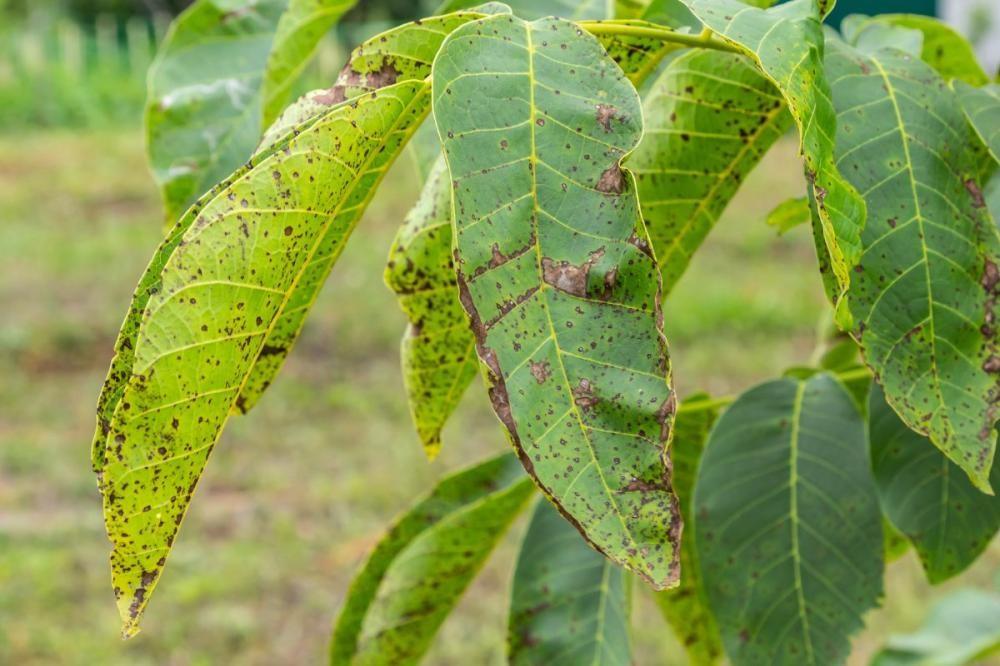

You pick mango fruit that looks sound and glossy, and a few days after it ripens at home, sunken black spots appear and grow day by day until the fruit rots. Or you find a sunken spot with concentric rings on a pepper, with a sticky orange mass in its center. Or the leaves of watermelon and cucumber fill with brown spots whose centers fall out, leaving the leaf looking perforated.
These are all faces of a single disease called anthracnose (also known as black rot or black spot in some crops), caused by fungi of the genus Colletotrichum. What puzzles growers and gardeners most about this disease is that fruit that looked sound at harvest collapses a few days later. The reason is that the infection actually happened in the field weeks earlier, and the fungus was waiting.
Disease: Anthracnose is a fungal disease that causes sunken black spots on mango, pepper and other fruit, which expand as the fruit ripens.
Stage: Infection enters the fruit while it is green, and symptoms appear after harvest, in storage or in transit.
Conditions: It intensifies with high humidity and with rain or spray droplets during flowering and fruit set.
Common mistake: Waiting for spots to appear and then spraying. Preventive treatment before flowering pays off far more.
Rule: Ventilation, pruning, collecting debris and preventive sprays timed to flowering and fruit set stop the disease before it starts.
Why do spots appear after picking? The secret of latent infection
A fungal spore lands on the green fruit in the field with splashing rain or irrigation water, germinates and forms a tiny attachment structure that penetrates the skin, then stops growing and stays dormant. Unripe fruit protects itself with antifungal compounds and a tough skin. As ripening begins, these defenses decline, and the fungus wakes up and invades the flesh.
This explains three observations familiar to anyone who has grown mango or pepper:
- Late spraying does not rescue: Spraying after spots appear on ripe fruit does not save them, because the infection is old.
- Protection at the right time: Real protection comes during flowering, fruit set and fruit growth, not at harvest.
- Effect of heat and storage: Forced ripening and warm storage speed up the appearance of spots, while moderate cooling delays them.
How do you recognize anthracnose?
Although crops differ, anthracnose carries a common sign you can recognize in most cases:
- Sunken spots: Slightly sunken into the surface of the fruit or stem, dark in color, usually round.
- Concentric rings: The spot often carries rings of tiny black dots (the fungal fruiting bodies).
- Colored sticky masses: In humid weather, salmon, orange or pink sticky masses ooze from the center of the spot. These are millions of spores held in a gelatinous matrix that dissolves in water, which is why the disease spreads with rain splash and overhead irrigation more than with wind.
Do not confuse it with
- Blossom-end rot in tomato and pepper: A flat, leathery spot at the end opposite the stem, caused by a disturbance in calcium supply, with no spores and no rings.
- Sunscald: A white or yellow papery patch on the side exposed to the sun, with no spore masses.
- Early blight in tomato: A dry spot at the stem end with rings, but without sticky orange masses.
- Gray mold: A dusty gray growth over soft tissue, not a defined sunken spot.
Anthracnose by crop
The causal agent differs from crop to crop, and so do the symptoms, their timing and how the disease spreads. So we present the main crops one by one, with a practical plan for each.
Mango
The main causal agent is Colletotrichum gloeosporioides and close species, and it is the most important postharvest disease of mango in regions where rain falls or humidity rises during flowering.
- On leaves and young shoots: Irregular dark brown spots whose centers may fall out, and dieback of tender shoot tips that look scorched.
- On flower panicles: Black spots on the panicle axis and flowers, which wilt and drop, so no fruit set occurs. A large share of the crop is lost here before it even begins.
- On fruit: Sunken black spots appearing with ripening, often forming "tear stain" streaks running down from the stem end, the trace left by raindrops carrying spores from infected shoots onto the fruit surface.
- Varieties: They differ greatly in susceptibility. Mango industry references indicate that Kent is highly susceptible and Haden is susceptible, while Keitt and Tommy Atkins are moderately resistant.
Mango plan: Prune dead branches, dried panicle remnants and mummified fruit hanging on the tree after harvest, since they are the spore reservoir for the next season. Focus spraying at panicle emergence and during flowering (one to two sprays), then during fruit growth and one spray before harvest.
In packing houses, fruit is dipped in hot water at about 52°C for minutes that vary with variety and fruit size to kill surface infections, then cooled to between 10 and 13°C, since anything lower causes chilling injury in mango.
Cucurbits: watermelon, cucumber and melon
The causal agent is Colletotrichum orbiculare, which has races that differ in their ability to infect the various species. Watermelon, melon and cucumber are the most affected, while zucchini and pumpkin are less susceptible.
- Leaves: Brown to reddish spots that begin near the veins and grow, then their centers dry and fall out, leaving the leaf perforated. In watermelon the spots are dark and angular.
- Stems and petioles: Elongated sunken lesions that may girdle the stem so that everything beyond it wilts.
- Fruit: Round, sunken, water-soaked-looking spots near maturity, which turn black and become covered with pink spore masses in humid weather. Early infection deforms small fruit or makes it drop.
The most favorable conditions for infection are temperatures between about 21 and 27°C with very high humidity for a long period, and symptoms can appear within four days of infection. The fungus is carried on seed taken from infected fruit and survives on plant debris.
Pepper
It is caused by a complex of Colletotrichum species, the most dangerous recently being Colletotrichum scovillei, which also infects green fruit, unlike most species that prefer ripe fruit.
- Spot shape: Round sunken spots on the fruit that grow with concentric rings, with orange to pink spore masses that make the surface look wet and gelatinous.
- Latent infection: Infection may be latent in green fruit and show up only at coloring.
- Means of spread: It spreads with infected seed and transplants and with crop residue, and it likes temperatures around 27°C with rain.
- Extension recommendations: University extension guidance advises a two- to three-year crop rotation away from nightshades, and not planting strawberries next to pepper because they are an alternate host.
Beans
The causal agent is Colletotrichum lindemuthianum, and its distinctive sign is darkening of the veins on the underside of the leaves, with sunken reddish-brown spots on the pods surrounded by a dark border.
It is carried mainly on seed, since an infected seed gives an infected seedling. That is why certified clean seed is the first line of defense, and you should not save seed from an infected crop.
Other crops
Anthracnose infects ripe tomato fruit with round sunken spots, as well as avocado, citrus, strawberry, papaya and grapes, ornamentals and shade trees such as elm and maple, and even some lawn grasses. Some species, such as C. gloeosporioides, have a wide host range, while C. orbiculare is specialized on cucurbits.
Prevention: the disease travels with water
Anthracnose spores are sticky and do not fly easily. They move with water splash, hands and seed. So prevention focuses on cutting these routes, from the seed to the picking crate:
- Clean seed and transplants: From a reliable source, since many anthracnose species are seedborne.
- Drip irrigation: Instead of overhead sprinklers, and cover the soil with mulch or plastic to keep soil splash and debris from reaching the fruit.
- Do not work in the field when plants are wet: Hands and tools carry the sticky spore masses.
- Remove infected fruit promptly: And do not leave it on the ground.
- Crop rotation: One to three years away from the same plant family, and turn the residue under immediately after harvest.
- Pick carefully: In dry weather, avoid wounding the fruit, and clean picking crates between seasons.
- Drain well: Puddles and permanent moisture around plants lengthen the wetness period.
Fungicides: timing before the name
Because infection happens well before symptoms appear, spraying is mainly preventive: in mango it starts with panicle emergence, in pepper with the first fruit set and continues until coloring, and in cucurbits with vine extension in fields with a history of the disease, or at the first spots.
The most effective groups against Colletotrichum are the strobilurins (FRAC 11) such as azoxystrobin and pyraclostrobin, which North Carolina university trials ranked among the best against pepper anthracnose, and the triazoles (FRAC 3), followed by contact protectants such as copper, mancozeb and chlorothalonil.
But note that resistance to strobilurins has been recorded in several Colletotrichum species around the world, so do not repeat them in consecutive sprays, and it is always best to mix or rotate them with another group.
What we rely on from Orkida's product range
At Orkida, for anthracnose we rely on a systemic triazole and strobilurins mixed with other groups, along with a copper protectant that breaks up repeated use of the groups. These are our choices and when we use each one:
- Score 250 EC: From Syngenta, difenoconazole (FRAC 3), a systemic triazole that enters leaf and fruit tissue quickly and halts construction of the fungal cell membrane. We rely on it especially against anthracnose of cucurbits and pepper, and it moves within the leaf, protecting even what the spray did not reach directly.
- Ortiva Top 325 SC: From Syngenta, azoxystrobin (11) with difenoconazole (3). Azoxystrobin prevents spore germination on the fruit surface while difenoconazole pursues the fungus inside the tissue, so we use it in the most dangerous stages: during mango flowering, and at pepper fruit set in humid weather.
- Bellis 38% WG: From BASF, pyraclostrobin (11) with boscalid (7), two actives that cut off the fungus's respiration at two different sites and prevent spore germination on fruit. We choose it for pre-harvest sprays in vegetables because of its short pre-harvest interval, and it also covers gray mold and leaf spots in the same spray.
- Exide 77 WP: Copper hydroxide 77% (FRAC M1), a contact protectant whose ions are released on the leaf and branch surface and stop Colletotrichum spores from germinating before they enter the tissue, and because it is multi-site, no resistance develops to it. We use it in mango after pruning and before panicle emergence to reduce spores on branches, and in vegetables as a break spray between systemics, breaking up repeated use of groups 3 and 11.
A rotation that protects fungicides from resistance: Score (3), then Bellis (7+11), then Score. Ortiva Top shares group 3 with Score and group 11 with Bellis, so if you use it during flowering, make the next spray a copper protectant such as Exide.
And follow the dose written on the label and the pre-harvest interval, especially for crops picked every few days, such as pepper and cucumber.
Frequently asked questions about anthracnose
Is a mango with black spots safe to eat?
If the spots are small and superficial, you can peel the fruit, remove the affected part and eat it quickly. If the rot has reached the flesh and changed its taste or smell, throw it away. The fungus does not infect humans, but other organisms invade the rotting flesh.
Why do spots appear on mangoes I buy even though they were sound?
Because the infection has been latent since the fruit was on the tree, and it becomes active with ripening. Keep the fruit somewhere mild and well ventilated, do not pile it up, and eat the ripe ones first.
Does anthracnose kill a mango tree?
It rarely kills a large tree, but it scorches young shoots, destroys flowers and spoils fruit, so you lose the season's crop. Sanitation pruning and spraying during flowering change the outcome greatly.
Does mango anthracnose spread to vegetables in my garden?
Some species, such as C. gloeosporioides, have a wide host range and can move between different crops, while other species are specialized, so cucurbit anthracnose, for example, infects only cucurbits. It is best not to leave rotting fruit of any kind in the garden.
Is copper enough on its own?
Copper is a good protectant on leaves and branches and reduces spores, but it does not enter the tissue and does not stop latent infections in fruit. In repeated infections it needs a program that combines it with a systemic fungicide during the critical periods.
Does anthracnose persist in the soil?
It lives on infected plant residue in and on the soil, and some species form hard structures that persist longer. So turning under residue, crop rotation and removing fallen fruit are an essential part of the cure.
Learn about other crop diseases and pests in the Pest Library.