
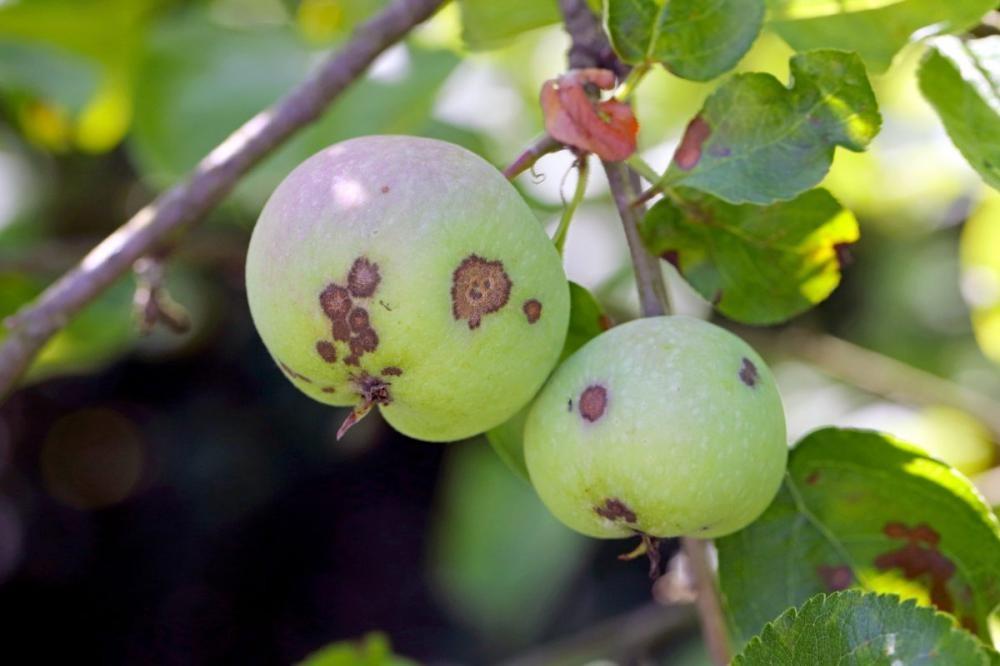

You pick an apple that looks beautiful from a distance, but up close you find velvety black spots that crack and look like rough leather. On the other side of the market, you peel a potato tuber and find its skin covered with corky bumps and small pits. Both conditions carry the same name, "scab," but they are different diseases in their cause and in how they are treated.
This is the confusion that costs growers money: someone who sprays a fungicide on potatoes with bacterial scab will see no effect, and someone who leaves spring apples unprotected will harvest fruit that cannot be marketed. Here we separate the types so you know where to put your effort.
Disease: Scab is a fungal disease that causes rough dark spots on fruit and leaves in apple and pear, and corky lesions on potato tubers.
Damage: It does not usually kill the plant, but it deforms the fruit and lowers its quality, price and storability.
Conditions: It increases with a cool, wet spring, and it overwinters on fallen leaves, buds and tubers.
Common mistake: Leaving fallen leaves in place and planting infected seed potatoes, since they are the source of infection for the next season.
Rule: Winter cleanup, clean seed and early protection before bloom work better than treatment after deformed fruit appears.
Scab is not one disease
In agriculture, the word "scab" describes any disease that leaves rough scars on the surface of a fruit or tuber. The cause, however, differs by plant.
- Apple scab: The fungus Venturia inaequalis, which infects apple leaves and fruit.
- Pear scab: The fungus Venturia pirina, which is close to the apple fungus, but each infects only its own host, so apple scab does not move to pear.
- Common potato scab: The bacterium Streptomyces scabies, which lives in the soil, and is not a fungus.
- Citrus and peach scab: Other fungi (citrus scab from Elsinoë, and peach scab from Cladosporium) that produce corky bumps or spots on young fruit.
Apple and pear scab: the disease of the cool, wet spring
This is the scab that deserves the biggest protection budget, because it spreads within a few weeks with the first spring rains. Understanding its life cycle is enough to know when to act.
- Winter in fallen leaves: The fungus overwinters in last year's leaves that fell to the ground, where its spore-bearing structures mature.
- Spring and rain: With rain and the opening of green buds, spores are released and carried by the wind to tender leaves and flowers.
- The wetness requirement: The primary infection needs a continuous period of leaf wetness, and cold lengthens the time required; it ranges from six hours to more than twenty hours depending on temperature.
- Symptoms after two weeks: Olive-colored spots appear on the leaves, turning velvety and then brown, and on the fruit small black spots that merge and crack.
- Secondary infection: Spores formed on the spots move to the rest of the trees with every rainy period, so the damage repeats throughout the season.
- Losses: Deformed and cracked fruit, early leaf drop that weakens the tree, and rots may appear in storage on fruit that looked sound at harvest.
Citrus, peach and other fruit scab
Scab is not limited to pome fruit; several fruits have their own scab caused by a different fungus. The symptoms look similar, but the timing differs according to the stage of fruit growth.
- Citrus: Brown or gray corky bumps on leaves and young fruit, affecting new growth in the wet spring season.
- Peach and apricot: Small black to olive spots on fruit close to maturity, and cracking of the skin in severe infections.
- Most important: Infection happens on the small fruit and shows up as it grows, so protection belongs in the first weeks of fruit growth, not at ripening.
- Common denominator: Wetness and winter debris, so sanitation and opening the canopy help every type.
Potato scab: a soil problem, not a leaf problem
The causal bacterium lives in most soils, enters the young tuber through lenticels and wounds, and secretes a toxin that kills cells, so the tuber forms corky tissue covering the lesion. The result is a rough skin that lowers the price of the tubers, although they remain edible after peeling.
- Critical period: The first three to four weeks after tuber formation begins.
- Dry conditions: Moisture deficit increases infection, and American trials indicate that keeping soil moisture high until the tuber reaches the size of a walnut reduces scab.
- Soil pH: Infection occurs over a wide range of pH, so adjusting acidity alone is not enough and the program should not be built on it.
- Varieties: They differ in susceptibility, and choosing a resistant variety is one of the best solutions.
- Powdery scab: A different disease caused by a fungus-like organism, which resembles common scab in appearance, and is confirmed by laboratory testing.
- Foliar sprays: They do not help against this disease because the problem is in the soil and on the tuber, not on the leaves.
Pome fruit protection plan, step by step
The goal of the program is to keep tender tissues protected during spring wet periods, and to reduce the spore source to a minimum.
- Collect fallen leaves in autumn, or shred and bury them, since they are the fungus's reservoir for your next season.
- Prune the trees to open the canopy and let air in, so the leaves dry faster and wetness duration is shorter.
- Choose less susceptible varieties when renewing the orchard, since some varieties are relatively resistant and others very susceptible.
- Start protective spraying as green buds open, and keep the interval between sprays short in wet weeks.
- After every long rain, check the trees, and use a systemic fungicide with curative action if you missed a wetness period.
- Rotate between fungicide groups, since reliance on a single group has led to resistance in several orchards.
- Spray the trees after harvest and before leaf drop, covering the underside of the leaves, because this reduces the spores that overwinter.
What about potatoes? A plan closer to cultivation
With potatoes, do not look for a foliar fungicide; what you do with irrigation, variety and soil is the real treatment.
- Plant clean, scab-free seed tubers, since infected seed carries the disease.
- Choose a resistant or tolerant variety if one is available.
- Keep moisture regular and good during tuber formation, and do not let the soil dry out.
- Rotate crops, and include green manure crops such as oats and rye between seasons.
- Rely on biological treatments for seed or soil if the disease recurs in the same field.
Orchard monitoring: what to check and when?
Regular monitoring is what separates a grower who is surprised by scab in summer from one who stopped it in spring. It does not need complicated tools.
- Autumn: Check the leaves before they fall, since many spots mean high pressure next spring.
- As buds open: Record rain and wetness days, since those are the possible infection days.
- Two weeks after rain: Look for small olive spots on tender leaves, which confirms that infection occurred.
- Before picking: Inspect a sample of fruit, and remember that late infections may show up only in storage.
Scab, storage and marketing
Scab does not only lower appearance; it opens a path for rot after harvest. That is why apple traders care about it more than growers expect.
- Cracked fruit: Secondary fungi enter it and it rots faster in storage.
- Hidden infection: Fruit that looks clean at harvest carries tiny spots that cannot be seen, and they show up months later in cold storage.
- Sorting: Separate infected fruit from sound fruit before storage, since spores move from them to the rest.
Common mistakes in scab control
We often see these mistakes behind a failed season, and all of them are avoidable.
- Starting after spots appear: Spores infect the tissue two weeks before you can see it, so spraying after spots appear is late.
- Neglecting autumn leaves: It leaves a whole reservoir of the fungus near the trees.
- One fungicide all season: It leads to resistance and reduced efficacy.
- Confusing fungal scab with potato scab: Neither is helped by the treatment for the other.
- Sulfur sprays in heat: They can burn sensitive leaves and fruit at high temperatures.
What we rely on at Orkida for apple and pear orchards
We build the scab program on three tools: a copper or sulfur protectant at the start, a systemic fungicide with curative action for infection days, then a planned rotation. These are the products we recommend.
- Score 250 EC: Difenoconazole from the triazole group, which covers scab of pome fruit, rust and powdery mildew, and has curative action that covers missed infection days. We rely on it as the backbone of the spring program.
- Kdos: A protective copper hydroxide, which we use at the start of the season before the leaves open to protect the buds. We avoid overusing it on fruit because it can cause russeting on the skin of some varieties.
- Sulfin 800 SC: Micronized sulfur 80%, a contact protectant that we put in early sprays in mild weather, and we avoid it in high heat. It is also useful against the powdery mildew that visits apple in the same period.
There is no foliar fungicide for common potato scab, so we do not recommend a product here; the solution lies in irrigation, variety and clean seed. And one piece of expert advice: follow the dose on the label and the pre-harvest interval.
Frequently asked questions
Are scab-infected apples safe to eat?
Yes, the disease does not harm human health, but the spots spoil the appearance and lower the price. Peeling the fruit or cutting off the affected part is enough, and avoid rotten fruit.
Does apple scab spread to pear?
No. Each has its own fungus, and each tree has its own host, but a mixed orchard needs protection for both.
Can an infected fruit be cured?
No. Spots that have formed remain, and spraying protects new fruit and uninfected leaves.
When should I spray after rain?
If you covered the trees with a protectant before the rain, you are relatively safe. If you missed a wetness period, a systemic fungicide with curative action helps within a few days of infection.
Does potato scab live in the soil for years?
Yes, the bacteria stay in the ground for a long time, which is why crop rotation and better moisture management help more than any spray.
Is agricultural sulfur good for apple?
It helps as a protectant in mild weather, but it burns in high heat and on some sensitive varieties, and it must not be mixed with oils or sprayed shortly before or after them.
Can I grow scab-resistant apples?
Yes, there are resistant varieties and less susceptible ones, and they are suitable when renewing an orchard. But resistance can break down over time if the orchard relies on it alone, so we keep a light protection program in place.
Should I leave fallen leaves under the trees?
No. They are the fungus reservoir from which next spring's scab starts. Collect them, or shred and bury them, since this is one of the cheapest prevention steps.