
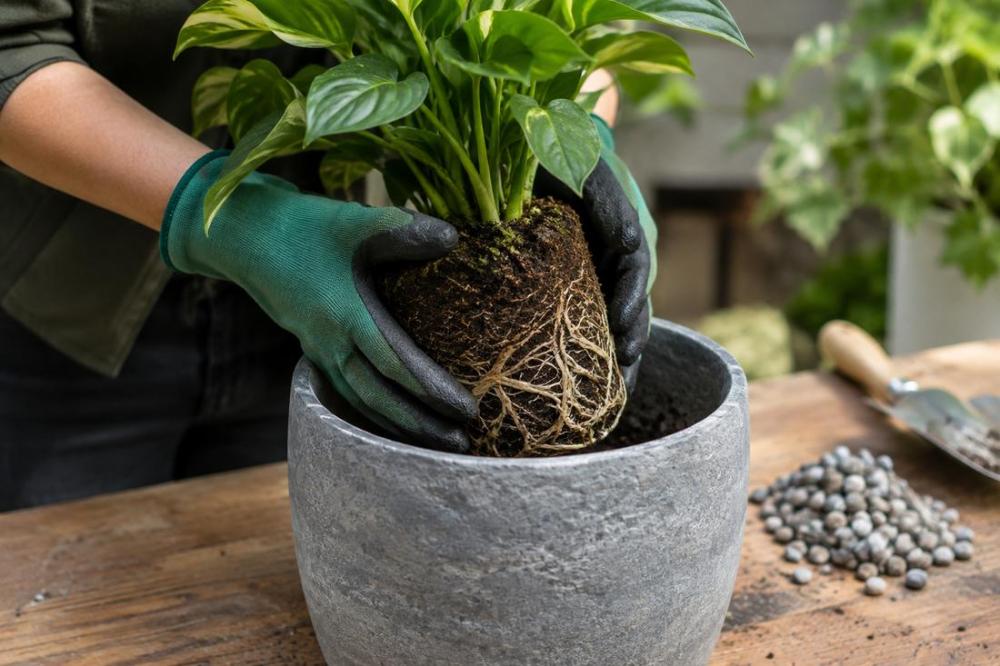

A plant in a planter cannot spread its roots like one in the ground. After a while the roots fill the planter, water runs straight out of the bottom, and growth stops. That is when it is time to move the plant to a bigger planter, or to plant it in a new one the right way.
In this article we explain when to repot, how to choose the new size, and the steps for planting in a planter from the drainage layer to the first watering.
When to move a plant to a bigger planter
- Roots growing out of the drainage hole or circling on the soil surface.
- Water runs straight through the planter without the soil soaking it up.
- The soil dries quickly, a day or two after watering.
- Growth has stopped despite watering and feeding.
- Best time to repot: the start of the growing season in spring; avoid repotting in peak heat.
How to choose the new size
- Go up one step: a planter about 5 cm wider in diameter than the current one.
- Do not jump to a much bigger planter: extra soil holds water around the roots and rots them.
- Check the drainage hole before you start.
Planting in a planter step by step
- Water the plant the day before so the root ball comes out in one piece.
- Add a drainage layer of gravel or drainage material in the bottom of the planter.
- Add a little light, airy potting soil on top of the drainage layer.
- Ease the plant out of the old pot and loosen circling roots with your fingers.
- Set it in the centre at the same depth it was before, no deeper and no higher.
- Fill the sides with soil and firm it lightly without packing it hard.
- Leave 2 to 3 cm empty below the rim so water does not overflow when you water.
- Water until it runs out of the drainage hole.
After repotting
- Keep the plant in indirect light for a few days while it settles.
- Do not feed straight away after repotting; wait 3 to 4 weeks for new roots to start.
- Slight wilting in the first days is normal, but do not overwater because of it.
Common mistakes
- A planter with no drainage: the most common cause of root rot.
- Heavy garden soil: it clumps in a planter and smothers the roots; use a light ready-made potting mix.
- Burying the stem deeper than before: exposes the stem to rot.
- Fixed daily watering: water when the soil surface dries, not on a schedule.
Products from Orkida
- Ecopots Amsterdam Planter, 20 cm: for small plants that have outgrown their nursery pot.
- Ecopots Rotterdam Planter, 40 cm: the next repotting step for small and medium shrubs.
- Ecopots Oslo Planter, 45 cm: for medium and large plants, with a drainage hole and removable plug.
Frequently Asked Questions
How often should I move a plant to a bigger planter?
When you see roots coming out of the drainage hole or water running straight through, usually every one to two years for fast-growing plants.
How much bigger should the new planter be?
About 5 cm wider in diameter than the current one.
Do I need gravel in the bottom?
A drainage layer helps excess water escape, as long as the planter has a drainage hole.
When should I feed after repotting?
After 3 to 4 weeks, once new roots start.
Why did my plant wilt after repotting?
Slight wilting in the first days is normal transplant shock; keep it in indirect light and do not drown it.