
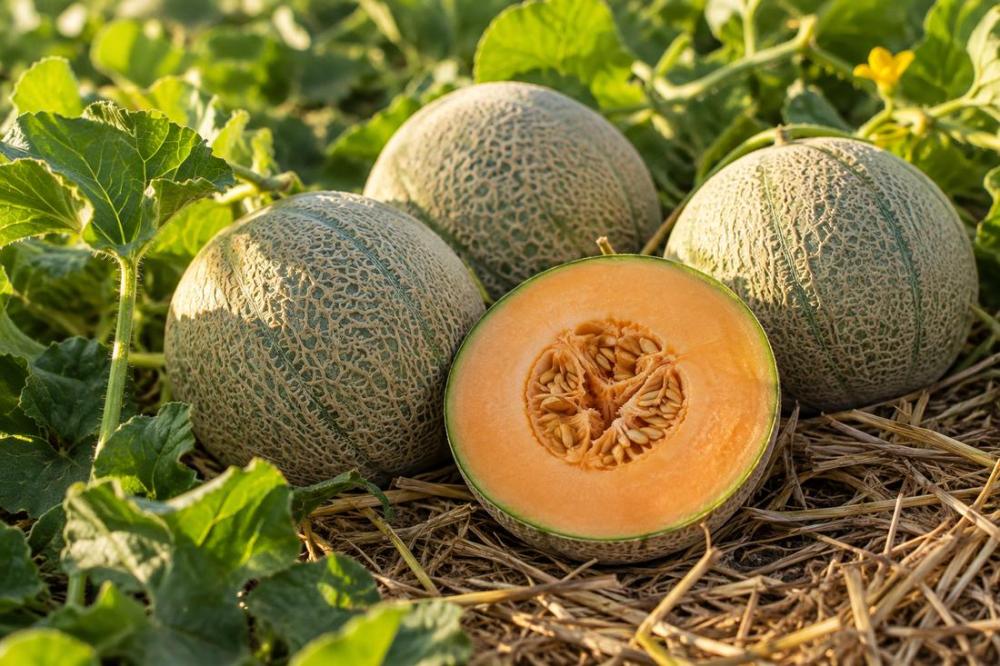

Melon (cantaloupe) is one of the sweetest warm-season crops, giving sugary fruit roughly two and a half months after sowing. It loves sun, warmth and well-drained soil, needs room to spread, and needs attention to watering and fungal disease.
In this article we explain how to grow melons from seed step by step: the best time, sowing and spacing, watering and feeding with rates, preventing mildew and insects, and how to tell when the fruit is ripe.
Best time to plant melons
- Melon is a warm crop: it does not germinate well in the cold, and intense heat affects fruit set.
- Sow it when temperatures are warm and mild, and avoid planting in the cold.
- Suitable for open fields and greenhouses.
How to plant, step by step
1. Preparing the ground
- Well-drained, light soil.
- Mix in organic manure such as Black Cow at 20 to 30 kg per 100 m² before planting.
2. Sowing
- Sow seeds at a depth of 2 to 3 cm.
- Spacing: 50 cm between plants and 150 cm between rows.
- After germination, keep the strongest plant in each hole.
Watering
- Moderate, regular watering, avoiding waterlogged soil.
- Drip irrigation is better than sprinklers, so leaves stay dry and fungal disease does not spread.
- Most important watering period: from flowering until the fruit sizes up.
- Reduce watering slightly near ripening to raise the sugar in the fruit.
Feeding with rates
- During vegetative growth: balanced 20-20-20 fertilizer at 1 to 2 g per litre as a spray or through irrigation, every 10 to 14 days.
- From the start of flowering: calcium and boron such as Calborn Plus at 2 ml per litre as a spray, helping fruit set and quality.
- During fruit sizing: soluble potassium sulphate 0-0-50 sprayed at 2 to 3 g per litre, raising sweetness and size.
Preventing disease and insects
Powdery and downy mildew
- Powdery: white powder on top of the leaf.
- Downy: angular yellow spots on top of the leaf with grey fuzz underneath.
- Treatment: Azox 250 SC at 80 to 100 ml per 100 litres of water for watermelon and melon, repeated every 10 to 14 days.
Whitefly and aphids
- They suck sap and spread viruses that curl the leaves.
- Imidor 350 SC: 15 to 30 ml per 100 litres of water on protected vegetables.
When to harvest melons
- Usually 70 to 80 days after sowing depending on season and region.
- Signs of ripeness:
- The rind turns from green to creamy yellow.
- A clear sweet smell where the fruit joins the stem.
- The stem separates easily when you press it lightly.
- Harvest early in the morning while the fruit is cool.
Common problems
The fruit is not sweet
- Causes: harvesting early, overwatering near ripening, potassium shortage, or too few leaves because of disease.
Flowers drop without setting fruit
- Causes: intense heat, too few pollinating insects, or boron deficiency.
The fruit cracks
- Cause: heavy watering after drought, especially near ripening.
Products from Orkida
- Sweet Super Hybrid Melon Seeds, 10 g: depth 2 to 3 cm, spacing 50 × 150 cm, harvest after 70 to 80 days.
- Black Cow Organic Cow Manure, 25 kg: 20 to 30 kg per 100 m² before planting.
- Bavaria 20-20-20 Balanced Fertilizer, 2 kg: 1 to 2 g per litre during vegetative growth.
- Calborn Plus Calcium and Boron, 1 litre: spray at 2 ml per litre from the start of flowering.
- SAF 0-0-50 Soluble Potassium Sulphate, 1 kg: spray at 2 to 3 g per litre during fruit sizing.
- Azox 250 SC: for powdery and downy mildew, 80 to 100 ml per 100 litres.
- Imidor 350 SC: for whitefly and aphids, 15 to 30 ml per 100 litres.
Frequently Asked Questions
How long do melons take from sowing to harvest?
Usually 70 to 80 days depending on season and region.
How do I know a melon is ripe?
The rind turns yellow, it gives off a sweet smell, and the stem separates easily.
Why are my melons not sweet?
Usually because of early harvesting, overwatering near ripening, or potassium shortage.
How far apart should melon plants be?
50 cm between plants and 150 cm between rows.
Can I grow melons in a greenhouse?
Yes, the Sweet Super variety suits both greenhouses and open fields.