
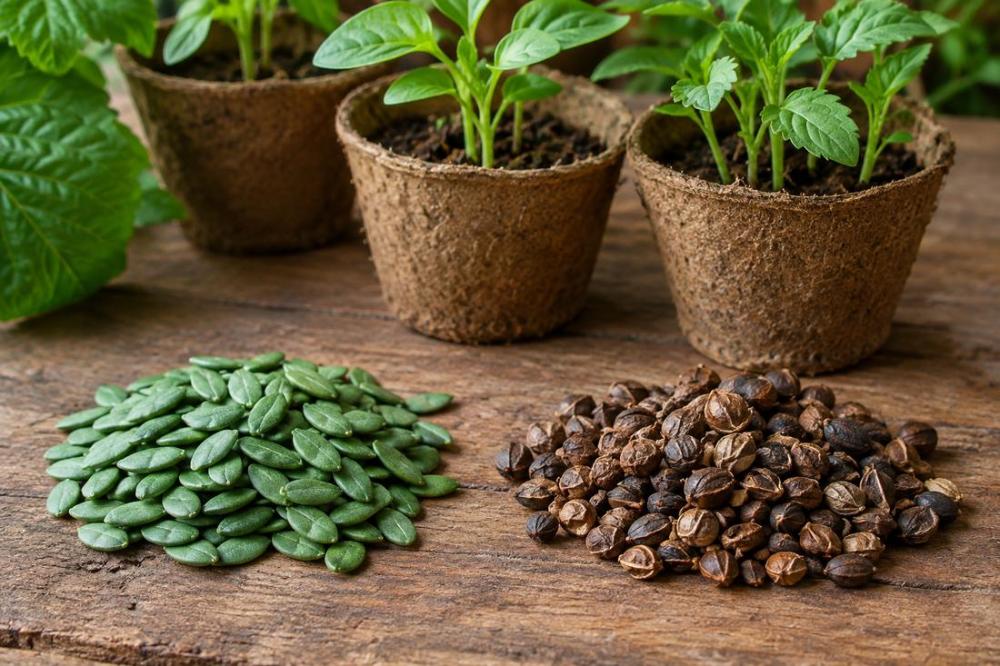

When you buy seeds, some packets say "F1 hybrid" and others say "non-hybrid" or "local". The difference is not only the price: it affects yield, fruit uniformity, disease tolerance, and whether you can save seed from your crop and sow it next year.
In this article we explain the difference between hybrid seeds and open-pollinated (non-hybrid) seeds, the pros and cons of each, and when to choose each one.
What are hybrid (F1) seeds?
- Seeds produced by crossing two selected parents from different lines, to combine their best traits.
- F1 means the first generation of this cross.
- The plants come out very uniform in size, shape and harvest timing.
What are open-pollinated (non-hybrid) seeds?
- Stable varieties that pollinate naturally and keep their traits from generation to generation.
- Such as local molokhia, Clemson okra and Egyptian kurrat.
- You can save their seed from the crop and sow it again with nearly the same traits.
Advantages of hybrid seeds
- Higher yield in most crops.
- High uniformity: fruit close in size and shape, which matters for selling at market.
- Earlier harvest in many varieties.
- Better tolerance of certain diseases, depending on the variety.
Disadvantages of hybrid seeds
- Higher price.
- You cannot save and resow their seed: the second generation is uneven and its traits differ.
- They need more care with feeding and watering to reach their full yield.
Advantages of open-pollinated seeds
- Cheaper, and you can resow from your own seed.
- Adapted to local conditions in many traditional varieties.
- Suited to home gardens and leafy greens cut in batches.
Disadvantages of open-pollinated seeds
- Usually lower yield than hybrids.
- Less uniformity in size and ripening time.
When to choose each type
Choose hybrid when
- You grow to sell and need uniform fruit and high yield.
- You grow fruiting crops such as cucumbers, watermelon and tomatoes on a commercial scale.
- You can feed and water regularly.
Choose open-pollinated when
- You grow at home for your own use.
- You grow leafy greens that are cut several times, such as molokhia, kurrat and chard.
- You want to save your seed and sow it every year.
Tips when buying seeds
- Read the germination and purity rates on the packet; low germination means you sow more seed.
- Check the seed treatment, such as metalaxyl or fludioxonil, which protects seedlings from soil rots.
- Check the right sowing time for the variety in your area.
- Store seeds somewhere cool and dry to keep their germination rate.
Products from Orkida
- Gemini F1 Hybrid Cucumber Seeds, 0.5 g: uniform cylindrical fruit and early harvest, 80% germination.
- Charleston Gray F1 Hybrid Watermelon Seeds, 590 g: for commercial open-field growing, 16 to 18 kg fruit, 90% germination.
- Egyptian Saidi Molokhia Seeds, 100 g: local non-hybrid variety, 92% germination.
- Clemson Spineless Okra Seeds, 20 g: a non-hybrid variety known for heavy cropping.
- Egyptian Kurrat Seeds, 100 g: local non-hybrid variety cut in batches.
Frequently Asked Questions
What does F1 mean on seeds?
It means first-generation hybrid seed, produced by crossing two selected parents to combine their best traits.
Can I sow seeds from a hybrid plant's fruit?
You can, but the plants come out uneven and different from the original, so we do not recommend it.
Which is better: hybrid or open-pollinated?
Hybrid is better for commercial yield and uniformity; open-pollinated is better for home growing, leafy greens and saving your own seed.
Why are hybrid seeds more expensive?
Because producing them needs controlled crossing between two lines, and they give higher yield and uniformity.
Are hybrid seeds genetically modified?
No, hybridisation is natural cross-pollination between two selected lines, not genetic modification.