
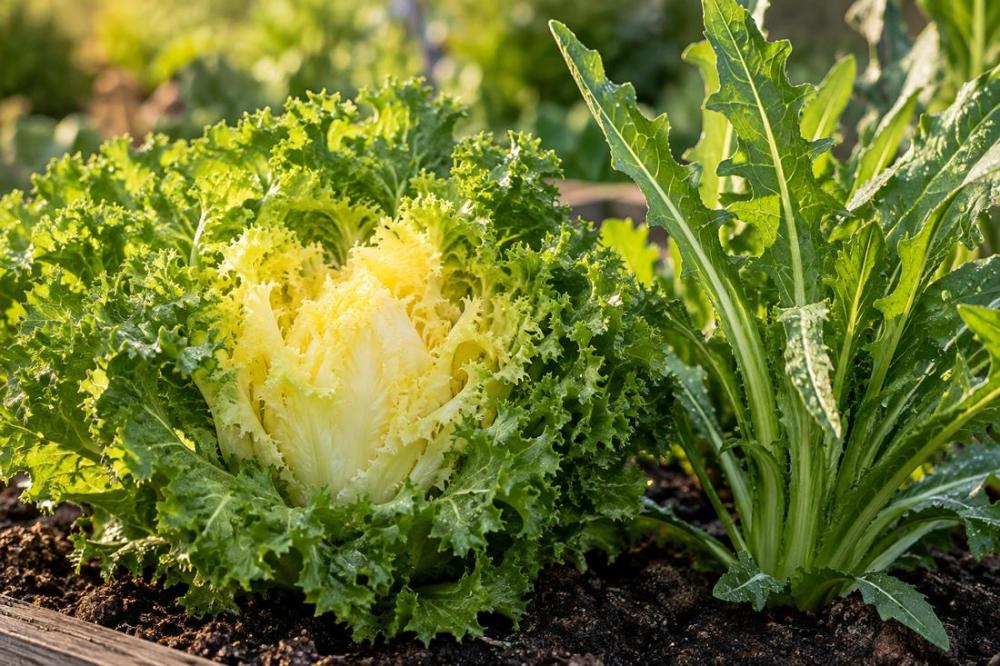

Chicory and endive are salad greens that love mild weather, and their leaves have a light bitterness that sets them apart from lettuce. They grow easily from seed in beds or fields and are ready to harvest within two to three months.
In this article we explain how to grow chicory and endive from seed: the types, the best time, depth and spacing, watering and feeding, how to reduce bitterness, and when to harvest.
Types of chicory
- Leaf chicory (Catalogna): long, toothed leaves cut in batches, with a light bitter taste.
- Heading endive: forms a large, full head with curly leaves and a pale yellow heart, and its taste is milder.
- Uses: salads, and the larger leaves can be cooked with oil and garlic.
Best time to grow chicory
- Chicory is a mild-season crop: it grows best between 15 and 25 °C.
- Hot areas: sow from September to November and harvest in winter.
- Highlands and mild areas: you can start earlier, from late summer.
- Intense heat makes the plant bolt quickly and increases bitterness.
How to grow chicory step by step
1. Preparing the soil
- Fertile, well-drained soil rich in organic matter.
- Remove weeds and stones before planting.
- Add composted organic fertilizer to the bed a week before planting.
2. Sowing
- Depth: 0.5 to 1 cm, because the seed is small.
- Sow directly in the bed, or in seedling trays and transplant after 4 to 5 true leaves.
- Germination: within one to two weeks with constant moisture.
3. Spacing
- 20 cm between plants.
- 40 cm between rows.
- Thin the seedlings if they come up crowded, keeping the strongest.
Watering chicory
- Regular watering without waterlogging, keeping the soil constantly moist.
- Steady watering matters while the head forms: drought followed by heavy watering shrinks the head and increases bitterness.
- Water in the morning, so the leaves dry before night.
Feeding chicory with rates
- Once the seedlings are established: balanced 20-20-20 fertilizer at 1 to 2 g per litre as a spray or through irrigation every 10 to 14 days.
- Do not overdo nitrogen late in the season, so the leaves do not turn soft.
How to reduce chicory bitterness
- Blanching: one to two weeks before harvest, gather the outer leaves over the heart and tie them loosely while dry. The heart turns paler and less bitter.
- Steady watering and avoiding heat reduce bitterness.
- Picking early in the morning gives more tender leaves.
When to harvest chicory
- Leaf chicory: after 60 to 80 days from sowing, and you can cut the outer leaves in batches.
- Heading endive: when the head is complete and the heart is full, cut the whole plant at soil level.
Common problems
The plant bolts quickly
- Causes: intense heat, drought or late sowing.
The head rots inside
- Cause: too much moisture inside the head, especially if it was tied while wet.
Small green insects under the leaves
- Aphids. Spray potassium soap at 10 ml per litre.
Products from Orkida
- Catalogna Chicory Seeds, 10 g: 0.5 to 1 cm deep; 20 cm between plants and 40 cm between rows; harvest after 60 to 80 days.
- Heading Endive Seeds (Bionda a Cuore Pieno), 9 g: large heads with curly leaves and a pale yellow heart; raise as seedlings and transplant at 20 × 40 cm.
- Bavaria 20-20-20 Balanced Fertilizer, 2 kg: 1 to 2 g per litre every 10 to 14 days.
- Plant Care Potassium Soap, 1 L: for aphids, 10 ml per litre.
Frequently Asked Questions
When should I plant chicory?
In hot areas from September to November, because it likes mild weather and bolts quickly in heat.
How deep should I sow chicory seeds?
0.5 to 1 cm, with constant moisture until they germinate.
Why is chicory bitter?
Bitterness is natural in chicory and increases with heat and drought. Blanching before harvest and steady watering reduce it.
When do I harvest chicory?
Leaf chicory after 60 to 80 days in batches, and heading endive when the heart is full.
Is chicory the same as lettuce?
No, it is from a different family, with tougher leaves and a light bitterness. The growing method is close to lettuce.