
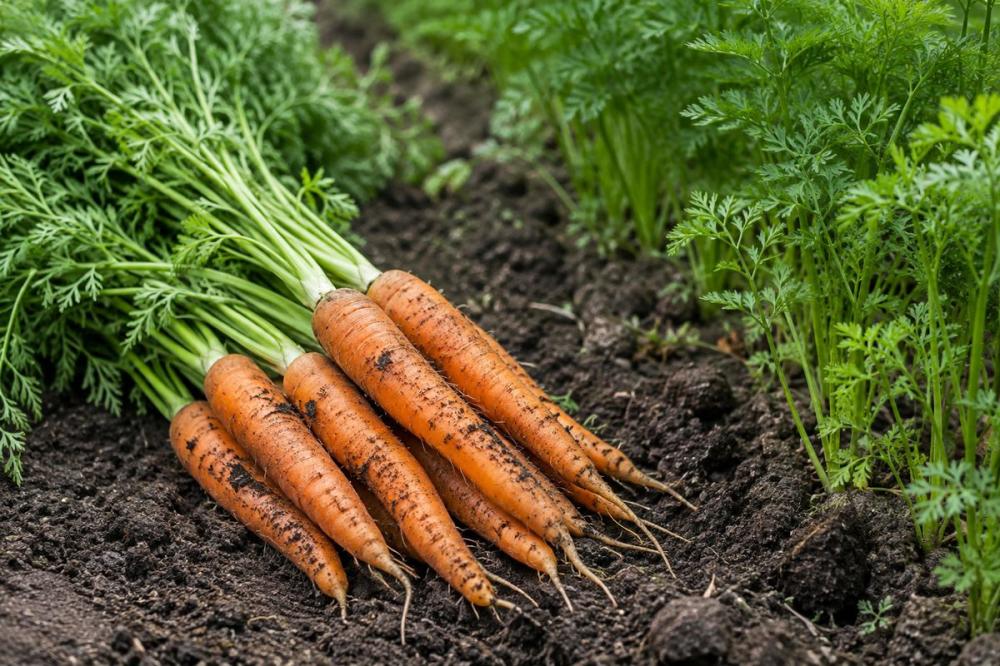

Carrots are a root vegetable that does well in the garden and even in deep pots, but the secret to success is the soil: loose, stone-free soil produces long, straight carrots, while hard soil produces short, forked ones.
In this article we explain how to grow carrots from seed step by step: the best time, preparing the soil, depth, spacing and thinning, watering and feeding, when to harvest, and why carrots crack and fork.
Best time to grow carrots
- Carrots like mild weather.
- Mild areas: in spring, summer and autumn.
- Warm areas: during the mild periods of the year, avoiding mid-summer heat.
- High heat makes the roots tough and less sweet.
Preparing the soil: the most important step
- Light, loose soil, sandy or light loam.
- Dig or turn the soil to a depth of 25 to 30 cm.
- Remove stones and clods: any obstacle makes the root fork or bend.
- Do not add fresh manure: it causes forked roots. Use only composted organic fertilizer.
- In pots: at least 30 cm deep for medium carrot varieties such as Nantes.
How to grow carrots step by step
1. Direct sowing
- Carrots are not transplanted: sow the seed directly where it will grow.
- Depth: only 0.5 to 1 cm.
- Spacing between rows: 20 to 30 cm.
- Tip: mix the tiny seeds with fine sand to spread them evenly.
2. Germination
- Carrots are slow to germinate, usually taking one to three weeks depending on temperature.
- Keep the soil surface moist throughout germination, because a dry crust stops seedlings emerging. Covering the rows with hessian or light fabric helps.
3. Thinning
- Once the seedlings have grown a little: thin them to one plant every 5 cm.
- Thinning is essential: without it you get thin, tangled, twisted roots.
Watering carrots
- Regular, balanced watering without waterlogging or drought.
- Drought followed by heavy watering cracks the roots.
- Reduce watering slightly near harvest to improve sweetness.
Feeding carrots with rates
- After thinning: balanced 20-20-20 fertilizer at 1 to 2 g per litre as a spray or through irrigation, every two weeks.
- During root bulking: soluble potassium sulphate 0-0-50 sprayed at 2 to 3 g per litre, or through irrigation for vegetables 3 to 5 kg per hectare. Potassium improves colour and sweetness.
- Do not overdo nitrogen: it produces lots of leaves and small roots.
When to harvest carrots
- Usually 70 to 90 days after sowing for Nantes varieties.
- The sign: the root reaches its full size and colour. Clear the soil from the top of one carrot and check its diameter.
- Water the ground the day before lifting so the carrots come out easily without breaking.
- Do not leave it too late: carrots left too long in the ground get tough and crack.
Common problems and their causes
Forked or crooked carrots
- Causes: stones or clods in the soil, hard soil, or fresh manure.
Cracked carrots
- Cause: irregular watering or late harvesting.
Thin, short roots
- Causes: no thinning, too much nitrogen, or shallow soil.
Green tops
- Cause: the top of the root is exposed to sun. Cover it with soil.
Seeds did not come up
- Most common cause: the soil surface dried out during germination, or the seeds were sown too deep.
Products from Orkida
- Nantesa 5 Coral Carrot Seeds, 15 g: direct sowing 0.5 to 1 cm deep; 20 to 30 cm between rows; thin to one plant every 5 cm.
- Bavaria 20-20-20 Balanced Fertilizer, 2 kg: 1 to 2 g per litre every two weeks.
- SAF 0-0-50 Soluble Potassium Sulphate, 1 kg: spray 2 to 3 g per litre during root bulking.
Frequently Asked Questions
How long do carrot seeds take to germinate?
Usually one to three weeks, and they need a moist soil surface throughout.
Should I transplant carrots?
No, carrots are sown directly where they will grow, because transplanting deforms the root.
Why are my carrots forked?
Because of stones or clods in the soil, hard soil, or fresh manure.
Can I grow carrots in a pot?
Yes, in a pot at least 30 cm deep with light soil.
How far apart should carrots be?
5 cm between plants after thinning, and 20 to 30 cm between rows.