
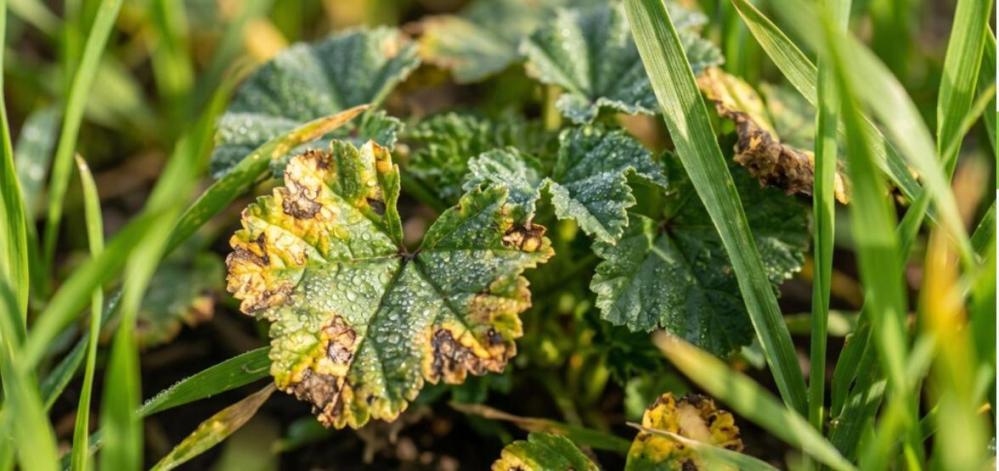

Bromoxynil is a selective herbicide for broadleaf weeds in wheat, barley and corn. It is sprayed on weeds while they are small, burns their leaves within days, and the crop carries on as normal.
This article explains how bromoxynil works, which weeds it controls, when to spray it for results, and why coverage matters more for it than for many others.
- Group: nitriles, photosynthesis inhibitors (HRAC group 6).
- Type: selective, contact, post-emergence herbicide.
- Kills: annual broadleaf weeds.
- Does not kill: grass weeds, or perennial weeds from their roots.
- Common forms: emulsifiable concentrate (EC), often at 280 g/L.
How does bromoxynil work?
It enters the leaf and stops photosynthesis, so the tissue starts to burn. Symptoms show quickly: yellow then brown spots on the leaves within two to four days, and small weeds die within one to two weeks.
Because it works by contact and does not move much within the plant:
- Coverage matters: any part the spray misses can survive and regrow.
- Small weeds are easier: large weeds have many leaves and protected growing points.
- It has no soil activity: it does not stop new weeds emerging after spraying.
Which weeds does it control?
Common annual broadleaf weeds in wheat and corn fields, such as:
- Mallow.
- Wild beet and purslane.
- Wild mustard.
- Pigweed and lamb's quarters.
Some broadleaf weeds need a mixture with a second active, which is why you find products that combine bromoxynil with another active.
Which crops?
- Wheat and barley.
- Corn and sorghum.
- Other crops if the label lists them.
Keep it away from neighbouring broadleaf crops such as vegetables, cotton and alfalfa, because it burns them.
When to spray it
1. While the weeds are small
The best time is when broadleaf weeds have 2 to 4 true leaves.
2. According to the crop stage
In wheat and barley, usually after the crop has 3 leaves and before heading. The label gives the exact stage.
3. Cover the weeds well
Use enough water and a nozzle that gives medium droplets, so the spray covers all the weed leaves.
4. Avoid extreme heat
Spraying in extreme heat can cause slight scorching on the leaf tips of the crop. Morning or late afternoon is better.
Bromoxynil or clethodim?
- Bromoxynil: for broadleaf weeds in a grass crop such as wheat and corn.
- Clethodim: for grass weeds in a broadleaf crop such as tomato and cotton.
Each is the opposite of the other, and your choice depends on the type of weed and the type of crop.
Safety
- Wear gloves, goggles, a mask and long clothing. Bromoxynil is one of the herbicides that needs extra care when preparing the mix.
- Keep it away from water sources.
- Do not spray in wind near broadleaf crops.
- Respect the pre-harvest interval on the label.
Products from Orkida
- Brager 28 EC, 5 litres: bromoxynil 28% for broadleaf weeds after emergence on larger areas.
- Brager 28 EC, 1 litre: the same product in a 1-litre pack.
- Deltabrox 280 EC, 1 litre: bromoxynil octanoate 28% for broadleaf weeds.
- Bromex 280 EC, 1 litre: bromoxynil octanoate 28% for broadleaf weeds in wheat and corn.
Frequently asked questions
Does it kill wild oats and grass weeds?
No. Bromoxynil is for broadleaf weeds only. Grass weeds in wheat need a herbicide made for them.
The weeds burned and then came back. Why?
Usually they were large, or the spray did not reach all their leaves and growing point. Spray while the weeds are small.
Does it harm wheat?
If you spray it at 1–1.5 litres per hectare (Brager 28 EC) after the weeds emerge, wheat tolerates it. Slight yellowing may appear on the leaf tips and then fade.
Does it prevent new weeds?
No, it has no soil activity. It only kills what has emerged at the time of spraying.