
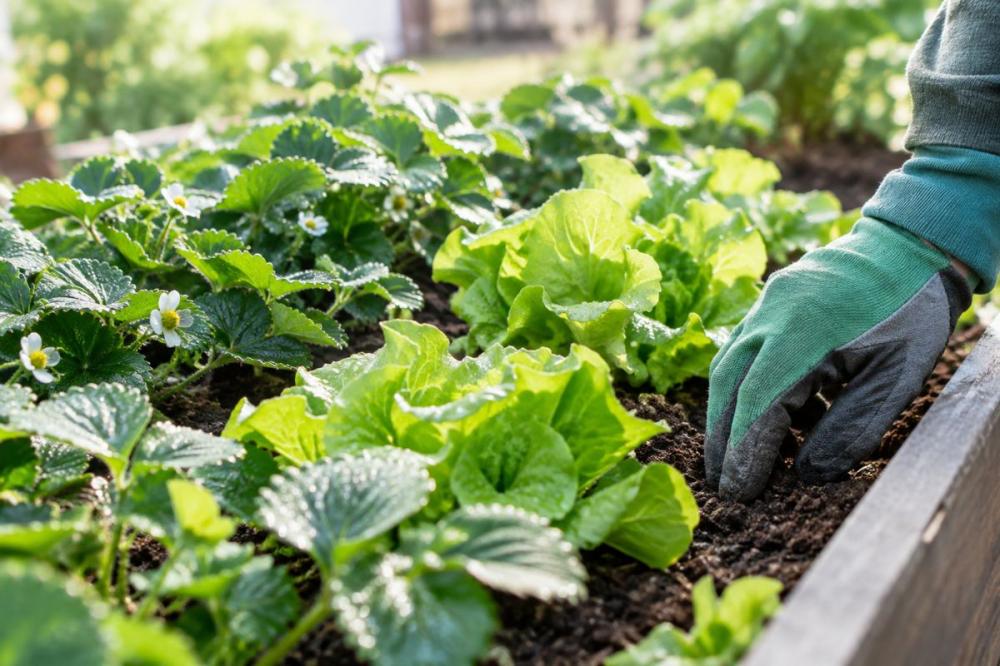

If you find holes in your lettuce, strawberry leaves and young seedlings, and shiny trails on the ground or walls in the morning, you most likely have snails or slugs. They come out at night and in damp weather, and they eat soft leaves and seedlings, sometimes wiping them out in a single night.
In this article we explain how to tell that snails are the problem, where they hide during the day, the manual methods, and how to use snail bait at the right dose.
Snails and slugs: what is the difference?
- Snails: have a shell they retreat into when it is hot and dry.
- Slugs: the same family but without a shell; their body is soft and slimy.
- Both eat the same plants, are active at night and after watering or rain, and are controlled the same way.
Signs of snails
- Irregular holes in leaves, especially soft leaves close to the ground.
- Seedlings cut at the stem overnight.
- Shiny silver trails on soil, tiles and walls, left by the slime they move on.
- Nibbled fruit such as strawberries and tomatoes near the ground.
Where do they hide during the day?
- Under stones, bricks and pots.
- In dense weeds and fallen leaves.
- Along the edges of planting beds and under discarded wood and plastic.
- Near irrigation pipes and spots that stay damp all the time.
Control steps
1. Reduce hiding places
- Clear fallen leaves, stones and discarded wood.
- Cut back dense weeds around vegetable beds.
- Raise pots slightly off the ground or clean underneath them regularly.
2. Change your watering time
- Water in the morning instead of the evening, so the ground dries before night. Wet ground at night lets snails come out and move easily.
3. Hand-picking
- Go out an hour after sunset or after watering with a torch, collect them with a glove and put them in a bag.
- Repeat several nights in a row, especially at the start of an infestation.
4. Snail bait (metaldehyde)
When the infestation is heavy or the area is large, use a ready-made bait such as Metarol 5% GR (metaldehyde 5%):
- Dose: 2 g per square metre.
- For valuable plants or sensitive seedlings: double the amount.
- How to apply: scatter the pellets on the soil around plants, in lines, or in small separate heaps.
- Timing: in the evening, with the soil moist after watering or rain, because that is when snails are active.
- Do not mix it with any other pesticide or fertilizer; use it on its own.
- The pellets do not rot in humidity and are not easily blown away, so they stay in place for a while.
Safety with snail bait
- Metaldehyde is toxic to dogs and cats and other pets. Do not scatter it where they can reach it, or place it under a cover or among dense plants.
- Keep it away from children, and do not leave pellets exposed on walkways.
- Wear gloves when scattering and wash your hands afterwards.
- Do not scatter it on fruit or leaves you will eat; apply it to the soil only.
When to be extra careful
- Winter and early spring, and humid weather after rain.
- Greenhouses and gardens with drip irrigation or frequent spraying.
- The seedling stage, because seedlings are what snails like most and what dies fastest.
Products from Orkida
- Metarol 5% GR 250 g: metaldehyde 5% snail and slug bait, 2 g per m², scattered in the evening on moist soil.
- Bellota Gardening Gloves Model 75102: for collecting snails, scattering bait and garden work.
Frequently Asked Questions
How many grams of snail bait per square metre?
With Metarol, 2 g per square metre, doubled for valuable plants and sensitive seedlings.
When should I scatter snail bait?
In the evening with the soil moist after watering or rain, because snails come out at night and in damp conditions.
Is snail bait dangerous for cats and dogs?
Yes, metaldehyde is toxic to pets. Scatter it where they cannot reach or place it under a cover.
Does salt kill snails?
It kills them if sprinkled directly on them, but salt harms the soil and plants, so we do not recommend it in the garden.
Why do snails come back every year?
Because their eggs stay in moist soil and among weeds. Keeping the area tidy and changing the watering time reduce their return.