
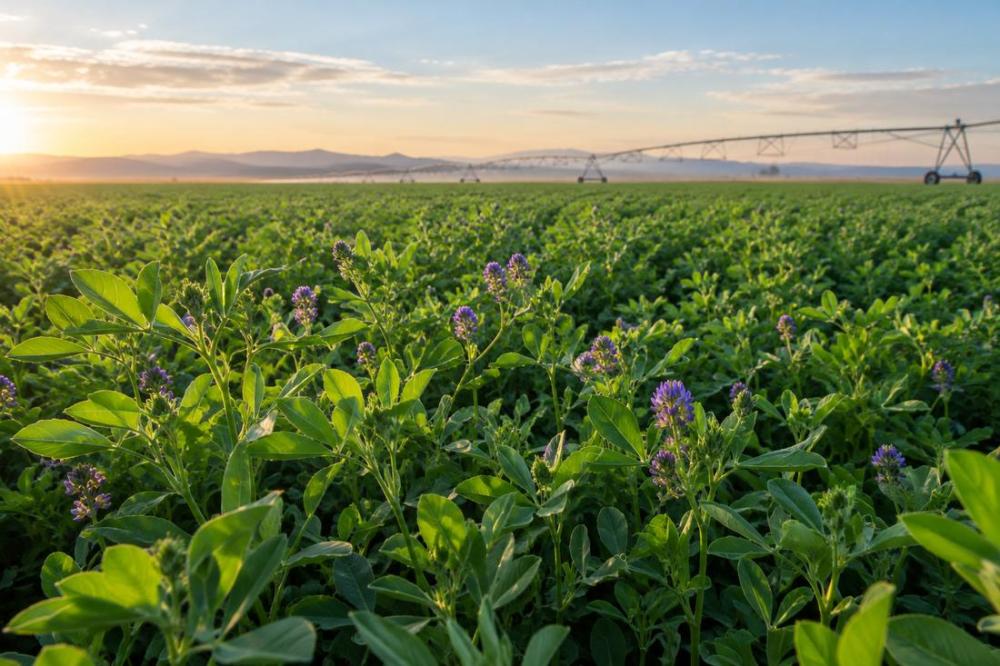

Alfalfa (lucerne) is one of the most important forages for cattle, horses and sheep: it is rich in protein, it can be cut several times a year, and one field keeps producing for years. But its success depends heavily on the start: seed rate, depth and seedbed preparation.
In this article we explain how to grow alfalfa step by step: soil preparation, seed rate per 1,000 m², depth, watering, and when to take the first cut.
Before sowing: preparing the land
- Soil pH: alfalfa likes a pH of around 6.5 or higher, and acidic soil weakens it.
- Drainage: it needs well-drained soil, because standing water rots the roots.
- Levelling and fining: plough, then fine and level the soil, because the seed is small and needs a fine, firm bed.
- Clear the weeds before sowing, because the seedlings are weak in the first weeks.
When to sow
- Autumn is the best time (roughly October and November), once the heat eases.
- Early spring also works, before the hot weather sets in.
- Avoid sowing in the height of summer, because the heat scorches young seedlings.
Seed rate per 1,000 m²
- The standard rate: about 20 to 22 kg per hectare, which is 2 to 2.2 kg per 1,000 m².
- A 1 kg bag covers roughly 450 to 500 m².
- Our seed has 99.9% purity and 90% germination, so there is no need to raise the rate much.
Sowing step by step
- Depth: 0.5 to 1.5 cm in normal soil, and up to 2 cm in sandy soil. Never go deeper than 2.5 cm.
- Sowing method: even broadcasting or rows; mixing the seed with fine sand helps spread it evenly.
- Firm the soil lightly after sowing so the seed is in contact with the soil.
- Water straight away after sowing.
Seed inoculation
- If the land has not grown alfalfa before, inoculating the seed with alfalfa root-nodule bacteria helps, so the plant fixes nitrogen from the air by itself.
Watering
- During establishment: light, frequent watering that keeps the soil surface moist until the seeds sprout and the seedlings are strong.
- After establishment: deeper watering at longer intervals.
- After every cut, water so the plant regrows quickly.
- Do not waterlog the field, because alfalfa suffers from standing water.
Feeding
- Alfalfa fixes its own nitrogen once root nodules form, so it does not need nitrogen fertiliser after establishment.
- Phosphorus and potassium matter for root strength and field longevity, and their rates are set by a soil test.
Cutting
- First cut: roughly 60 days after sowing.
- After that: cut when flowering is just starting (the first purple flowers appear), because this timing balances forage yield and quality.
- Leave about 5 to 7 cm above the ground so it regrows.
- One field can stay productive for about 5 years with good management.
Products from Orkida
- Egyptian Alfalfa Seeds (Abu Gamal), 1 kg: 99.9% purity, 90% germination, metalaxyl treated.
Frequently Asked Questions
How much alfalfa seed do I need per 1,000 m²?
About 2 to 2.2 kg per 1,000 m².
How deep should alfalfa be sown?
0.5 to 1.5 cm, and up to 2 cm in sandy soil.
When should I take the first cut?
Roughly 60 days after sowing.
When is the best time to sow alfalfa?
In autumn once the heat eases, or in early spring.
How many years does an alfalfa field last?
About 5 years with good watering and management.