
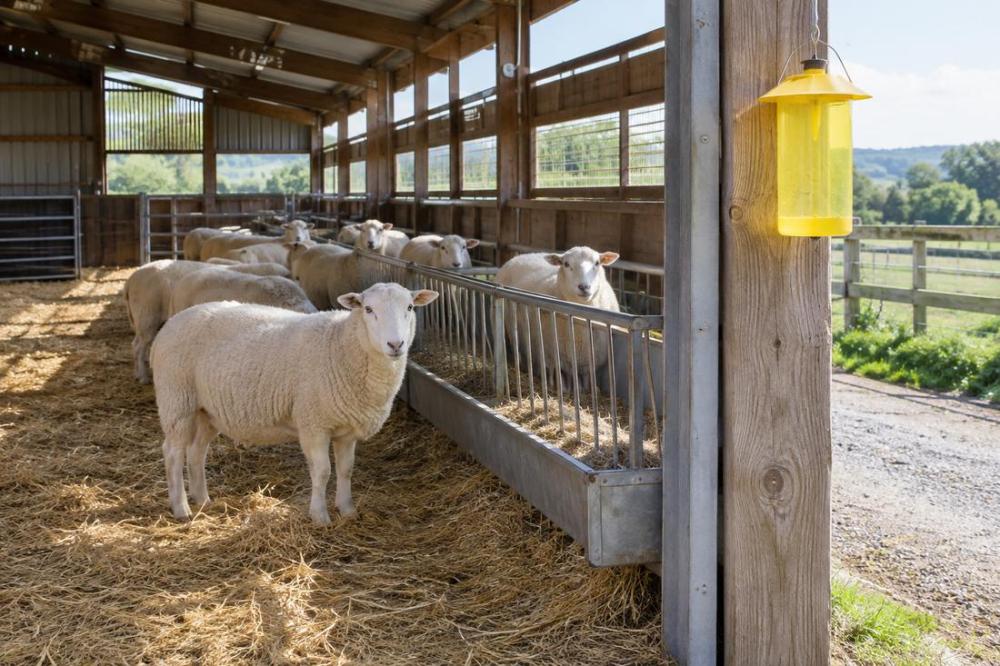

Flies in sheep, cattle and poultry barns are more than a nuisance: they stress the animals, reduce their comfort and feeding, and carry disease between the barn and the house. The main reason is that a barn offers everything flies need to breed: wet manure, leftover feed and water.
In this article we explain a complete plan for fly control in barns: from cleaning manure and stopping larvae, to residual spraying, baits and traps, with the rate for each product.
Why are there so many flies in the barn?
- Wet manure: the favourite place to lay eggs, and the larvae finish developing in it within days.
- Wet leftover feed around feeders and drinkers.
- Leaking drinkers that keep the floor damp all the time.
- Manure left to build up for weeks without cleaning or treatment.
Step 1: Clean the manure and reduce moisture
- Remove manure regularly and collect it in one place away from the barn and the house.
- Fix leaking drinkers and dry the ground around them.
- Clear leftover feed from under the feeders every day or two.
- Improve ventilation so the floor dries faster.
Step 2: Stop the larvae in the manure
This is the most important step, because killing adult flies without treating the larvae brings the problem back within days. Maggots is a growth regulator with 2% cyromazine that stops larvae developing in manure before they become flies.
Choose the method by how wet the manure is
- Dry scattering: 250 g per 10 m², scattered directly on manure areas when they are wet or liquid.
- Spraying: dissolve 250 g in 4 litres of water per 10 m² and spray the surface of manure heaps a week after they are collected; repeat whenever a new layer of no more than 10 cm builds up.
- Drenching: dissolve 250 g in 10 litres of water per 10 m² over manure heaps, treat twice 15 days apart, then renew every 6 weeks or before new manure exceeds 10 cm.
Step 3: Residual spray where flies rest
Flies rest on walls, ceilings, posts and door frames. A residual spray on these surfaces kills flies that land on them for a period.
- Deltafly 25 SC: 25 ml per 5 litres of water, sprayed at 1 litre of solution per 20 m² of surface.
- Or Cypersel 100 EC: 10 ml per litre of water as a residual surface spray.
- Take the animals out before spraying and only bring them back once the spray has fully dried.
- Do not spray the animals themselves, their feed, water or feeders.
Step 4: Fly baits
Granular bait attracts and kills flies, and suits places where flies gather in large numbers.
- Zyrox Fly: 200 g per 100 m², reapplied every 7 days or according to fly numbers.
- Scatter it on dry surfaces or on dedicated bait boards, where flies gather such as windows and the tops of walls.
- Keep it out of the animals' reach and away from feed and drinkers.
- Note: blood-feeding flies are not attracted to baits, so combine baits with spraying and traps.
Step 5: Water traps around the perimeter
A water trap works without insecticide and draws flies away from the barn and the house.
- Force Catch water trap: add the attractant to the container, add water to the marked level and close it tightly.
- Hang it about 1.5 metres above the ground.
- Place it several metres away from seating areas and building entrances, and close to breeding sources such as barns and waste bins.
- Use several traps around the site instead of one, starting at the beginning of the fly season.
- When it fills up, empty it and refill it with Eco Fly attractant (a 20 g pack is enough for one trap).
- Outdoor use only.
Fogging for heavy infestations
When flies are very heavy around the barn, thermal fogging gives a fast knock-down of flying adults.
- Cypersel 100 EC for thermal fogging: 25 ml per litre of kerosene or diesel, not diluted with water.
- Super 2000 Gold fogging machine: portable with a 2-litre tank, runs on diesel with the insecticide, and suits sheep barns and farms.
- Take the animals out before fogging and only bring them back once the area is ventilated.
- Fogging has no residual effect, so combine it with larval treatment and residual spraying.
Common mistakes
- Spraying adult flies and forgetting the manure: a new generation appears within days.
- Using the same product all season: flies build resistance. Rotate between products from different groups.
- Putting the water trap inside the barn or by the door: it attracts flies to the very place you want to protect.
- Scattering bait where animals can reach it.
Products from Orkida
- Maggots Fly Larvicide Granules: 2% cyromazine for larvae in manure, 250 g per 10 m².
- Deltafly 25 SC: residual spray, 25 ml per 5 litres of water per 20 m².
- Cypersel 100 EC: 10 ml per litre for residual spraying, and 25 ml per litre of kerosene or diesel for thermal fogging.
- Zyrox Fly Granular Bait: 200 g per 100 m² every 7 days.
- Force Catch Water Fly Trap: an outdoor trap with attractant and no insecticide.
- Eco Fly Water Trap Attractant: a 20 g pack to refill one trap.
- Super 2000 Gold Fogging Machine: a portable 2-litre fogger that runs on diesel.
Frequently Asked Questions
What is the best way to control flies in a barn?
The full plan: clean the manure, treat larvae with Maggots, spray walls with a residual product, and add baits and water traps around the perimeter.
Can I spray while the animals are inside?
No. Take the animals out before spraying and only bring them back once the spray has dried, and never spray feed or water.
How often should I treat the manure?
By drenching: twice 15 days apart, then every 6 weeks, or before new manure exceeds 10 cm.
Where should I hang the water trap?
Outside, about 1.5 metres high, several metres from seating areas and close to breeding sources.
Why do flies come back after spraying?
Because the larvae in the manure were not treated, or because the flies have become used to the same product.
Read next
- Cyromazine: The Fly Larvicide That Cuts the Problem at Its Source
- Fly Traps: Types and How to Choose the Right One for Home, Restaurant or Farm
- Cyantraniliprole: The Modern Fly Bait for Resistant Flies
- Disinfecting Poultry and Livestock Houses with Virkon S: Dilution Rates and Coverage
- Electric Sheep Shearing Machines: When to Shear, How to Shear and Blade Care