
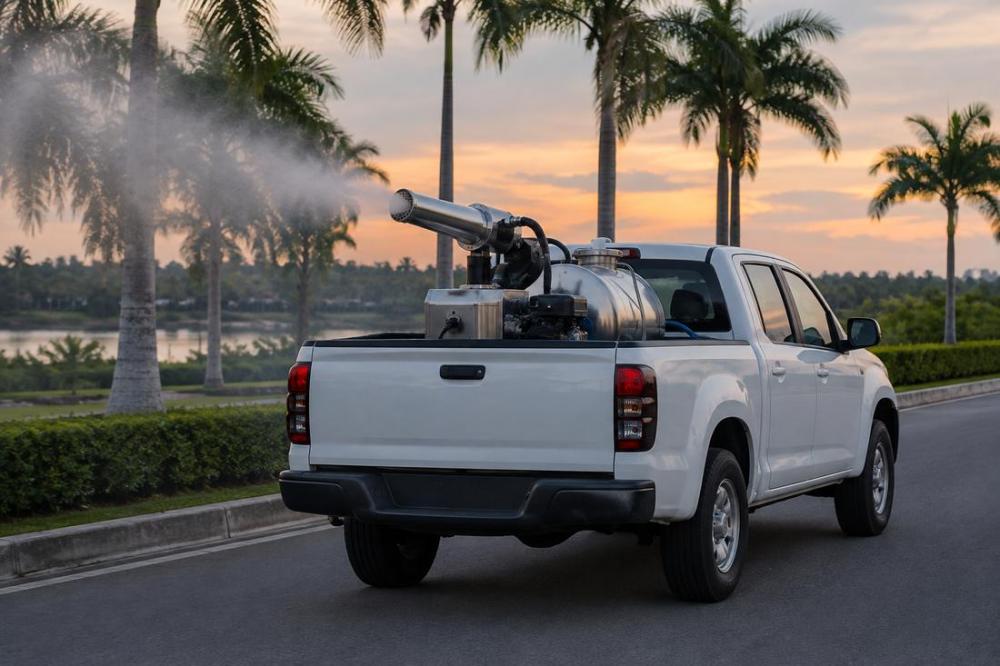

Treating mosquitoes and flies across a whole neighbourhood, a large farm, or streets and parks is not a job for a handheld machine. For this you need a vehicle-mounted sprayer: a large tank from 69 to 150 litres, a powerful engine, and controls inside the cab while you drive.
In this article we explain the two types of vehicle-mounted machines, cold ULV and thermal fogging, the difference between them, how to choose the right machine, and how to operate and maintain it.
Cold ULV or thermal fogging?
Vehicle-mounted cold ULV machine
- Produces a very fine cold mist without heat, with droplets roughly between 5 and 55 microns depending on the machine.
- Works with water-based or oil-based solutions depending on the product.
- Does not produce thick white smoke, so it suits residential areas and roads.
- Uses less insecticide because the droplets are small and uniform.
Vehicle-mounted thermal fogger
- Heats the solution and releases thick white smoke that spreads quickly between trees and buildings.
- The insecticide is usually mixed with diesel or kerosene.
- You can see where the fog reaches, so you can judge coverage by eye.
- Suits farms, valleys and open areas with dense trees.
Available machines and their key specifications
Cold ULV machines
- Micron AU9000E (British): 50-litre solution tank and 10-litre flush tank, 10 hp engine, droplets of 15 to 20 microns for oil-based and 20 to 25 for water-based products, full electronic control from the cab.
- VECTORFOG TU100 (Korean): 130-litre stainless tank, 3 independent nozzles, droplets of 10 to 30 microns, solution output of 50 litres per hour.
- Hurricane P-HC-H (Korean): 150-litre tank, 3 nozzles, droplets of 5 to 30 microns, spray reach of 5 to 20 metres.
- DRS Teknik HSC 100 (Turkish): 100-litre tank, 18 hp engine, 2 to 4 nozzles, a head that turns 240 degrees, and a self-cleaning system.
- White Fog ULV1200 Twin (Turkish): 100-litre tank and 5-litre cleaning tank, 18 hp engine, 4 nozzles turning 360 degrees, with selectable droplet sizes of 15, 30 and 55 microns.
- Swingfog Fontan Mobilstar (German): 69-litre stainless tank, ULV, ULV-Plus and LV modes, spray rate from 5 to 100 litres per hour.
Thermal foggers
- IZ-400 (Korean): 140-litre tank, spray rate up to 200 litres per hour, droplets of 5 to 40 microns, works with water-based or oil-based solutions.
- Turbo Fog 2000 (Korean): 140-litre stainless tank, two fog cannons that run together or separately, output of 80 litres per hour.
- Swingfog SN 101 (German): 69-litre stainless tank, spray rate from 32 to 120 litres per hour depending on the nozzle.
How to choose the right machine
- Residential areas and streets: cold ULV, because there is no thick smoke and it uses less insecticide.
- Farms, dense trees and open land: thermal fogging penetrates further.
- Area size: the bigger the area, the bigger the tank (130 to 150 litres) to reduce refills.
- The product you will use: make sure the machine accepts water-based or oil-based solutions to match it.
- Vehicle size: machine weights range from about 40 kg to 200 kg empty, so check the vehicle bed can carry it.
Installation and operation
- Secure the machine in the vehicle bed or at the rear using the dedicated mounting points.
- Fill the tank with the right solution; on the IZ-400, do not fill beyond 80% of capacity.
- Start the engine and let it reach operating speed.
- Control on/off, spray direction and output from the remote inside the cab.
- Drive at a slow, steady speed so coverage is even.
Best time to spray
- Before or after sunset and at dawn: when mosquitoes are active and the air is calm.
- Avoid midday and strong wind: the mist rises or drifts away from the target.
- In stores and enclosed spaces: leave the area until the fog has completely cleared before entering, and never run the machine without ventilation.
Maintenance and cleaning
- Use the flush tank or system after every use to clean the lines and nozzles (available on the Micron, DRS and White Fog).
- On the Turbo Fog 2000: pause for 5 to 10 minutes after every hour of operation, and open the cleaning port after use.
- Check fuel and solution levels before every run, and never run the machine with a leak.
- Wear a mask and full protection while filling and operating.
What goes in the tank?
- Mixing ratios differ between ULV and thermal, and from product to product. See the full ratios for Demon Max, Pirimo, Perilan and Cypersel in our fogger and ULV mixing ratios article.
- ULV example: Pirimo at 1 litre of product per 4 litres of diesel, applied at 40 ml per 1000 m².
- Thermal example: Pirimo at 1 litre of product per 20 litres of diesel, applied at 40 ml per 1000 m².
Products from Orkida
- Micron AU9000E ULV Sprayer (British): 50-litre tank, controlled from the cab.
- VECTORFOG TU100 ULV Sprayer, 130 litres: 3 nozzles, droplets of 10 to 30 microns.
- Hurricane ULV Sprayer, 150 litres: 3 nozzles, reach up to 20 metres.
- DRS Teknik HSC 100 ULV Sprayer: 18 hp, self-cleaning.
- White Fog ULV1200 Twin: 4 nozzles turning 360 degrees.
- Swingfog Fontan Mobilstar: German, ULV and LV.
- IZ-400 Fogging Machine, 140 litres: thermal fog up to 200 litres per hour.
- Turbo Fog 2000 Fogging Machine: two cannons, 140-litre tank.
- Swingfog SN 101 Fogger: German thermal fogger, 69 litres.
- Pirimo 500 EC: ULV 1 litre per 4 litres of diesel, thermal 1 litre per 20 litres of diesel.
Frequently Asked Questions
What is the difference between a vehicle-mounted ULV machine and a thermal fogger?
ULV releases a cold mist without thick smoke and suits neighbourhoods and roads; a thermal fogger releases thick white smoke that penetrates farms and trees.
How fast should I drive while spraying?
At a slow, steady speed so coverage is even on both sides of the road.
When is the best time to treat mosquitoes from a vehicle?
Before or after sunset and at dawn, when the air is calm without strong wind.
Do these machines need electricity?
Most run on a petrol engine and use a 12-volt battery (the vehicle's or the machine's own) for starting and control.
Can I use a water-based product in a thermal fogger?
The IZ-400 accepts water-based or oil-based solutions, but use each product's thermal fogging ratio, such as Pirimo at 1 litre per 20 litres of diesel.