
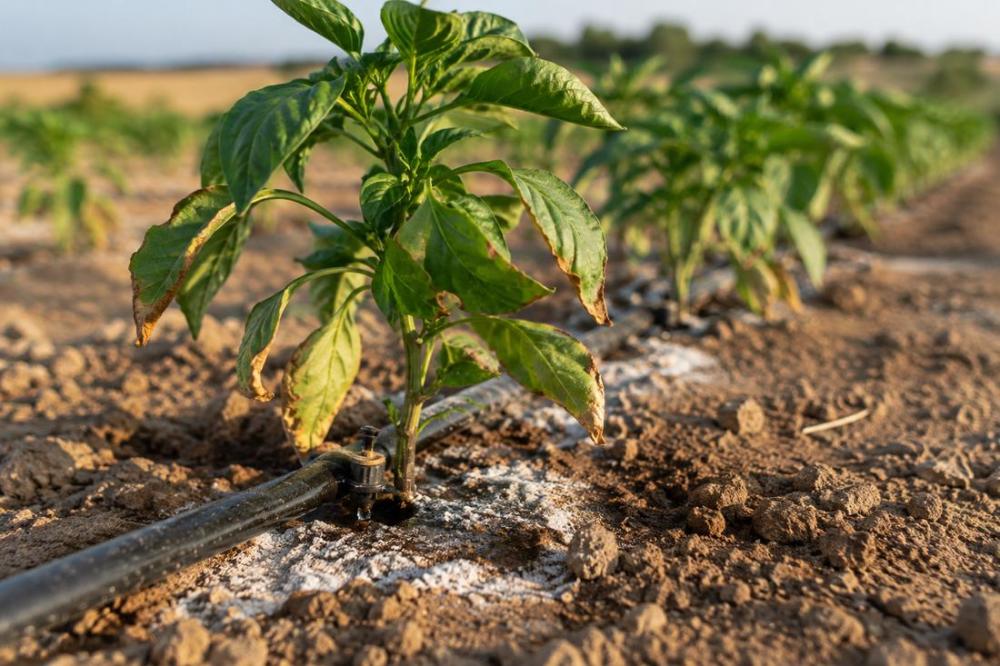

If leaf edges look scorched, plants stop growing even though you water and fertilise, and a white crust appears on the soil surface, the problem is most likely salinity. Excess salts stop roots drawing up water even when the soil is wet, so the plant goes thirsty in moist ground.
In this article we explain the signs of salinity and where it comes from, how to find out how severe it is, the treatment steps, and the exact rate for each salinity corrector.
Signs of soil salinity
- Scorched leaf edges and yellowing, especially on older leaves.
- Slow growth, short plants and small leaves.
- A white crust on the soil surface and around drippers.
- Wilting at midday even when the soil is moist.
- Poor germination and some seedlings dying after planting.
Where does salinity come from?
- Saline irrigation water, especially well water.
- Too much chemical fertiliser without leaching the soil.
- Heat and high evaporation with light irrigation, so salts build up at the surface.
- Poor drainage that leaves water and salts sitting around the roots.
How do you know how saline the soil is?
- Test the soil and irrigation water before choosing a treatment and rate.
- Low: 600 to 1,200 ppm.
- Medium: 1,200 to 3,000 ppm.
- High: 3,000 to 4,000 ppm.
Treatment steps
- Leach the salts: a deep irrigation that pushes salts below the root zone, making sure drainage works.
- Agricultural gypsum: its calcium displaces sodium from the soil and improves permeability.
- A liquid salinity corrector with the irrigation water, according to the salinity level.
- Humic acid activates roots and helps them cope with salt stress.
- Re-test after a few months to see what has changed.
Rate for each product
Agricultural gypsum 25 kg
- 0.8 to 2 kg per square metre depending on salinity and soil type, spread, mixed into the topsoil and irrigated straight away.
- On highly saline land split the dose into two applications with an irrigation in between.
- Repeat every 4 to 6 months, and do not mix with phosphate fertilisers.
Delta Salt Plus 20 L
- Low salinity: 3 L per hectare, and 500 to 750 ml per greenhouse tunnel (500 m²), twice a season.
- Medium salinity: 5 L per hectare, and 750 to 1,000 ml per tunnel, 3 times a season.
- High salinity: 8 L per hectare, and 1,500 ml per tunnel, 3 to 4 times a season.
- Do not mix with phosphorus fertilisers.
Delta Salt 5 L and 20 L
- 5 to 7 L per hectare with the irrigation water (0.5 to 0.7 L per 1,000 m²).
- Date palms: 3 L per palm per season.
- Ornamentals: 3 L per hectare.
Salt Free 1 L (for gardens and small areas)
- Half a litre per 1,000 L of water for mild salinity, 1 L for medium and 2 L for high.
- Apply in 3 to 4 doses, one every 5 days.
Codasal 20 L
- Fruit trees: 1 to 3 L per hectare with the irrigation water, repeated every 7 to 15 days.
- Contains 15% chelated calcium that displaces excess sodium from the soil.
Sersalt 20 L
- Clay soil: 6 to 7 L per hectare through drip irrigation.
- Sandy soil: 4 to 6 L per hectare through drip irrigation.
- Repeat every 2 to 3 weeks with a deep irrigation.
Vitasal Corrector 20 L
- 5 to 10 L per feddan through drip irrigation, repeated according to salinity.
- Mixes with most fertilisers except concentrated phosphates.
Mega Humic Acid 12% (1 L)
- Greenhouses: half a litre per 500 m², once every two weeks.
- Open-field vegetables: 8 L per hectare, once every 7 to 10 days.
- Trees and palms: 5 L per hectare, twice a season.
Tips that change the result
- Do not mix gypsum or calcium correctors with phosphate fertilisers in the same tank.
- Give a leaching irrigation before planting on land known to be saline.
- Cut back on chemical fertiliser while treating salinity and do not raise rates.
- Cover the soil surface with straw or mulch to reduce evaporation and salt build-up.
Products from Orkida
- Agricultural Gypsum for Soil Salinity, 25 kg: 0.8 to 2 kg per square metre.
- Delta Salt Plus for Soil and Irrigation Water Salinity, 20 L: rate by salinity level.
- Delta Salt with Amino Acids and Humic, 20 L: 5 to 7 L per hectare.
- Delta Salt with Amino Acids and Humic, 5 L: for medium-sized areas.
- Salt Free pH and Salinity Corrector, 1 L: for small gardens.
- Codasal with Chelated Calcium, 20 L: for fruit trees.
- Sersalt Soil Salinity Corrector, 20 L: for clay and sandy soils.
- Vitasal Corrector, 20 L: calcium, nitrogen and amino acids.
- Mega Humic Acid 12%, 1 L: to activate roots.
Frequently Asked Questions
How do I know if my soil is saline?
Scorched leaf edges, a white crust on the soil surface and weak growth; a soil and water test confirms it.
How much gypsum do I need per square metre?
0.8 to 2 kg per square metre depending on salinity and soil type.
Can I mix a salinity corrector with phosphorus fertiliser?
No, gypsum, Delta Salt Plus and Vitasal should not be mixed with phosphate fertilisers.
How often should I repeat the salinity treatment?
Gypsum every 4 to 6 months, and liquid correctors from weekly to every 3 weeks depending on the product.
Which product suits a small garden?
Salt Free 1 L: half a litre to 2 L per 1,000 L of water depending on salinity.