
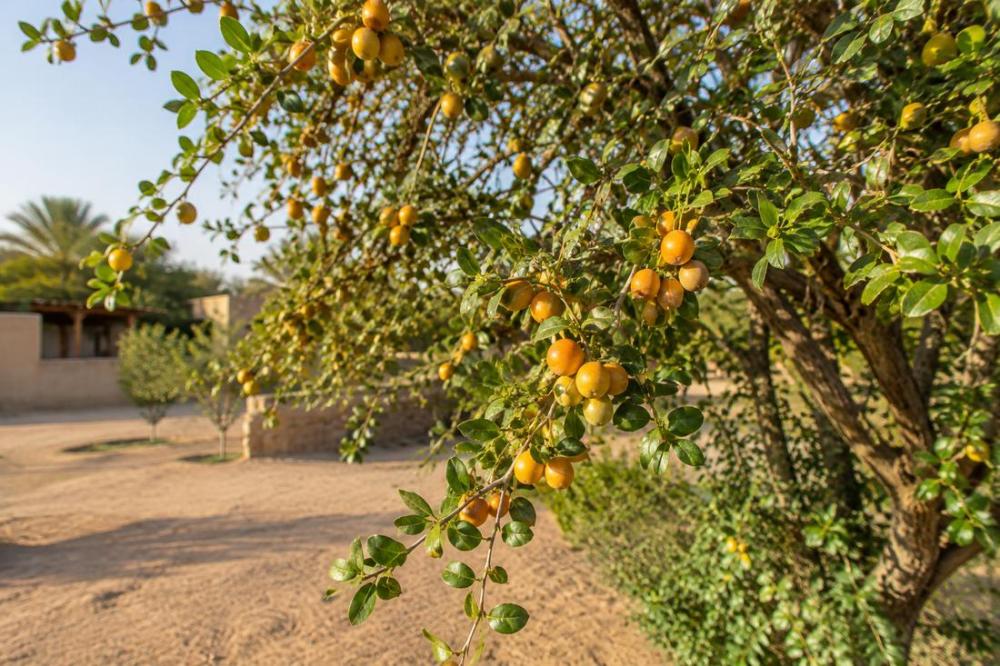

The sidr (Christ's thorn jujube) is one of the toughest trees against heat, drought and salinity, which is why you find it in homes, rest houses and farms. But that toughness makes many people neglect it, and problems appear: worms inside the nabaq fruit, white powder on the leaves, and sap-sucking insects on the branches.
In this article we explain how to care for a sidr tree, from watering, fertilizing and pruning to its most common pests and diseases, with real treatment rates.
A quick look at the sidr tree
- It tolerates extreme heat, drought and salty soil better than most fruit trees.
- Its roots run deep, so it prefers deep, spaced-out watering over light daily watering.
- It fruits on new growth, so correct pruning increases the crop.
- Its fruit, nabaq, usually ripens in winter and early spring depending on the variety.
Watering sidr correctly
- Young tree: water twice a week in summer until the roots are established.
- Mature tree: a deep watering every one to two weeks in summer, less in winter.
- Keep watering regular at fruit set: sudden drought while fruit is forming makes it drop.
- Do not flood the soil: water standing around the trunk causes root rot.
Fertilizing a sidr tree
- Well-rotted organic manure in winter: 5 to 15 kg per tree depending on age and size, under the outer edge of the branches, then water.
- Seaweed growth booster at the start of growth: spray 2 to 3 ml per litre of water.
- Calcium and boron from the start of flowering: spray 1 ml per litre of water to help fruit set hold and reduce fruit drop.
- Do not overdo nitrogen: it gives you lots of branches and leaves and little fruit.
Pruning sidr
- The best time is after harvest and before new growth starts.
- Remove dead and crossing branches and branches growing inwards, so sun and air can get in.
- Do not cut more than a third of the tree in one year.
Common sidr pests and treatment
Sidr fruit fly (worms in the nabaq)
- The sign: small holes in the fruit with white maggots inside, and fruit falling before it ripens.
- The most important step: collect fallen fruit every day and bury it deep or seal it in bags, because the maggots finish their life cycle in the soil.
- Spraying: Deltathrin 25 EC at 0.35 to 0.5 ml per litre of water (35 to 50 ml per 100 litres) as the fruit starts to form.
Mealybugs and scale insects
- The sign: white cottony clumps or scales stuck to the branches, with sticky honeydew and black sooty mould on the leaves.
- Systemic spray: Imidaprid 200 SL at 1 ml per litre of water (100 ml per 100 litres).
- For hard scales: a mineral oil such as Mynol at 10 to 15 ml per litre of water, in mild temperatures.
Common sidr diseases
Powdery mildew
- The sign: white powder on the leaves and young fruit, with curled leaves.
- Treatment: micronized sulfur at 2 g per litre of water.
- Warning: do not spray sulfur in extreme heat, or within two weeks of a mineral oil spray.
Fruit drop
- Common causes: drought at fruit set, a lack of calcium and boron, or fruit fly damage.
- The fix: keep watering regular, spray calcium and boron, and collect infested fruit as you go.
Products from Orkida
- Deltathrin 25 EC: for fruit flies and caterpillars, 0.35 to 0.5 ml per litre.
- Imidaprid 200 SL, 250 ml: systemic for mealybugs and sucking insects, 1 ml per litre.
- Mynol 950 EC, 1 L: mineral oil for scale insects, 10 to 15 ml per litre.
- Cosavet micronized sulfur, 1 kg: for powdery mildew, 2 g per litre.
- Black Cow organic cow manure, 25 kg: 5 to 15 kg per tree.
- Bocal Plus calcium and boron, 1 L: 1 ml per litre from the start of flowering.
- Acadian seaweed liquid fertilizer, 1 L: spray 2 to 3 ml per litre at the start of growth.
Frequently Asked Questions
Why are there worms in my sidr fruit?
Usually the sidr fruit fly, which lays its eggs in the fruit where maggots hatch. Collect fallen fruit and spray as the fruit starts to form.
How often should I water a sidr tree?
A mature tree needs a deep watering every one to two weeks in summer, and a young one twice a week until it is established.
When should I prune sidr?
After harvest and before new growth begins.
Can sidr tolerate salty water?
It tolerates salinity better than most trees, but very high salinity weakens growth and yield.