
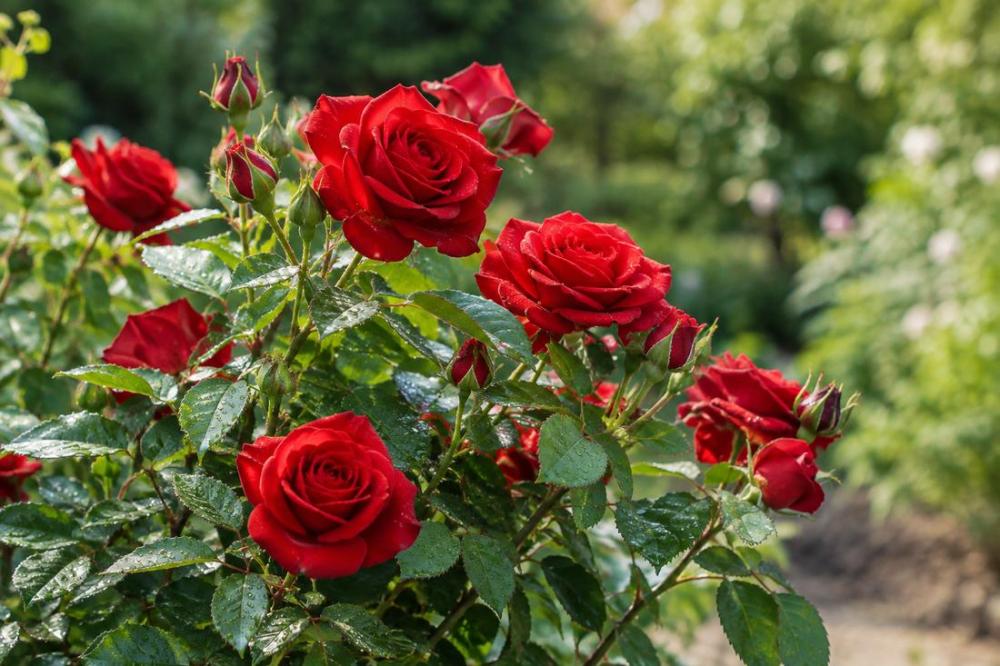

Roses flower almost all year if you get four things right: sun, correct watering, regular feeding and pruning. Most of their problems come from aphids, red spider mite and powdery mildew, and all of them are manageable if caught early.
In this article we explain rose care in gardens and pots: position and soil, watering, feeding with rates, pruning, and treating the most common pests and diseases.
Position and soil
- At least 6 hours of direct sun a day, ideally morning sun.
- Light, well-drained soil: roses do not tolerate standing water at the roots.
- Add well-rotted organic manure: in beds and pots mix it at 20 to 30% of the soil, and in the garden 2 to 5 kg per square metre.
- A roomy pot with drainage holes if growing in a container.
Correct watering
- Water deeply so it reaches the roots, rather than light daily sprinkles.
- In summer pots usually need water every day or two, and garden beds 2 to 3 times a week depending on the soil.
- In winter water less, because growth is slower.
- Water at the base and keep the leaves dry, especially late in the day, because wet leaves encourage powdery mildew.
Feeding
- Balanced liquid fertilizer: 2 ml per litre of water every 10 to 14 days in the growing and flowering season.
- Seaweed extract: spray 2 to 3 ml per litre once a month to strengthen the plant and help it cope with heat.
- In winter cut feeding to once a month.
- Do not feed dry soil; water first, then feed.
Pruning
Deadheading
- Cut spent flowers just above the first leaf with 5 leaflets; this encourages the bush to produce new flowers quickly.
Main pruning
- In late winter before new growth starts.
- Cut main canes back by a third to a half above an outward-facing bud.
- Remove dead, weak and crossing canes, and open the centre of the bush to air.
- Use sharp, clean secateurs so cuts are smooth and do not spread disease.
Common rose pests and treatment
Aphids
- Small green or black insects clustering on buds and soft tips; buds become distorted and do not open well.
- Treatment: a systemic insecticide such as Imidor: 15 to 30 ml per 100 litres of water, covering both sides of the leaves.
Red spider mite
- Tiny yellow speckles on leaves and fine webbing underneath, common in hot, dry weather.
- Treatment: Kanemite: 1 to 1.5 ml per litre for ornamentals, sprayed on leaf undersides, once per season and rotated with a different product.
Common rose diseases and treatment
Powdery mildew
- A white, powdery coating on leaves and buds, common with humidity and poor air flow.
- Treatment: Gatin: 0.2 ml per litre of water as a foliar spray at the first signs, covering both leaf surfaces and new growth.
- Prevention: space between bushes, water at the base and remove infected leaves.
Leaf spots
- Remove infected and fallen leaves and dispose of them, because they carry the infection into next season.
Products from Orkida
- Nours 7-7-7 Balanced Liquid Fertilizer, 1 L: 2 ml per litre every 10 to 14 days.
- Acadian Seaweed Liquid Fertilizer, 1 L: spray 2 to 3 ml per litre.
- Black Cow Organic Cow Manure, 25 kg: 20 to 30% mixed into potting soil.
- Imidor 350 SC: for aphids, 15 to 30 ml per 100 litres of water.
- Kanemite 15% SC: for red spider mite, 1 to 1.5 ml per litre for ornamentals.
- Gatin 5% EC: for powdery mildew, 0.2 ml per litre.
- Bahco Light Pruning Shears: for flowers and houseplants.
- Felco 2 Swiss Secateurs: for canes up to 25 mm.
Frequently Asked Questions
Why is my rose not flowering?
Usually too little sun, too much nitrogen, or not removing spent flowers.
How often should I water a potted rose?
In summer usually every day or two, less in winter, and never leave it standing in water.
When should I prune roses?
Main pruning in late winter, and deadheading throughout the season.
What is the white powder on rose leaves?
Powdery mildew, treated with a fungicide such as Gatin at 0.2 ml per litre, with good air flow and watering at the base.
Do coffee grounds or banana peels help roses?
They do not replace a balanced fertilizer; well-rotted organic manure is a surer way to improve the soil.