
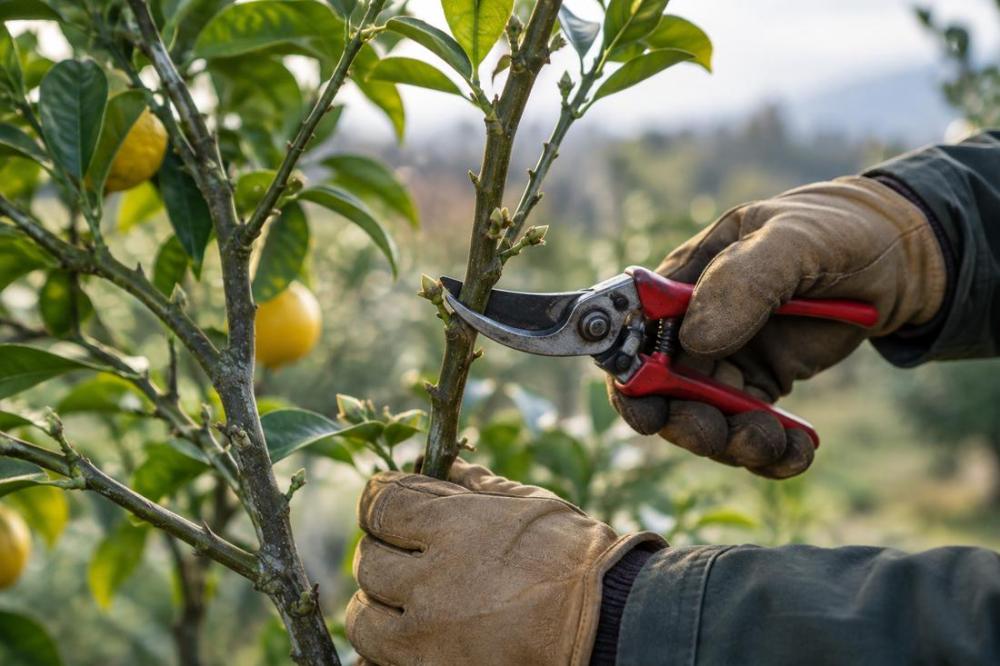

Correct pruning makes a tree stronger and more productive, and lets sun and air into the canopy so disease drops. Wrong pruning, or pruning at the wrong time, can stop a tree fruiting for a whole year or open the door to disease.
In this article we explain when to prune fruit and ornamental trees, the types of pruning, how to make a correct cut, and which shear or saw suits each branch thickness.
Why prune trees?
- To shape young trees so they grow a strong, balanced framework.
- To raise yield and quality: an open tree gets more light, so fruit is bigger and better coloured.
- To reduce disease and pests: removing dead and infected branches and letting air into the canopy.
- To rejuvenate old trees whose cropping has declined.
When is the best time to prune?
- Deciduous fruit trees such as grapes, pomegranates, figs and peaches: late winter, before the buds start to open.
- Citrus such as lemons and oranges: light pruning after harvest, and remove suckers (shoots below the graft) as they appear.
- Shrubs and hedges: after a flush of growth, with light trims during the season to keep the shape.
- Palms: remove only dry and broken fronds; do not strip too many green fronds, because they feed the palm.
- Avoid heavy pruning at the peak of summer: large wounds in the heat stress the tree, and inner branches scorch when suddenly exposed to the sun.
- Dead and broken branches can be cut whenever you see them.
Types of pruning
Formative pruning
- For young trees in their first 2 to 3 years.
- Choose 3 to 4 main branches spaced around the trunk and remove crowded ones.
Fruiting pruning
- For bearing trees every year.
- Thin crowded and crossing branches and open the centre to light.
Sanitation pruning
- Remove dead, diseased and broken branches.
- Cut well below the affected part to remove the infection completely.
Rejuvenation pruning
- For old, weak trees, spread over 2 to 3 years instead of cutting everything at once.
How to make a correct cut
- Cut above an outward-facing bud by about half a centimetre to a centimetre, at a slight angle so water does not sit on the wound.
- Do not leave a stub, because it dies back and becomes an entry point for disease.
- Cut a branch at its collar (the swollen area where it joins the larger branch) without damaging it.
- Heavy branches take three cuts: an undercut 30 cm from the trunk, a top cut a little further out so the branch drops, then cut the remaining stub at the collar. This prevents the bark from tearing.
- Do not remove more than a quarter to a third of the tree in one year.
Which tool for each branch?
- Branches up to 25 mm: hand secateurs such as Felco 2 or ARS 120EU.
- Branches from 25 to 45 mm: long-handled loppers such as Kamikaze KM-675.
- Branches over 45 mm: a pruning saw such as Kamikaze S-330H (up to 8 cm) or Felco 630 (up to 12 cm).
- Palms: a curved-blade palm saw such as ARS CT-32E reaches the fronds easily.
- Large areas and daily pruning: a battery electric pruner cuts up to 40 mm in one press.
Cleaning tools and aftercare
- Disinfect blades with alcohol between trees, especially when a tree is diseased, so you do not spread the disease.
- Keep blades sharp: a clean cut heals faster than a crushed one.
- Water the tree after pruning and feed it when new growth starts.
- Collect diseased prunings and remove them from the farm instead of leaving them under the trees.
Products from Orkida
- Felco 2 Swiss Secateurs: professional hand pruner for branches up to 25 mm.
- ARS 120EU Japanese Secateurs: hand pruner for branches up to 22 mm.
- Kamikaze KM-675 Spanish Loppers, 75 cm: long handles for branches up to 45 mm.
- Kamikaze S-330H Pruning Saw: curved saw for branches up to 8 cm.
- Felco 630 Pruning Saw: 33 cm curved blade for large branches up to 12 cm.
- ARS CT-32E Palm Saw: for pruning palms and high branches.
- IES-0409 Electric Pruner: battery powered, cuts branches up to 40 mm.
- IKRA Electric Hedge Trimmer: for trimming hedges and shrubs.
Frequently Asked Questions
When should I prune fruit trees?
Deciduous trees in late winter before the buds open; citrus with light pruning after harvest.
Can I prune in summer?
Only light trimming and removing dead branches; avoid heavy pruning in the heat.
How much can I cut from a tree at once?
No more than a quarter to a third of the tree per year.
How do I prune a lemon tree?
Thin crowded and crossing branches after harvest, and remove suckers growing below the graft.
Do I have to disinfect my secateurs?
Yes, especially between diseased and healthy trees, so you do not spread disease.
Read next
- Essential Farm and Garden Tools: What You Actually Need
- Petrol Chainsaw: How to Choose the Right One and Look After It
- Two-Stroke vs Four-Stroke Engines: What Is the Difference and Which Suits Your Machine?
- Battery Electric Pruning Shears: How to Choose the Size by Branch Thickness
- Electric Hedge Trimmers: The Right Way to Trim Hedges and Shrubs
- Manual Pruning Shears: Bypass or Anvil, and How to Choose the Size by Branch Thickness
- Apricot Tree Care: Feeding, Gummosis and Aphids
- Tecoma Care: Pruning and More Flowers