
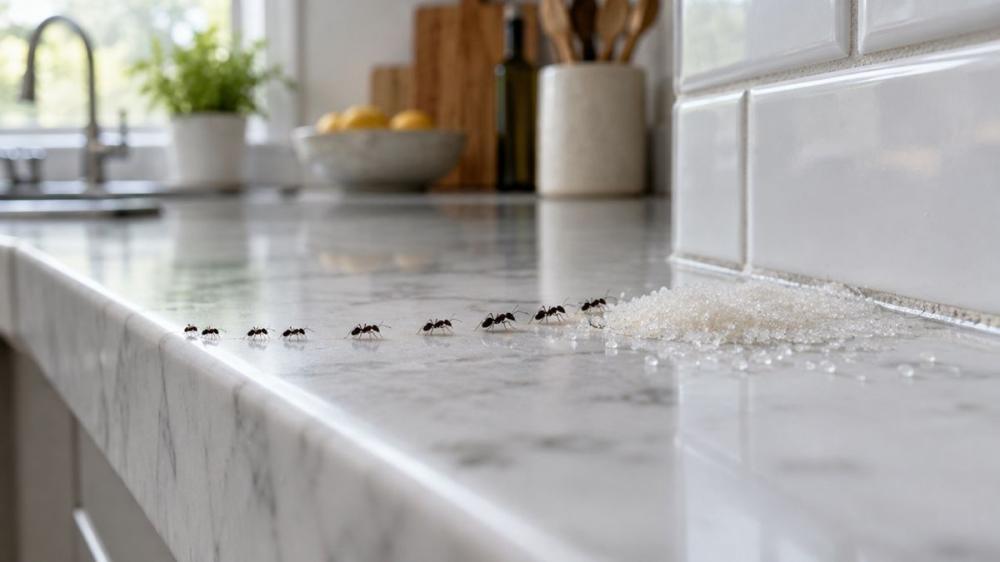

When ants appear in the kitchen, the first thing many people think of is ant killer from the pharmacy. Some of what you find in pharmacies and supermarkets kills the ants you can see, but the nest stays, so the ants come back within days. The reason is that most of these products are repellent sprays that only kill what is on the surface.
This article explains which pharmacy products work and which do not, and why gel and bait are the solution that reaches the nest.
What will you find at the pharmacy for ants?
- Insect sprays (aerosols): they kill the ants you spray, but the smell repels the rest and scatters the colony.
- Boric acid powder: it helps a little if applied correctly, but moisture affects it and ants avoid large amounts.
- Chalk and ant pens: their effect is weak and short-lived.
- Home mixtures (vinegar, lemon, cinnamon): they push ants away from a spot for a while but do not kill the colony.
On smells and repellents, read Ant Repellents: Smells Ants Hate and Do Home Mixtures Work?.
Why does a spray not get rid of ants?
The ants you see on the counter are less than a tenth of the colony. The queen, eggs and larvae are inside the nest in the wall or under the tiles. When you spray:
- Only the worker ants in front of you die.
- The colony senses danger and sometimes splits into more than one nest.
- The ants change their route and appear from somewhere else.
What is the right solution?
Non-repellent gel and bait. Ants eat it and carry it to the nest, so it reaches the queen and larvae, and the whole colony is eliminated.
- Find the ant trail and its entry point.
- Place small dots of gel on the trail and near the entry, not on the ants themselves. Each spot should be 0.1 to 1 gram (about 6 mm across), or a thin line 3 mm wide and 5 cm long, up to 7.5 cm on very active trails. The more placements along the trail, the better.
- Do not spray anything on or around the gel.
- Remove exposed food and sugars so the gel is the available food.
- Wait 3 to 7 days. More ants around the gel at first is a sign it is working.
- Check the spots every few days and add gel where it has been eaten.
Do not place gel on surfaces that are washed often, such as dining table tops, or on surfaces hotter than 50°C, where it liquefies.
Identify the type of ant in your home in Household Ant Types: How to Identify the Ant in Your Home and Treat It.
When should you spray?
If the ants come from outside or from the garden, spray a barrier around the entrances with a non-repellent product such as Advion WDG, and keep the gel inside:
- Light infestation: 2.5 g per litre of water, meaning one 10 g sachet in 4 litres.
- Heavy infestation: 5 g per litre of water, meaning two sachets in 4 litres.
- Where to spray: a band around door and window thresholds, along the outside base of walls, and on ant trails in the yard.
The difference between powder, gel and spray is in Ant and Cockroach Powder: Types, How to Choose and How to Use It.
Common mistakes
- Spraying on the gel trail, which repels ants from it.
- Moving the gel every day.
- Using a large amount in one spot instead of many small dots.
- Stopping treatment early before the effect reaches the nest.
Products from Orkida
- Advion Ant Gel 30 g: indoxacarb 0.05% from Syngenta, non-repellent and carried by ants to the nest.
- Advion Ant Gel Package 120 g: four tubes for large homes and widespread infestations.
- Advion WDG 10 g: indoxacarb 20% water-dispersible granules for a barrier spray around entrances.
Frequently Asked Questions
What is the strongest ant killer?
The strongest is the one that reaches the nest. A non-repellent gel is stronger than a spray because ants carry it into the colony.
How many days until the ants disappear?
You will see improvement within 3 to 7 days, and most ants disappear within two weeks if you follow the method.
Why did ants increase after I applied the gel?
Because the ants found food and brought others. This is a sign the gel is working. Leave it and do not spray on it.
Is gel safe around children?
The amount in each dot is very small. Place it in cracks and hidden spots out of reach of children and pets.