
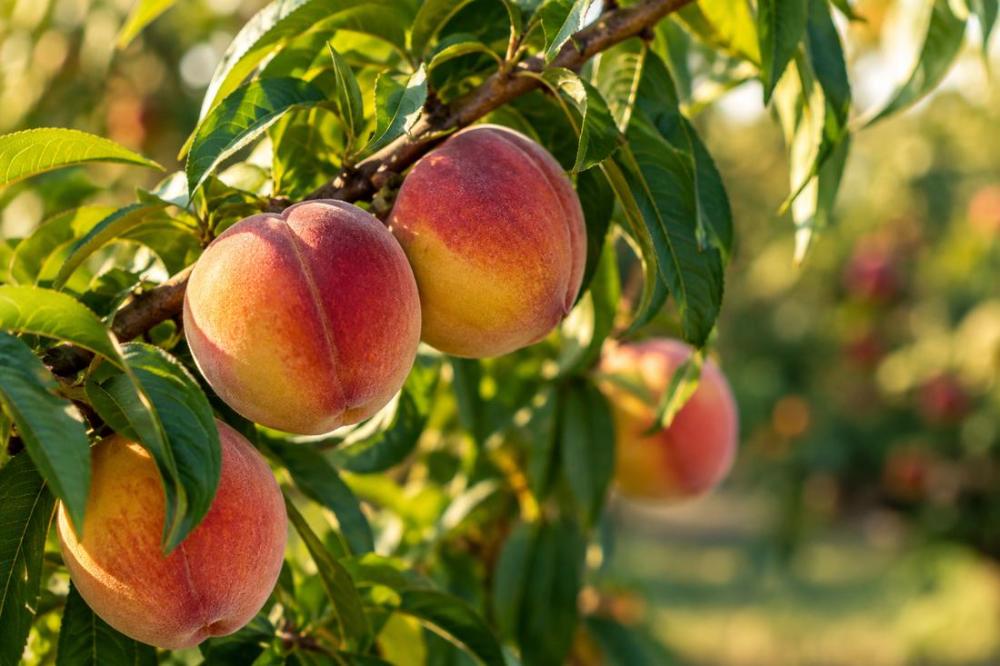

The peach tree is one of the most rewarding fruit trees in a garden, but it needs more attention than most. Its best-known problems are: spring leaves that come out puckered, curled and red, gum oozing from the trunk and new shoots, and worms in the fruit.
In this article we explain how to care for a peach tree, from watering, feeding and pruning to treating leaf curl, gummosis, aphids and fruit fly, with rates.
Peach leaf curl
- The sign: the first spring leaves come out puckered and curled, red or purple in colour, then yellow and drop.
- The cause: a fungal disease that infects the buds in winter, and it cannot be cured once the leaves have curled.
- Prevention: spray Armitel C copper fungicide at 2.5 g per litre of water over the whole tree after leaf fall in autumn, and again before bud swell in late winter.
- Remove infected leaves and burn them or dispose of them away from the tree.
Gummosis (gum oozing from the trunk)
- The causes: pruning wounds or breaks, stem borers, stress from drought or overwatering, and some fungal and bacterial diseases.
- The fix: clean the gum and remove dead bark back to healthy wood, then paint or spray the area with Armitel C copper at 2.5 g per litre.
- Watch the watering: do not let water collect around the trunk.
Aphids on peach
- The sign: curled leaves on new shoots with colonies of small green or black insects underneath.
- The fix: Imidaprid 200 SL at 1 ml per litre of water, and do not spray during flowering to protect bees.
Fruit fly and wormy fruit
- The sign: small punctures in the fruit, with soft, rotting flesh and larvae inside.
- The fix: Deltathrin 25 EC at 0.35 to 0.5 ml per litre of water from the start of fruit colouring, keeping to the pre-harvest interval.
- Collect infested and fallen fruit and dispose of it regularly.
Powdery mildew
- The sign: white powder on young leaves and fruit.
- The fix: Cosavet micronized sulfur at 2 g per litre of water, avoiding spraying in strong heat.
Feeding a peach tree
- In winter: Black Cow well-rotted cow manure at 5 to 15 kg per tree depending on age, mixed around the root zone.
- During growth: Pioneers 20-20-20 balanced fertilizer at 25 to 100 g per tree once a month.
- As the fruit swells: SAF 0-0-50 potassium sulfate at 2 to 3 g per litre of water to improve size, colour and taste.
Pruning and thinning
- Prune in winter while the tree is dormant, to an open-centre vase shape so sun and air get in.
- Peaches fruit on last year's shoots, so do not cut all the new growth.
- Thin the fruit while small, leaving about 15 cm between fruits so they size up and branches do not break.
Products from Orkida
- Armitel C copper fungicide: for leaf curl and gummosis, 2.5 g per litre.
- Imidaprid 200 SL, 250 ml: for aphids, 1 ml per litre.
- Deltathrin 25 EC: for fruit fly, 0.35 to 0.5 ml per litre.
- Cosavet micronized sulfur, 1 kg: for powdery mildew, 2 g per litre.
- Black Cow organic cow manure, 25 kg: winter feeding, 5 to 15 kg per tree.
- Pioneers 20-20-20 balanced fertilizer, 1 kg: during growth, 25 to 100 g per tree monthly.
- SAF soluble potassium sulfate 0-0-50: as the fruit swells, 2 to 3 g per litre.
- Samurai pruning shears, model 1002: for winter pruning.
Frequently Asked Questions
Why are my peach leaves curled and red?
Peach leaf curl, prevented with a copper spray in autumn and late winter before bud swell.
Why is my peach tree oozing gum?
Usually wounds, borers, watering stress or a fungal disease. Clean the area and treat it with copper.
When should I prune a peach tree?
In winter while it is dormant, to an open-centre vase shape.
Why do my peaches have worms?
Usually fruit fly, controlled with Deltathrin from the start of colouring and by collecting infested fruit.