
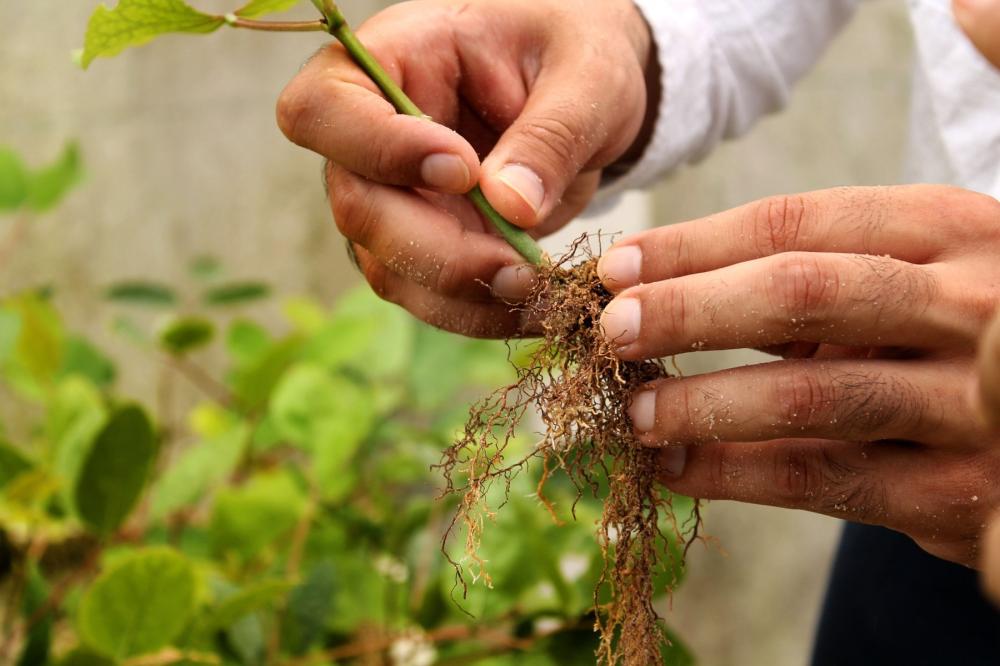

Plants that wilt despite good irrigation, stunted growth, general yellowing, and knots and swellings on the roots when you pull the plant: these are classic signs of nematodes, microscopic worms that live in the soil and attack roots. They cause heavy losses, especially in greenhouses and vegetables.
This guide explains what nematodes are, how their symptoms differ from nutrient deficiency and diseases, how to prevent and control them, and how to choose the right product.
Clearest sign: knots and swellings on the roots from pinhead to pea size, which do not rub off the way soil clumps do.
Crops affected: tomato, cucumber, pepper, eggplant, watermelon, potato and many other vegetables and fruit crops.
Common mistake: adding heavy fertilizer to treat wilting. The cause is in the roots, not the nutrition.
Rule: pull up an infested plant and inspect its roots before any treatment. A correct diagnosis saves money and the season.
What are nematodes?
Tiny thread-like worms that cannot be seen by eye. Some are beneficial and some harmful. The most dangerous type for vegetables is the root-knot nematode, which enters the root and forms galls that block water and nutrients from reaching the plant, so the foliage weakens and yield falls.
Symptoms of infestation
- Wilting in the heat of the day even though the soil is moist.
- Yellowing leaves and stunted growth.
- Knots and swellings on the roots, and abnormal root deformation and branching.
- Fewer and smaller fruit.
- Infestation appearing in round patches in the field, then widening season after season.
- The plant pulls out easily because the roots are weak.
How do you tell nematodes from root diseases?
- Nematodes: hard knots on the roots that do not separate when rubbed, and the roots are mostly alive.
- Fungal root rot: brown or black soft, decaying roots, and the outer layer slips off under pressure.
- Nutrient deficiency: even yellowing with no root deformation. See Plant Nutrient Deficiency Symptoms.
- Soil insects: chewed roots and visible wounds. See Soil and Root Pests.
Prevention before planting
- Check the soil and the roots from the previous season before planting.
- Use healthy seedlings free of knots.
- Rotate crops with non-host crops such as cereals instead of susceptible vegetables.
- Solarize the soil in summer by tilling, irrigating and covering it with plastic.
- Use resistant rootstocks where available for grafted vegetables.
- Clean tools and machinery between fields so infested soil is not carried over.
- Remove infested root residues after the season and dispose of them.
Control plan
- Confirm the infestation: pull up several plants from different spots and inspect the roots.
- Treat before planting: preventive soil treatment is far better than treating after galls have formed.
- Choose a product registered for nematodes: products are either granules mixed into the soil or liquids applied through irrigation water, depending on the product and crop.
- Keep the soil moist: products need well-aerated moist soil to reach the root zone.
- Add soil improvers: such as good organic matter and humic acids to strengthen new roots.
- Follow growth: inspect new roots after a few weeks to confirm the infestation is receding.
- Rotate active ingredients: to reduce tolerant strains.
Common mistakes
- Treating wilting with fertilizers or fungicides without checking the roots.
- Treating after large galls have formed, when the damage is done.
- Applying the product to dry soil.
- Growing the same susceptible crop season after season in the same soil.
- Moving infested seedlings to a clean field.
- Not cleaning tools between fields.
- Ignoring the safety interval and the label instructions.
Products from the Orkida Store
We start with diagnosis and prevention, then choose the product that suits the crop and irrigation method. We advise following the label dose and the safety interval.
- Velum Prime 400 SC Nematicide 1 L – Fluopyram for Root-Knot: from Bayer; a fluopyram nematicide against root-knot nematodes.
- Nemakick 30 SL Imicyafos Nematicide 500 ml: from Agro-Kanesho; a non-systemic nematicide for soil nematodes and some root rots.
- Vapozate 50% EC Fosthiazate Nematicide for Root-Knot Nematodes 1 L: a fosthiazate nematicide against root-knot nematodes.
- Thiafos 500 EC Fosthiazate 50% Root-Knot Nematicide 1 L: a fosthiazate nematicide against root-knot nematodes.
- Nimasol 10% GR Fosthiazate Granular Nematicide 1 kg: a granular fosthiazate form mixed into the soil during planting preparation.
- Nemax 20 SC Abamectin Nematicide 1 L: an abamectin nematicide against root-knot nematodes.
Frequently asked questions
Do galled roots heal?
Existing galls do not disappear, but treatment protects new roots and stops the decline.
Is treatment preventive or curative?
Prevention before planting works best. Treatment after infestation only reduces the damage.
Does solarization kill nematodes?
It reduces numbers in the surface layers and is not enough alone in severe infestations.
Can I grow the same crop after infestation?
It is better to rotate with a non-host crop or use resistant rootstocks.
How do I know the problem is nematodes?
By inspecting the roots. Hard galls that do not separate are a clear sign.
Do nematodes spread through water?
Yes, they spread with soil, water, tools and infested seedlings.
If you are not sure of the diagnosis or the infestation is large, visit your nearest Orkida branch with a photo of the plant roots or a sample and we will point you to the right product.