
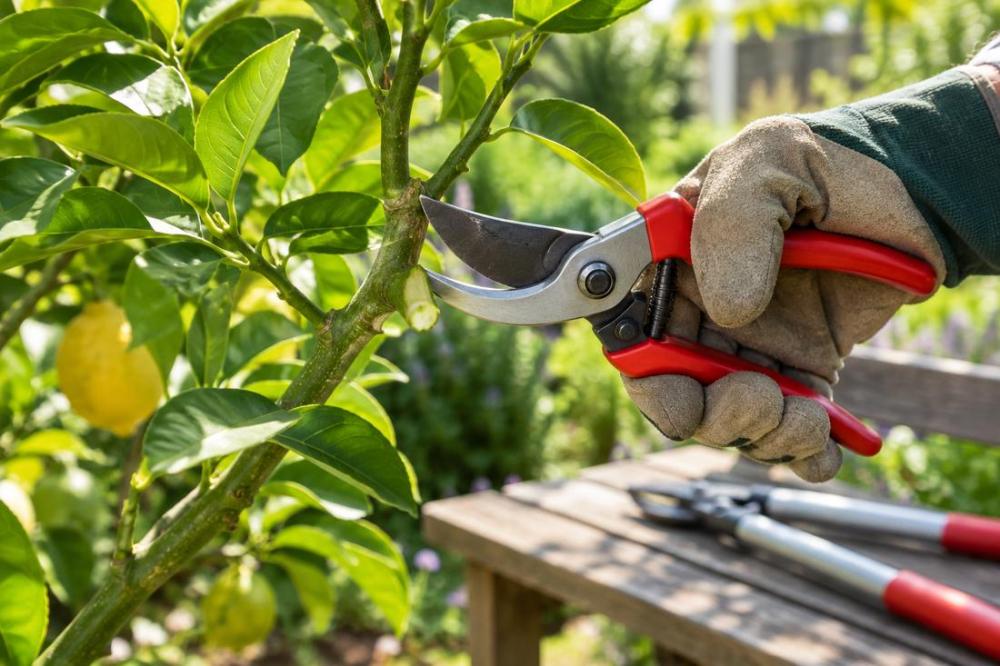

Most pruning problems start with the wrong shears: small secateurs on a thick branch crush the bark and open the door to disease, while big loppers on soft growth just tire you out. The simple rule: choose the shears by the thickness of the branch you are cutting, not by price or looks.
In this article we explain the types of manual pruning shears, bypass versus anvil, how to choose the size by branch diameter, and how to look after your shears so they last for years.
Bypass or anvil?
Bypass shears
- How they cut: two blades pass each other like ordinary scissors.
- Result: a clean cut that does not crush the bark, so the wound heals faster.
- Best for: live green branches on fruit trees, roses and ornamentals, and the first choice for most people.
Anvil shears
- How they cut: a single blade closes onto a flat base.
- Result: more cutting force, but they can crush green wood.
- Best for: dry, dead branches and hard wood.
How to choose the size by branch thickness
- Up to about 20 mm: small hand secateurs, such as ARS 130DX (19 mm) or KAMIKAZE KM-19 (20 mm).
- 20 to 25 mm: professional hand secateurs, such as FELCO 2, 4 and 8, KAMIKAZE KM-5 and KM-2L (25 mm), and ARS VS-8XZ and 120EU (22 mm).
- 30 to 45 mm: two-handed loppers, such as ARS LPB (30 to 34 mm), Bellota 3588 and 3578 (35 mm), Bellota 3442 (40 mm), and KAMIKAZE KM-660 and KM-675 (45 mm).
- Over 45 mm: shears are no longer enough; use a pruning saw.
Types of shears by job
Hand secateurs
- Use: everyday pruning of thin and medium branches, roses and shrubs.
- Length: about 184 to 230 mm, held in one hand.
- Mind your hand size: FELCO 8 and FELCO 4, for example, are designed for larger hands.
Two-handed loppers
- Use: thick and high branches that hand secateurs cannot reach or cut.
- Length: about 40 to 77 cm; the longer the arms, the more cutting force and the less effort.
- Best for: large fruit trees and renewing old shrubs.
Hedge shears
- Use: shaping hedges and shrubs and cutting dense soft growth in one go.
- Blades: long, and some are wavy like the KAMIKAZE KM-30 (23 cm blade) so they grip branches without slipping.
- Not for: a single thick branch; use loppers for that.
Harvest and flower snips
- Use: picking grapes and fruit and cutting flowers, herbs and soft plants.
- Advantage: light and precise, so they do not damage the bunch or tear the stem.
- Not for: woody or thick branches.
The right way to cut
- Cut about half a centimetre above a bud at an angle sloping away from it.
- Keep the sharp blade on the tree side and the lower jaw on the part you are removing.
- Cut with the branch deep in the jaw, not at the blade tip, for the strongest cut.
- Do not twist the shears while cutting, as this loosens the pivot bolt and ruins the edge.
Caring for your shears
- Wipe off sap and dirt after every use.
- Disinfect the blades with 70% alcohol between trees, especially when cutting diseased wood.
- Put a drop of oil on the bolt and spring from time to time.
- Sharpen only the bevelled side of the blade and leave the flat side as it is.
- Replace worn parts instead of the whole tool: on the KAMIKAZE KM-2L, for example, the blade, spring and bolt are all replaceable.
Products from Orkida
- FELCO 2 Swiss Pruning Shears: bypass, up to 25 mm.
- FELCO 4 Swiss Pruning Shears: bypass, up to 25 mm, for larger hands.
- FELCO 8 Swiss Pruning Shears: angled head that eases wrist strain, up to 25 mm.
- FELCO 5 Swiss Pruning Shears: up to 25 mm.
- ARS VS-8XZ Japanese Pruning Shears: up to 22 mm.
- ARS 120EU Japanese Pruning Shears: up to 22 mm.
- KAMIKAZE KM-5 21 cm Spanish Pruning Shears: up to 25 mm.
- KAMIKAZE KM-2L 23 cm Spanish Pruning Shears: up to 25 mm, with replaceable parts.
- KAMIKAZE KM-19 21 cm Spanish Pruning Shears: up to 20 mm.
- Bellota 23505 Spanish Pruning Shears: for everyday pruning.
- ARS LPB-20L Large Japanese Loppers: up to 34 mm.
- ARS LPB-20M Medium Japanese Loppers: up to 30 mm.
- Bellota 3588 Spanish Loppers: 40 cm long, up to 35 mm.
- Bellota 3578 Spanish Loppers: 50 cm long, up to 35 mm.
- Bellota 3442 Large Spanish Loppers: 75 cm long, up to 40 mm.
- KAMIKAZE KM-660 60 cm Spanish Loppers: up to 45 mm.
- KAMIKAZE KM-675 75 cm Spanish Loppers: up to 45 mm.
- KAMIKAZE KM-30 60 cm Spanish Hedge Shears: 23 cm wavy blades.
- Bellota 3461 Spanish Hedge Shears: 65 cm long for shaping shrubs.
- Bellota 3622 MB Grape, Fruit and Flower Harvest Snips: for picking and precise cuts.
- Bahco 330139 Light Pruning Snips: for herbs, flowers and soft plants.
Frequently Asked Questions
What are the best pruning shears for home use?
Bypass secateurs that cut up to 20 to 25 mm handle most garden, rose and small fruit tree work.
What is the difference between bypass and anvil?
Bypass shears cut like scissors with a clean cut for live wood; anvil shears press the branch onto a base and suit dry wood.
When do I need loppers?
When the branch is thicker than 25 mm or too high to reach with hand secateurs.
Do I need to disinfect my shears?
Yes, between trees and after cutting any diseased branch, so you do not spread disease.
How often should I sharpen my shears?
When they start crushing the branch instead of cutting it, or you need more force than usual, it is time to sharpen.