
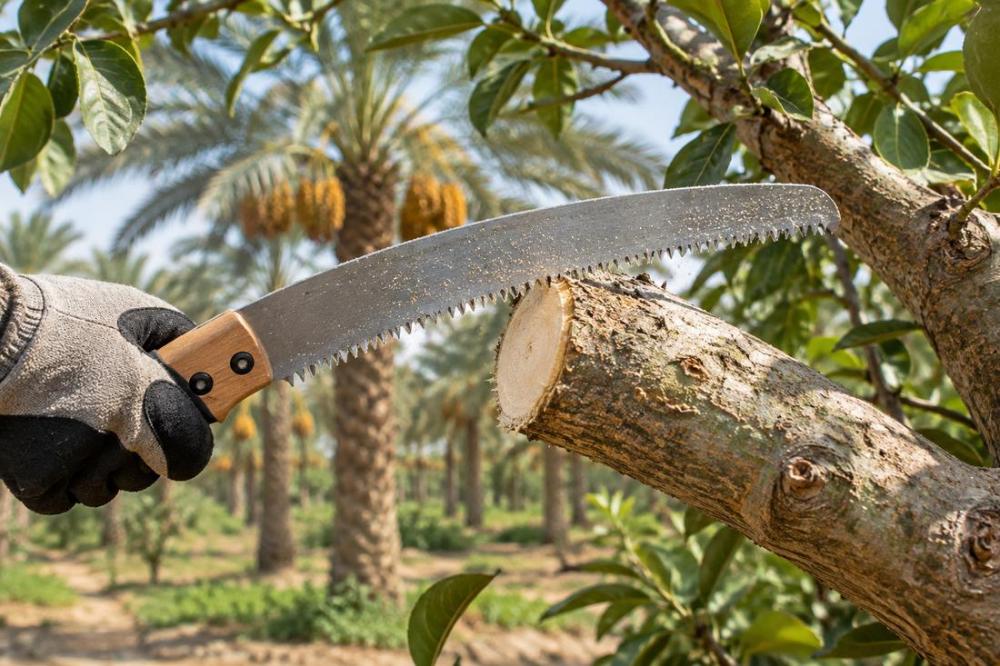

Once a branch is thicker than about 45 mm, shears are no longer enough and you need a pruning saw. The right saw cuts a thick branch in a few strokes with a clean cut, while the wrong one tears the bark and tires your hand. Date palms in particular have their own palm saws, with a curved blade made for fronds and frond bases.
In this article we explain the types of manual pruning saws, the difference between straight, curved and folding blades, how to choose the length by branch thickness, and how to cut safely.
Types of pruning saws
Straight saw
- Blade: straight, giving you more control for precise cuts.
- Best for: nearby branches and cutting in tight spaces.
- Example: FELCO 611 with a 330 mm blade that cuts up to 100 mm.
Curved saw
- Blade: curved, so it grips the branch and cuts faster with less effort.
- Best for: thick and high branches on fruit and ornamental trees.
- Examples: FELCO 630 with a 330 mm blade up to 120 mm, FELCO 640 with a 270 mm blade up to 100 mm, and KAMIKAZE S-330H with a 33 cm blade up to 80 mm.
Folding saw
- Blade: folds into the handle, so you can carry it safely in a pocket or on a belt.
- Best for: light pruning, medium branches and moving between trees.
- Example: KAMIKAZE E-180H with an 18 cm blade that cuts up to 50 mm.
Palm saw
- Blade: long and curved with strong teeth that cut fronds and frond bases quickly.
- Best for: cleaning date palms and removing dry fronds and high branches.
- Examples: ARS CT-32E with a 320 mm blade up to 125 mm and a holster, and the 33 cm curved Korean RHINO palm saws.
How to choose the blade length
- Up to 50 mm: a folding saw or a small saw with an 18 cm blade.
- 50 to 80 mm: a curved saw with a 30 to 33 cm blade.
- 80 to 125 mm: a professional saw such as the FELCO 630 or ARS CT-32E.
- Thicker than that: you need an electric or petrol chainsaw.
Japanese teeth and pull-stroke cutting
- Most modern pruning saws cut on the pull stroke, towards you, not on the push.
- The benefit: the blade stays taut and does not bend, so the cut is cleaner with less effort.
- Impulse-hardened or heat-treated teeth stay sharp longer, as on KAMIKAZE, FELCO and ARS saws.
How to cut a thick branch safely
- Make a small undercut 20 to 30 cm from the trunk, about a third of the way through.
- Cut the branch from above a little beyond the first cut, so it falls without stripping the trunk.
- Cut the remaining stub at the edge of the swollen collar joining the branch to the trunk, without cutting into the collar itself.
- Keep your footing steady and do not cut above shoulder height while standing on an unstable ladder.
Caring for your saw
- Clean sap and sawdust from the teeth after every use.
- Disinfect the blade between trees if you are cutting diseased wood.
- Return the blade to its sheath or fold it after work to protect you and the teeth.
- Wipe the blade with a light oil before storage so it does not rust.
Products from Orkida
- FELCO 611 33 cm Swiss Pruning Saw: straight, up to 100 mm.
- FELCO 630 33 cm Swiss Pruning Saw: curved pull-stroke, up to 120 mm.
- FELCO 640 27 cm Swiss Pruning Saw: curved, up to 100 mm.
- ARS CT-32E Japanese Palm Saw: up to 125 mm, with a holster.
- RHINO JR970CW 33 cm Curved Palm Saw, Wooden Handle: for palms and high branches.
- RHINO JR2930C 33 cm Curved Palm Saw, Chrome Handle: for palms and high branches.
- KAMIKAZE S-330H 53 cm Spanish Pruning Saw: curved, up to 80 mm, with sheath.
- KAMIKAZE E-180H 39 cm Spanish Pruning Saw: folding, up to 50 mm.
- Bellota 4588 Spanish Hand Saw, Plastic Handle: 33 cm curved Japanese blade.
- Bellota 4587 Spanish Hand Saw, Wooden Handle: 32 cm blade, 250 g.
- Bellota 3011 Spanish Branch and Root Saw: for dry and green branches and roots.
- SL-J 30 cm Pruning Saw with SK5 Blade: for medium branches.
- Bellota 600C Medium Axe, 600 g: for chopping wood and branches.
Frequently Asked Questions
What is the best saw for pruning trees?
A curved saw with a 30 to 33 cm blade covers most branches on fruit and ornamental trees.
What is the difference between a palm saw and an ordinary pruning saw?
A palm saw has a longer, more curved blade with stronger teeth to cut fronds and frond bases quickly.
Why do pruning saws cut on the pull stroke?
Because the blade stays taut and does not bend, so it cuts faster and cleaner with less effort.
What branch diameter can a hand saw cut?
From 50 mm with folding saws up to 120 to 125 mm with professional saws.
How do I cut a heavy branch without stripping the trunk?
Make an undercut first, then cut from above, and finally cut the remaining stub at the branch collar.