
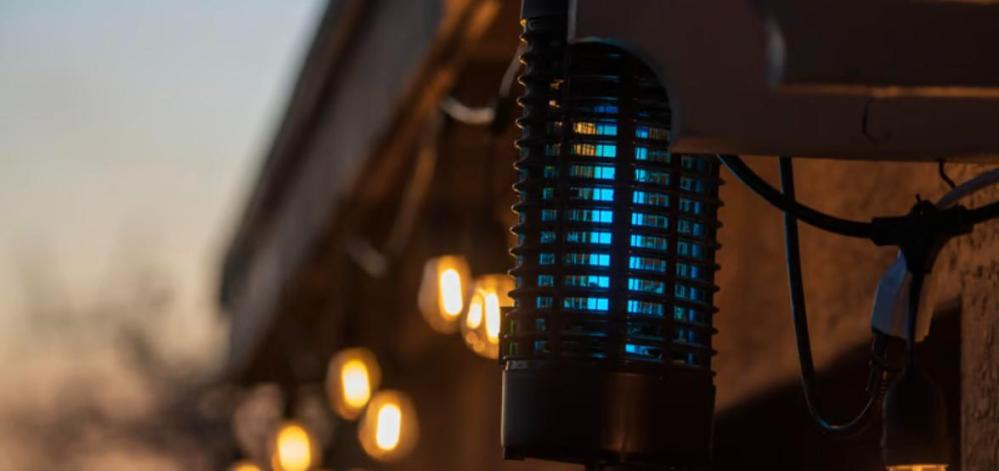

One fly circling a restaurant table is enough to lose a customer, and one mosquito buzzing in a bedroom is enough to ruin a night's sleep. An insect light trap is a quiet solution that works day and night with no spraying and no smell, but it is not one single device, and not every trap works in every place.
This guide explains why insects are drawn to light in the first place, how glue board, zapper and suction traps differ, and where to hang a trap for the best results.
Why are insects attracted to light?
Many flying insects naturally move toward light, a behaviour called phototaxis. There is no single agreed explanation for it, but the best-known theories are:
- Navigation: insects steer by the sun or moon, so a nearby light source confuses their sense of direction and pulls them in.
- Safety: to an insect, light means open space and a way out.
- Eyesight: a fly's eyes are very sensitive to ultraviolet light, so it sees a trap's light far more clearly than we do.
Insects drawn to light traps: house flies, gnats and small flying insects, moths, and some flying beetles.
Insects not drawn to them: cockroaches, which avoid light and seek darkness, so light traps do not work on them.
What light does a trap use?
Traps use special lamps that give off UV-A ultraviolet light, the light flies see most clearly. To us it looks like a dim blue-violet glow, while a fly can see it from far away.
- Fluorescent tubes: the most common lamps in glue board and zapper traps.
- LED lamps: last longer and use less electricity.
Worth knowing: a lamp loses much of its pull over time while it still lights up, and can lose around half its UV output within six months of continuous use. So do not wait for it to burn out before changing it.
Types of insect light traps
Glue board light trap
The insect flies toward the light and sticks to a board hidden inside the trap. No sound, no sparks, and the insect stays whole on the board.
- Best for: kitchens, restaurants, food factories and anywhere with food.
- Advantage: quiet and clean, and customers never see the caught insects.
- Extra benefit: the board shows you which insects you have and how many, so you know the size of the problem.
- Upkeep: replace the board whenever it fills up or gets dusty.
Electric zapper light trap
The insect touches an electric grid inside the trap, dies instantly and drops into a small tray.
- Best for: warehouses, corridors and service entrances.
- Advantage: fast, with no glue boards to change.
- Note: it crackles, and small insect fragments can scatter when it zaps, so it should never hang above food preparation areas.
Suction fan trap
The light draws the insect in, then a small fan pulls it into a closed container where it dies. Small, weak fliers cannot resist the airflow, which makes this type the best fit for mosquitoes and gnats.
- Best for: bedrooms, offices and outdoor seating.
- Advantage: quiet and spark-free.
- Upkeep: empty and clean the container from time to time.
Do light traps work on mosquitoes?
They do, with conditions. Mosquitoes do not rely on light the way flies do. They find people through the carbon dioxide in our breath, body heat and smell, which is why a regular zapper catches few mosquitoes.
- Choose a suction trap, because the fan pulls mosquitoes in before they fly off.
- Traps that support a carbon dioxide cylinder attract mosquitoes much more strongly.
- Place it near where people sit and switch it on before sunset, when mosquitoes become active.
- A trap alone is not enough. Mosquitoes breed in any standing water, so their breeding spots must go too.
Which trap fits your space?
Before buying, measure your space in square metres, then pick a trap whose coverage is larger than that area.
- Home kitchen: a small glue board trap covering about 80 m² is usually enough.
- Restaurant or commercial kitchen: a glue board trap with two or more lamps, plus an extra trap at each entrance.
- Shop or large hall: a large glue board trap covering 150 m², or several traps spread out.
- Warehouse or service entrance: a zapper, since crackling and debris do not matter there.
- Bedroom or office: a small, quiet suction trap.
- Patio or garden: an outdoor suction trap that handles humidity and covers a wide area.
Where should you hang a light trap?
Where a trap hangs matters as much as which trap it is. A good trap in the wrong spot catches very little.
- Inside, near entrances: flies come in through doors, so place the trap inside near them, not facing them.
- Out of sight from outside: a trap visible through a door or window draws insects in from the street.
- Away from food: at least 1.5 m for a glue board trap and 3 m for a zapper.
- Away from strong light: sunlight and bright lighting compete with the trap and weaken its pull.
- Height: 1.5 to 2 m for flies, and closer to seating for mosquitoes.
- In large spaces: spread out several traps instead of one big trap in the middle.
How to keep your trap working well
- Bug Zapper: How to Choose the Right Size and Where to Hang It
- Keep it on all the time: flies are active during the day, so do not run it only at night.
- Change the lamp on time: at least once a year, and every six months in restaurants and places where it runs around the clock.
- Replace the glue board: whenever it is full or dusty, even if it has not been long.
- Clean the grid and container: empty the zapper tray and the suction container regularly.
- Unplug it: before any cleaning or lamp change.
When buying a spare board or lamp, make sure it is the right size for your trap. You will find spare glue boards and lamps in the Light Traps category.
Products from Orkida
- ProCatch COMPACT Glue Board Light Trap
- ProCatch ELITE Glue Board Light Trap
- ProCatch ULTIMATE Glue Board Light Trap
- ProCatch ARC PRO Electric Zapper
- ProCatch VORTEX Suction Fan Trap
- ProCatch NIGHTGUARD Suction Fan Trap
Insect light trap FAQs
Do insect light traps really work?
Yes, especially on flies and small flying insects, as long as you choose the right type, hang it in the right spot and change the lamp and board on time.
Do insect traps kill mosquitoes?
They reduce their numbers, and suction traps suit them best. But mosquitoes are drawn to human breath more than to light, so their breeding spots must be removed too.
What is the best insect trap for restaurants?
A glue board trap, because it is quiet, no insect fragments scatter over food, and customers never see the hidden board.
Is the trap's light harmful to people?
The trap gives off low-intensity UV-A light, which is safe in normal use. Still, do not stare into it up close for long.
Do light traps work on cockroaches?
No. Cockroaches avoid light and hide in the dark, so they need other control methods such as gel and baits.
Does a trap replace insecticide?
The trap catches flying insects that come inside, but their breeding source still needs the right insecticide.
Read also
- Fly Traps: Types and How to Choose the Best One for Home or Farm
- Mosquito Traps: Do They Really Work and How to Get Rid of Mosquitoes
- Insecticides: Types and How to Choose the Right One for the Insect and Location
- Light Trap Glue Boards: How to Choose the Right Size for Your Trap and How Often to Change It