
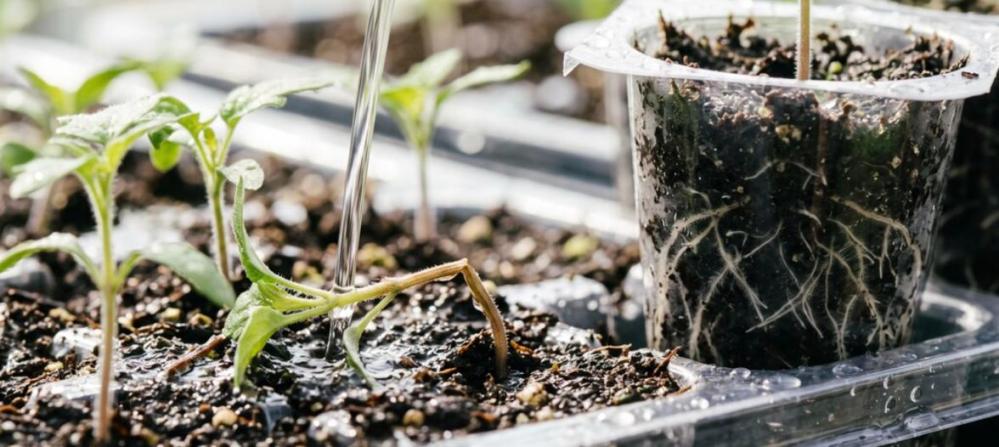

Hymexazol is a soil fungicide, applied as a drench or seed treatment to protect seedlings and transplants from the soil fungi that rot roots and make the stem collapse at soil level. It is strongest on Pythium and Fusarium and is one of the most widely used actives in nurseries.
This article explains how hymexazol works, which fungi it controls and how to drench it properly in trays and in the field.
- Group: isoxazoles, FRAC group 32.
- Type: systemic fungicide absorbed by roots, applied to the soil.
- Works on: Pythium, Fusarium and Aphanomyces in the soil.
- Weaker on: Rhizoctonia, which needs a second active if it is the problem.
- Common forms: soluble liquid (SL) at 30%.
How does hymexazol work?
It stops nucleic acid production in the fungal cells, halting the growth of fungal threads in the soil around the root. The root absorbs it and part of it moves inside the young plant, protecting the root zone and the base of the stem.
Manufacturers also report that it stimulates root growth, so the seedling develops a stronger root system.
Which problems does it control?
- Damping-off: before and after emergence, in nursery trays and direct sowing.
- Root rot: caused by Pythium in vegetables and cucurbits.
- Early Fusarium wilt: as a preventive for young transplants.
- Root diseases of beet and rice: as the label directs.
How to use it
1. In nursery trays
Drench the trays with the solution after sowing or with the first watering, so it wets the whole medium to root depth. With Tachigaren 30% SL, use 100–150 ml per 100 litres of water.
2. At transplanting in the field
Drench around the transplant right after planting, or add the dose to drip irrigation water in the first week.
3. Seed treatment
Some labels allow soaking or coating seeds before sowing. Stick to the stated concentration.
4. Do not wait for full wilting
Hymexazol is mainly preventive. A collapsed seedling will not recover; the benefit is stopping the spread to the rest.
Tips for a better result
- Reduce excess moisture. Pythium loves saturated soil, and overwatering wastes the fungicide's effect.
- Use a clean growing medium in trays instead of garden soil.
- If you suspect Rhizoctonia (dry brown rot at the stem), add an active that controls it as the label directs.
- Rotate with other groups effective on soil fungi, such as metalaxyl or propamocarb.
Safety
- Wear gloves and goggles.
- Keep it away from drinking water and kitchen utensils.
- Stick to the dose and pre-harvest interval on the label.
Products from Orkida
- Tachigaren 30% SL, 500 ml: hymexazol 30% for soil fungi and root rot.
- Higreen 300 SL, 1 litre: hymexazol 30% for root rot and damping-off.
- Terazol 300 SL, 1 litre: systemic hymexazol 30% for soil and root fungi.
- Chigazol 30% SL, 1 litre: hymexazol 30% for soil fungi and root rot.
Frequently asked questions
Is hymexazol sprayed on leaves?
No. It is a soil fungicide, used as a drench around roots, through irrigation water or as a seed treatment.
Does it work on all root rots?
It is strongest on Pythium, Fusarium and Aphanomyces. Rhizoctonia and Phytophthora need other actives.
How often do I apply it?
Usually once at sowing or transplanting, repeated as the label allows when conditions favour disease.
Does it harm young seedlings?
Not at the label dose; it is made for seedlings. A higher dose does not add protection.