
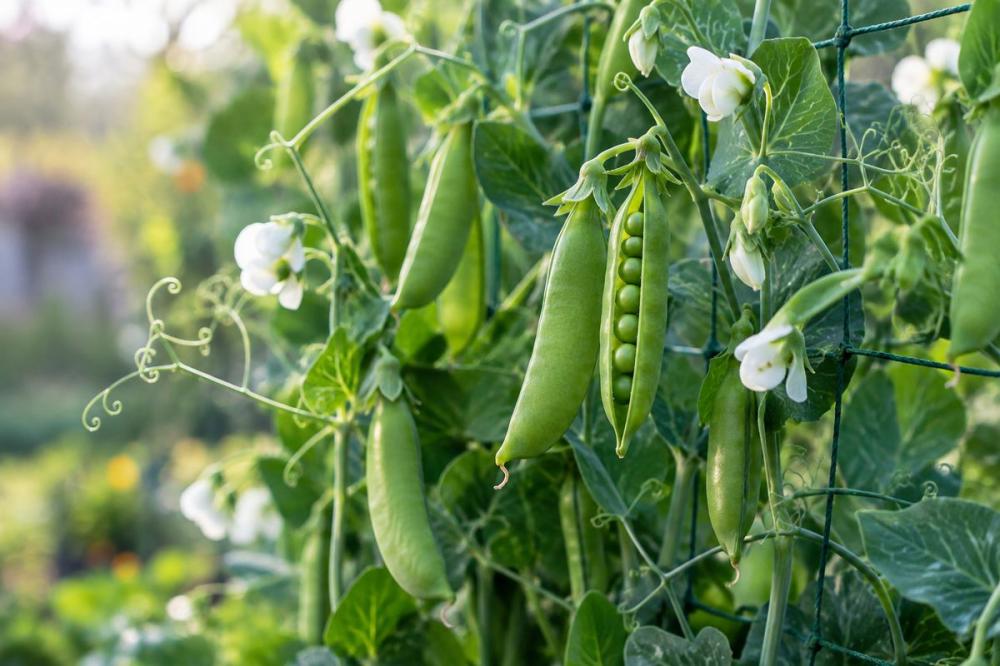

Peas are an easy winter vegetable, sown directly with no need for seedlings. They are also legumes, meaning their roots fix nitrogen from the air, so they need little nitrogen fertilizer and improve the soil for the next crop.
In this article we explain how to grow peas from seed step by step: the best time, depth and spacing, support, watering and feeding, and when to pick the pods.
Best time to grow peas
- Peas like cool, mild weather.
- Mild areas: in autumn.
- Areas with mild winters: from autumn to early winter.
- Avoid heat during growth: high temperatures stop flowering and make the peas tough.
How to grow peas step by step
1. Soil
- Well-drained soil, light to medium.
- No need for a lot of organic fertilizer; a moderate amount of compost is enough.
2. Sowing
- Sow seeds directly where they will grow.
- Depth: 3 to 4 cm.
- Spacing: 5 cm between seeds in the row and 60 cm between rows.
- Water moderately after sowing, without waterlogging, so the seeds do not rot.
3. Thinning
- If the plants come up crowded, thin them for balanced growth.
Support
- Most pea varieties climb with tendrils and benefit from support.
- Put up a net or strings about a metre high along the row.
- Benefits: clean pods, better airflow, fewer diseases and easier picking.
Watering peas
- Regular watering without waterlogging.
- The critical time: flowering and pod filling. Drought then reduces the number of peas in each pod.
- Do not wet the leaves, to limit powdery mildew.
Feeding peas
- Little nitrogen: peas fix their own, and extra nitrogen produces lots of leaves and few pods.
- Early growth: balanced 20-20-20 fertilizer at 1 g per litre, once or twice.
- At flowering: soluble potassium sulphate 0-0-50 sprayed at 2 to 3 g per litre, to improve pod filling.
When to pick peas
- The sign: the pod fills out and the peas inside reach a good size while it is still green and glossy.
- Usually two to two and a half months after sowing, depending on temperature.
- Pick regularly, every two to three days, as picking encourages the plant to keep flowering and producing.
- Do not leave it too late: pods that turn yellow have starchy, hard peas.
- Hold the stem with one hand and pick the pod with the other so you do not pull up the plant.
Common problems
White powder on the leaves
- Powdery mildew, common towards the end of the season and in humid conditions. Keep good airflow and water at the roots.
Big plants with few pods
- Cause: too much nitrogen, or heat during flowering.
Seeds did not come up
- Cause: heavy watering after sowing rotted the seeds, or sowing in very cold, waterlogged soil.
Small green insects on the tips
- Aphids. Spray potassium soap at 10 ml per litre.
Products from Orkida
- Lincoln Pea Seeds, 55 g: sow directly 3 to 4 cm deep; 5 cm between seeds; 60 cm between rows.
- Bavaria 20-20-20 Balanced Fertilizer, 2 kg: 1 g per litre in early growth.
- SAF 0-0-50 Soluble Potassium Sulphate, 1 kg: spray 2 to 3 g per litre at flowering.
- Plant Care Potassium Soap, 1 L: for aphids, 10 ml per litre.
Frequently Asked Questions
When should I plant peas?
From autumn to early winter, in cool, mild weather.
How deep should I sow peas?
3 to 4 cm deep, with 5 cm between seeds in the row.
Do peas need support?
Most varieties benefit from a net or strings about a metre high.
Do peas need nitrogen fertilizer?
Very little, because they fix nitrogen from the air through their roots.
When should I pick peas?
When the pod has filled out while still green and glossy, every two to three days.