
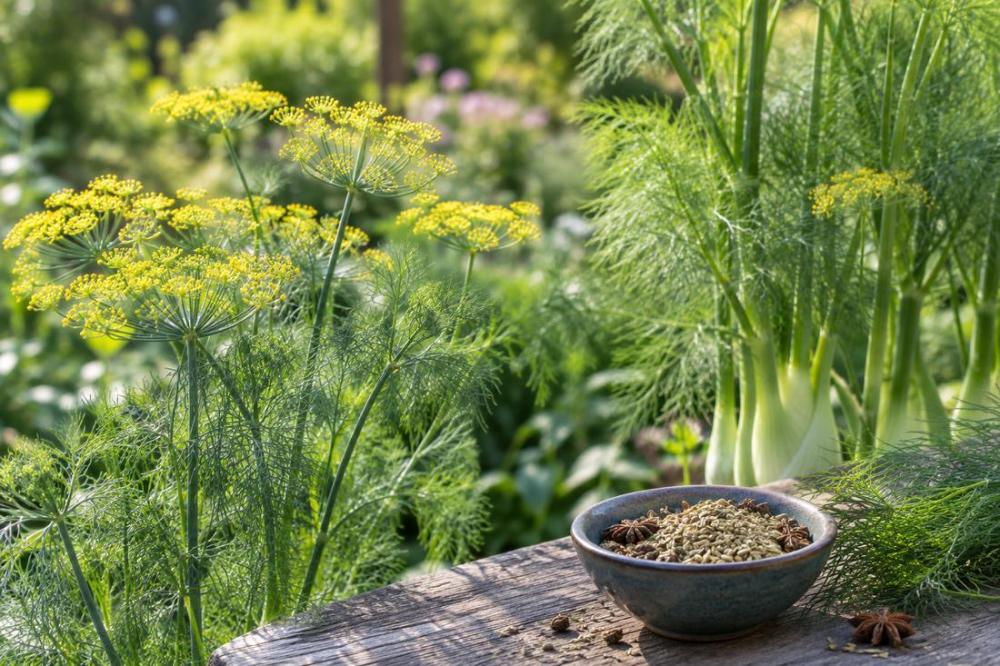

Dill, anise and fennel are aromatic herbs from the same family, and all three are sown directly from seed because they dislike transplanting. Dill is grown for its leaves, anise for its seeds, and fennel for both leaves and seeds.
In this article we explain how to grow dill, anise and fennel from seed: the best time, depth and spacing, watering, and when to cut the leaves or collect the seeds.
What all three have in common
- Direct sowing: they have taproots and dislike transplanting, so sow them where they will grow.
- Full sun and a well-ventilated spot.
- Light, well-drained soil.
- Regular weeding, because the seedlings are weak at first.
- Regular watering without waterlogging.
Growing dill
Timing
- In spring, or earlier when the weather is mild, avoiding high heat early in growth.
Method
- Depth: about 1 cm.
- Spacing: about 4 cm between plants and 30 cm between rows.
- Germination: quick when moisture and temperature are right.
Cutting
- Start cutting once the plant reaches a good size and the leaves are fully grown.
- Cut the leaves gradually as needed, which encourages new growth and extends the harvest.
- Protect the plant from strong wind, as its stems are thin.
Growing anise
Timing
- In a nursery bed: during March.
- Direct sowing in the field: during April and May.
- Mild weather is best for good germination and growth.
Method
- Depth: 1 to 2 cm.
- Spacing: about 30 × 30 cm.
- Keep the soil moist during germination without waterlogging.
Collecting the seeds
- Timing: from June to September depending on sowing date.
- The sign: when the flower heads turn yellow and the seeds are close to full maturity.
- Let the plants dry partially before collecting the seeds, for better quality and easier storage.
Growing fennel
Method
- Sow directly about 1 cm deep.
- Thinning: leave 20 to 30 cm between plants.
- Do not plant it next to dill, as they cross-pollinate and the flavour changes.
Harvest
- Leaves: cut gradually, like dill.
- Seeds: collect them when the heads dry and change colour.
Feeding
- Aromatic herbs do not need much fertilizer: too much reduces their aroma.
- Balanced 20-20-20 fertilizer at 1 g per litre every two weeks is enough, especially after cutting.
Common problems
The plant bolts quickly
- Causes: heat or drought. In dill this reduces the leaf harvest.
Weak, collapsing seedlings
- Causes: overwatering, weeds or sowing too deep.
Small green insects on the tips
- Aphids. Spray potassium soap at 10 ml per litre.
Products from Orkida
- Dill Seeds, 2 g: sow directly 1 cm deep; 4 cm between plants and 30 cm between rows; cut gradually.
- Anise Seeds, 2 g: 1 to 2 cm deep; 30 × 30 cm spacing; collect seeds from June to September.
- Wild Fennel Seeds (Otus), 1 g: for home gardens; sow directly and thin to 20 to 30 cm.
- Bavaria 20-20-20 Balanced Fertilizer, 2 kg: 1 g per litre every two weeks.
- Plant Care Potassium Soap, 1 L: for aphids, 10 ml per litre.
Frequently Asked Questions
Should I transplant dill and anise?
Direct sowing is best, because their taproots dislike transplanting. Anise can be started in a nursery bed and moved carefully.
When should I collect anise seeds?
When the flower heads turn yellow and the seeds are nearly mature, usually from June to September.
Can I plant dill and fennel next to each other?
Better not, as they cross-pollinate and the flavour changes.
How do I cut dill so it keeps growing?
Cut the leaves gradually as needed, and do not remove the whole plant.
Do aromatic herbs need a lot of fertilizer?
No, too much fertilizer reduces the aroma. A light feed every two weeks is enough.