
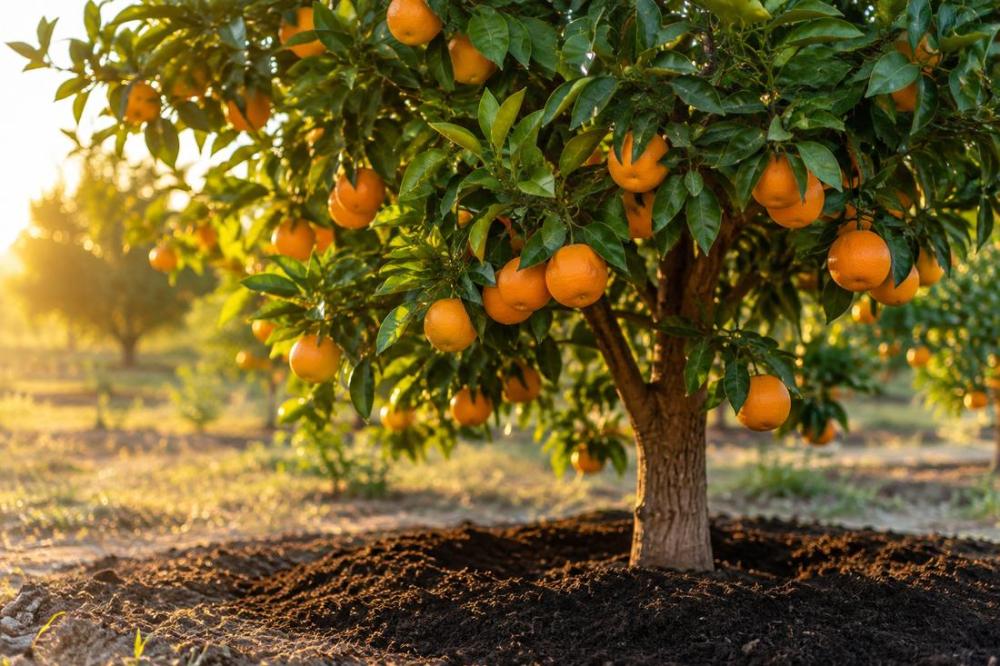

A fruit tree needs different food in each season: organic matter to build the soil, nitrogen during growth, phosphorus before flowering, calcium and boron at fruit set, and potassium while the fruit sizes up. Give it the same fertilizer all year and you get lots of leaves and little fruit.
In this article we give you a yearly feeding programme for fruit trees such as citrus, grapes, pomegranates, figs and mangoes, with rates and the correct way to apply fertilizer under the tree.
How to apply fertilizer under a tree correctly
- Spread fertilizer at the edge of the canopy (under the branch tips), where the feeder roots are, not against the trunk.
- Water before and after feeding, so roots do not burn and the fertilizer moves down to the root zone.
- Split fertilizer into several applications instead of one large dose.
Stage one: winter and before growth starts
- Well-rotted organic manure: 5 to 15 kg per tree depending on age and size, mixed into the soil under the tree and watered in.
- Repeat every 2 to 3 months as the tree needs.
- Benefit: improves soil structure and water holding and feeds the tree gradually.
Stage two: start of vegetative growth
- Support new growth with a fertilizer containing amino acids plus macro and micronutrients such as Codafol Maximus: spray 3 to 4 ml per litre of water.
- Treat iron yellowing in alkaline soils with chelated iron: 2 to 3 kg per hectare with irrigation water as soon as yellowing between the veins appears.
Stage three: before flowering
- Phosphoric acid: 100 ml per tree with irrigation water every two weeks, to strengthen roots and improve flowering and fruit set.
- Do not overdo nitrogen at this stage, so leaves do not grow at the expense of flowers.
Stage four: fruit set
- Calcium and boron are the two most important nutrients for holding fruit set and reducing small-fruit drop.
- Calborn Plus: spray 2 ml per litre.
- Or Codacal Boro: spray 2 to 3 ml per litre every 15 to 20 days.
Stage five: fruit sizing
- A high-potassium fertilizer raises fruit size, sweetness and colour.
- Fert Drip 10-10-40: 50 to 100 g per tree with irrigation water depending on age and size, or spray 2 to 3 g per litre.
- Or potassium sulphate 0-0-50: spray 2 to 3 g per litre.
Stage six: after harvest
- Apply organic manure again so the tree recovers what it spent on the crop and prepares for next season.
- This is the best time to prune citrus and remove dead branches.
Mistakes that cost tree yields
- Fertilizer against the trunk: burns the trunk and the roots cannot use it.
- Too much nitrogen at flowering: strong leafy growth and few flowers.
- Feeding dry soil: burns the roots; water first.
- Mixing iron or calcium with phosphates in the same tank: it precipitates and the plant cannot use it.
- Ignoring drought at fruit set: small fruit drops even when feeding is right.
Products from Orkida
- Black Cow Organic Cow Manure, 25 kg: 5 to 15 kg per tree, repeated every 2 to 3 months.
- Codafol Maximus, 1 L: amino acids plus macro and micronutrients, spray 3 to 4 ml per litre for trees.
- Agis Chelated Iron 6%: for iron-deficiency yellowing, 2 to 3 kg per hectare with irrigation.
- Al-Takamol Phosphoric Acid 85%: 100 ml per tree with irrigation every two weeks.
- Calborn Plus: calcium and boron, spray 2 ml per litre at fruit set.
- Fert Drip 10-10-40: for fruit sizing, 50 to 100 g per tree with irrigation.
- SAF 0-0-50 Soluble Potassium Sulphate: spray 2 to 3 g per litre during fruit sizing.
Frequently Asked Questions
When should I fertilize fruit trees?
Organic in winter and after harvest, nitrogen at the start of growth, phosphorus before flowering, calcium and boron at fruit set, and potassium during fruit sizing.
How many kilos of organic manure per tree?
5 to 15 kg depending on the tree's age and size.
Where do I put the fertilizer?
Under the branch tips, not against the trunk, and water before and after.
Why does my tree flower but not set fruit?
Usually a shortage of calcium and boron, drought, or too much nitrogen at flowering.
How do I treat yellow citrus leaves?
If yellowing is between the veins on new leaves, it is usually iron deficiency, treated with chelated iron through irrigation.
Read next
- Best Fertilizer to Increase Yield: A Feeding Programme by Plant Stage
- Cow Manure: Treated vs Untreated, How to Use It and How Much
- Plant Micronutrients: What They Do, Types and How to Apply Them
- Pomegranate Tree Care: Feeding, Fruit Splitting and the Fruit Borer
- Avocado Tree Care: Planting and Why It Is Not Fruiting