
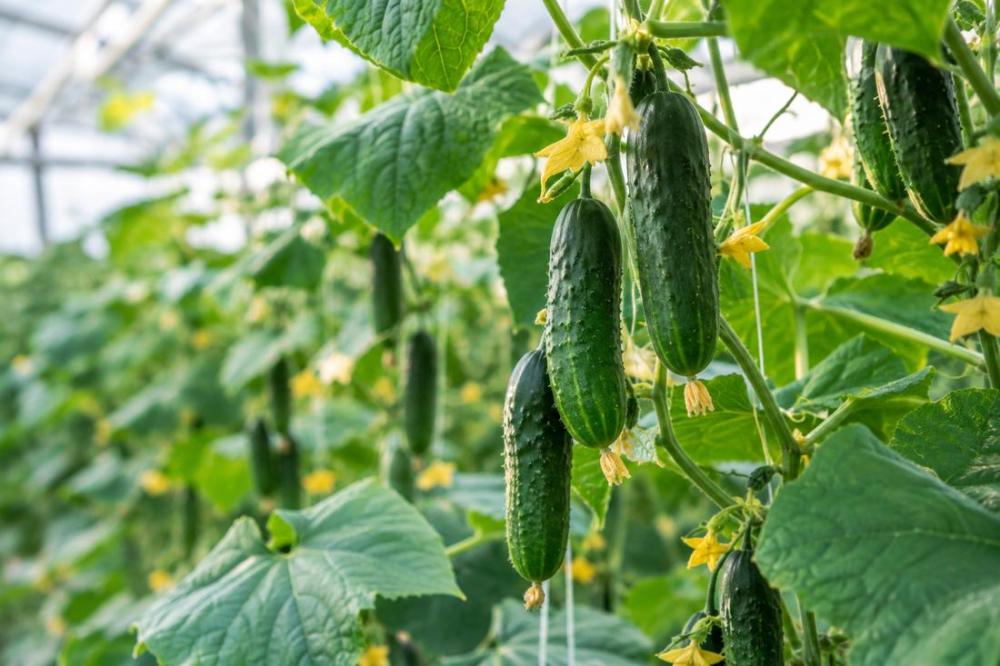

Cucumbers, courgettes, watermelon and melons all belong to the cucurbit family and share almost the same diseases: powdery mildew, downy mildew, angular leaf spot, root rots and insect-borne viruses. The difference between a good crop and a lost one is usually recognising the disease at the first sign.
In this article we explain the most common cucumber and cucurbit diseases, how to tell them apart, treatment with rates, and a prevention programme.
Powdery mildew
Symptoms
- White, powdery spots on the upper leaf surface that spread until they cover the whole leaf.
- Leaves yellow and dry, and fruit is smaller and lower in quality.
- Spreads in dry weather with mild temperatures and night humidity.
Treatment
- Vivando 50 SC: 20 to 25 ml per 100 litres of water at the first symptoms. Pre-harvest interval 7 days.
- Or Gatin 5% EC: 0.2 ml per litre of water as a foliar spray covering both leaf surfaces.
- Rotate products from different groups to avoid resistance.
Downy mildew
Symptoms
- Angular yellow spots on top of the leaf bounded by the veins.
- Grey or purple fuzz under the leaf, especially in the morning.
- Spreads fast with high humidity, dew and poor air flow.
Treatment
- Pirastak 45 SC: 50 ml per 100 litres of water for cucumbers. Pre-harvest interval 28 days.
- Or Vacomil Forte 65% WP: 225 g per 100 litres of water for cucurbits.
- Or Azox 250 SC: 80 to 100 ml per 100 litres of water for cucumbers, watermelon and melon, repeated every 10 to 14 days.
Bacterial angular leaf spot
- Water-soaked angular spots that turn brown; the tissue drops out, leaving holes in the leaf.
- Preventive copper treatment: Exide 77 at 1.5 to 2 g per litre of water for cucumbers and melons, or Cuproxide 77 at 200 g per 100 litres for cucurbits.
- Do not work in the field while leaves are wet, so you do not spread the bacteria.
Root rots and damping-off
- Seedlings wilt and collapse at the soil surface, and larger plants wilt at midday despite watering.
- Treatment: Chigazol 30% at 1 to 2 ml per litre of water with irrigation around the roots.
- Prevention: good drainage, no overwatering, and disinfecting trays before raising seedlings.
Viruses (leaf curl and yellowing)
- Leaves curl and mottle yellow and green, and growth is stunted.
- There is no direct cure; viruses are spread by whitefly, aphids and thrips, so the answer is controlling the vector.
- Imidor 350 SC: 15 to 30 ml per 100 litres of water for aphids, whitefly and thrips on protected vegetables. Pre-harvest interval 3 days.
- Pull out badly infected plants and remove them from the field.
Root-knot nematodes
- Midday wilting and general weakness, with clear galls on the roots.
- Velum Prime 400 SC: 2 to 3 ml per litre of water with irrigation around the roots, at planting or the start of growth.
A short prevention programme
- Good air flow: proper spacing and trellising cucumbers.
- Drip irrigation instead of sprinklers, and watering in the morning.
- Preventive spraying as conditions favour disease (humidity and dew).
- Remove infected leaves and crop debris after harvest.
- Rotate crops and do not plant cucurbits in the same spot every season.
Products from Orkida
- Vivando 50 SC: for powdery mildew, 20 to 25 ml per 100 litres for cucumbers and courgettes.
- Gatin 5% EC: for powdery mildew, 0.2 ml per litre.
- Pirastak 45 SC: for downy mildew, 50 ml per 100 litres.
- Vacomil Forte 65% WP: for downy mildew and bacterial spot, 225 g per 100 litres.
- Azox 250 SC: for downy and powdery mildew, 80 to 100 ml per 100 litres.
- Exide 77 WP: copper for angular leaf spot and downy mildew, 1.5 to 2 g per litre.
- Chigazol 30% SL: for root rot and damping-off, 1 to 2 ml per litre with irrigation.
- Imidor 350 SC: for virus-carrying insects, 15 to 30 ml per 100 litres.
- Velum Prime 400 SC: for nematodes, 2 to 3 ml per litre with irrigation.
Frequently Asked Questions
What is the difference between powdery and downy mildew on cucumbers?
Powdery mildew is white powder on top of the leaf; downy mildew is angular yellow spots on top with grey fuzz underneath.
Why are my cucumber leaves turning yellow?
Possibly downy mildew, a nutrient shortage, overwatering suffocating the roots, or a virus if the leaves also curl.
Can a virus be cured?
No; control the whitefly, aphids and thrips that spread it and remove infected plants.
When should I spray a fungicide?
Preventively as humidity and dew begin, or at the first symptoms, early in the morning or late afternoon.
Is the same treatment used for courgettes and watermelon?
Yes, cucurbits share the same diseases, but check the pre-harvest interval for each crop.