
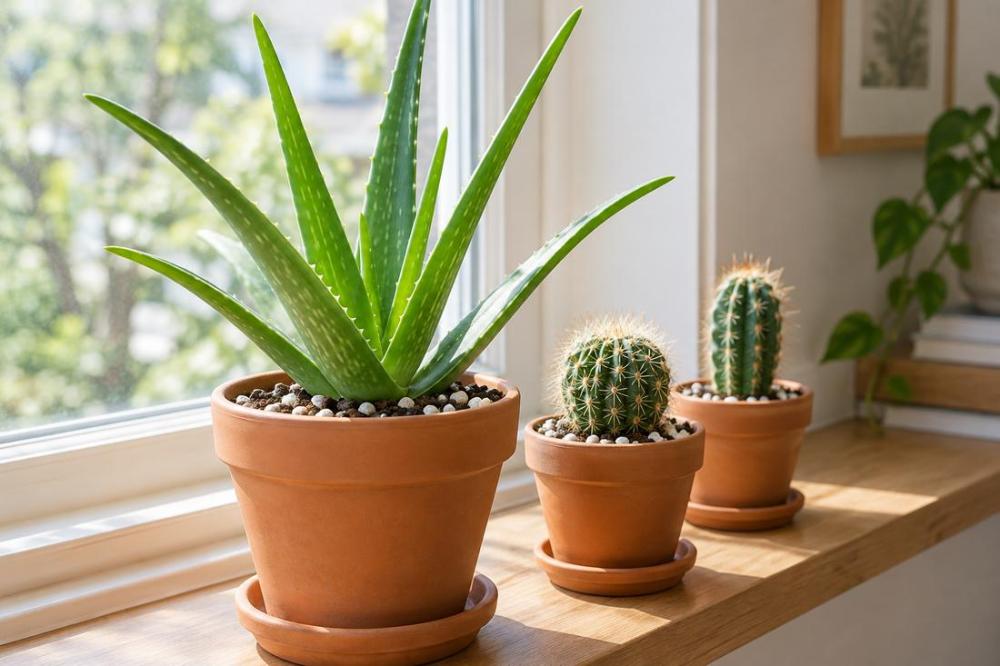

Cacti and aloe vera are among the easiest houseplants, yet many of them die, and the reason is usually one thing: too much love with water. Cacti are used to drought, and heavy watering rots their roots fast. There are other problems too, such as leaves falling and thinning, and white clumps between the leaves.
In this article we explain how to care for cacti and aloe vera, from watering, soil and light to treating root rot and mealybugs, with rates.
Watering cacti and aloe vera correctly
- The golden rule: only water when the soil is completely dry.
- In summer: usually once every one to two weeks depending on heat and pot size.
- In winter: once every 3 to 4 weeks or less.
- Water the soil, not the leaves, and never leave water in the heart of an aloe.
- Always empty the saucer after watering.
Soil and pot
- Light, fast-draining soil: mix potting soil with agricultural perlite at roughly a third to a half.
- A pot with drainage holes is a must, and terracotta is better because it breathes.
- Do not choose a pot that is too big for the plant, because extra soil holds excess water.
Light
- Cacti like direct sun or very strong light.
- Aloe vera likes strong light, and sudden scorching sun turns its leaves red.
- If the plant is getting thin, tall and leaning, it is searching for light, so move it closer to a brighter window.
Cactus root rot
- The sign: a soft brown base, wilting or falling leaves, and a rotten smell from the soil.
- First step: take the plant out of the pot and cut off soft brown roots and parts with clean scissors.
- Let it dry in the shade for one to two days, then replant in fresh dry soil mixed with perlite.
- Treatment: Hygreen 300 SL at 2.5 ml per litre of water as a soil drench, then do not water until fully dry.
- If the rot has reached the whole stem: take healthy leaves or offsets and replant them.
Mealybugs on cacti
- The sign: white cottony clumps between the leaves, at the base, and sometimes on the roots.
- For light infestations: potassium soap at 10 ml per litre of water sprayed directly on the clumps.
- For heavy infestations: Imidaprid 200 SL at 1 ml per litre of water.
- Check the roots when repotting, because mealybugs can hide there.
Fertilizing cacti and aloe vera
- Light feeding during growth only (spring and summer): balanced 10-10-10 liquid fertilizer at 3 ml per litre of water once a month.
- Do not fertilize in winter or straight after repotting.
- Too much fertilizer gives soft, weak growth that rots quickly.
Products from Orkida
- AGROLITE agricultural perlite, 100 L: lightens the soil and improves drainage.
- Hygreen 300 SL, 500 ml: for root rot, 2.5 ml per litre as a soil drench.
- Plant Care potassium soap, 1 L: for light mealybug infestations, 10 ml per litre.
- Imidaprid 200 SL, 250 ml: for heavy mealybug infestations, 1 ml per litre.
- Balanced 10-10-10 liquid fertilizer, 1 L: 3 ml per litre once a month during growth.
Frequently Asked Questions
How often should I water a cactus?
When the soil is completely dry, usually every one to two weeks in summer, and much less in winter.
Why is my aloe vera dropping leaves and going soft?
Usually overwatering and the start of root rot. Stop watering, check the roots, and change the soil if needed.
Why is my cactus growing tall and leaning?
It is searching for light. Move it closer to a brighter window.
What is the white stuff between cactus leaves?
That is mealybug, treated with potassium soap for light infestations or a systemic spray for heavy ones.