
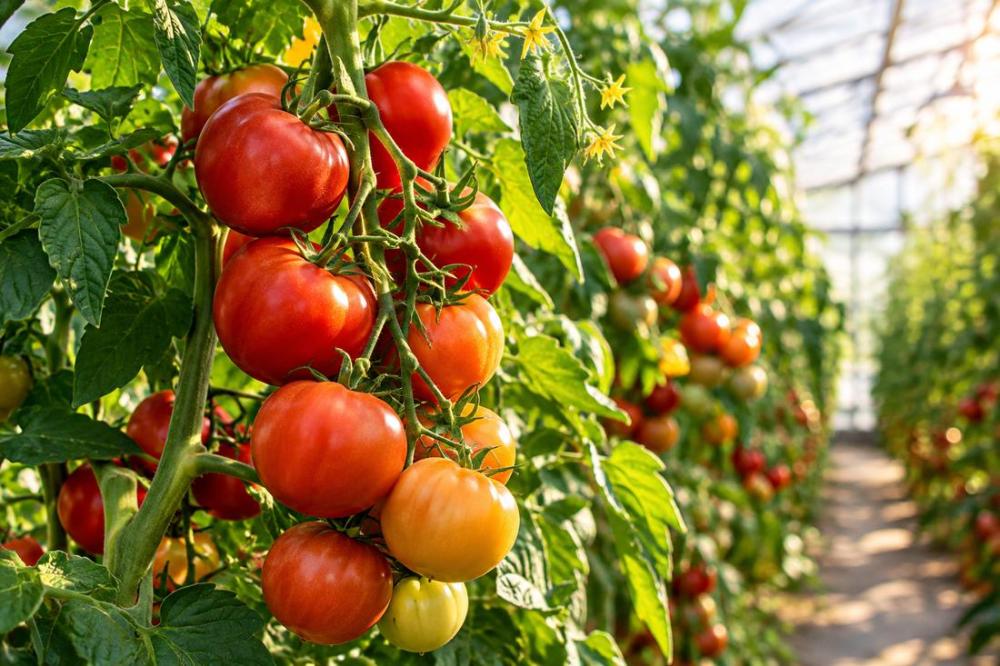

No single fertilizer increases yield on its own. What really raises the harvest is giving the plant the nutrient it needs at each stage: nitrogen during growth, phosphorus at flowering, calcium and boron at fruit set, and potassium while the fruit sizes up.
In this article we explain the best fertilizer for higher yield in vegetables and trees, stage by stage, with rates, and the mistakes that cost you the crop.
Why fertilize by stage?
- Each stage has a different need: a flowering plant does not need the same fertilizer it needed as a seedling.
- Too much nitrogen at flowering produces many leaves and few flowers.
- Potassium while fruit sizes up raises weight, sweetness and firmness.
Stage one: vegetative growth
- Goal: strong roots and healthy foliage that can carry a crop.
- Balanced 20-20-20 fertilizer: 1 to 2 g per litre as a spray or through irrigation every 10 to 14 days.
- A root stimulant after transplanting helps seedlings establish faster.
Stage two: before and at the start of flowering
- Goal: more and stronger flowers.
- High-phosphorus fertilizer supports flowering and roots.
- Seaweed extract: spray 2 to 3 ml per litre at the start of flowering, as it improves flowering and fruit set and strengthens the plant against heat.
Stage three: fruit set
- Goal: flowers turning into fruit instead of dropping.
- Calcium and boron: the two most important nutrients at this stage.
- Calborn Plus: spray 2 ml per litre.
- Or Codacal Boro: spray 2 to 3 ml per litre every 15 to 20 days.
Stage four: fruit sizing
- Goal: bigger, heavier fruit of higher quality.
- Soluble potassium sulphate 0-0-50: spray 2 to 3 g per litre.
- Reduce nitrogen at this stage.
A complete fertilizer for all stages
- A liquid fertilizer with amino acids plus macro and micronutrients, such as Codafol Maximus, works as general support:
- Vegetables (tomatoes, peppers, cucumbers): 2 to 3 ml per litre.
- Fruit trees (grapes, citrus, mango): 3 to 4 ml per litre.
Mistakes that cost you the crop
- Too much nitrogen at flowering: dense leaves and little fruit.
- Drought at fruit set: flowers and small fruit drop.
- Spraying fertilizer at midday: burns the leaves. Spray early morning or late afternoon.
- Mixing calcium with phosphates or sulphates in the same tank: it precipitates and the plant cannot use it.
- Ignoring micronutrient deficiency: yellowing between the veins means a shortage of iron, magnesium or zinc.
Products from Orkida
- Bavaria 20-20-20 Balanced Fertilizer, 2 kg: for vegetative growth, 1 to 2 g per litre.
- Acadian Seaweed Liquid Fertilizer, 1 L: spray 2 to 3 ml per litre at the start of flowering and fruit set.
- Calborn Plus: calcium and boron, spray 2 ml per litre at fruit set.
- Codacal Boro, 1 L: calcium and boron for firm fruit, 2 to 3 ml per litre every 15 to 20 days.
- SAF 0-0-50 Soluble Potassium Sulphate, 1 kg: for fruit sizing, spray 2 to 3 g per litre.
- Codafol Maximus, 1 L: amino acids plus macro and micronutrients, 2 to 3 ml per litre for vegetables and 3 to 4 ml for trees.
Frequently Asked Questions
What is the best fertilizer to increase yield?
There is no single one; the best is a programme: balanced during growth, then phosphorus and seaweed at flowering, then calcium and boron at fruit set, then potassium for fruit sizing.
When should I give potassium?
From the start of fruit formation and throughout fruit sizing.
Why do flowers drop without setting fruit?
Usually a shortage of calcium and boron, drought, intense heat or too much nitrogen.
Should I spray fertilizer or add it through irrigation?
The base goes in through irrigation, while foliar spraying gives a quick boost of micronutrients, calcium and boron.
When should I spray foliar fertilizer?
Early morning or late afternoon, avoiding midday heat.