
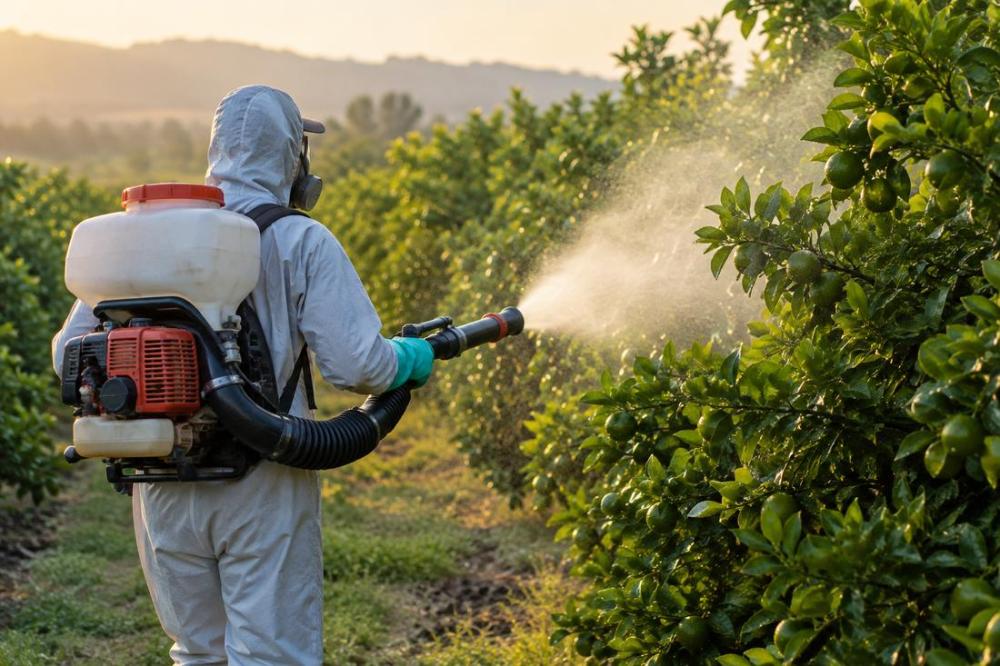

When the area is large, such as a farm, a rest house, a big garden or a row of trees, a hand or battery sprayer takes hours. This is where a backpack mist blower comes in: a petrol machine worn on the back, with a powerful fan that turns the spray solution into a fine mist and pushes it up to 18 metres.
In this article we explain what a backpack mist blower is, when to use it instead of a sprayer or a fogging machine, how to prepare the fuel, run it and clean it, and the differences between the models we stock.
What is a backpack mist blower and how does it work?
- A two-stroke petrol engine drives a powerful air fan.
- The solution flows from the tank to the nozzle, and the air stream breaks it into fine droplets and carries them far.
- The mist penetrates between tree leaves and covers both sides better than an ordinary sprayer.
- It needs no electricity, so it works anywhere outdoors.
When to use it instead of a sprayer or a fogger
Use a backpack mist blower when
- You need to spray tall trees or rows of trees and young palms, as the vertical reach goes up to 16 metres on some models.
- The area is large and a hand sprayer takes too long.
- You want to apply an insecticide or fungicide to crops and trees, or treat mosquitoes and flies in gardens, rest houses and camps.
An ordinary sprayer is better when
- The area is small or you need precise spot treatment, such as wall cracks or around the house.
A fogging machine is better when
- You want a quick knock-down of flying insects in the air at dawn or dusk, without spraying surfaces and leaves.
Quick comparison of the models
Cifarelli M1200 (Italian)
- 77 cc engine, 5 hp.
- 17-litre liquid tank and 2.3-litre fuel tank.
- Horizontal reach up to 18 metres and vertical up to 16 metres.
- Average droplet size 90 microns, with 9-step flow control.
- Empty weight 11.5 kg, convertible to ULV with an optional nozzle.
IGEBA PORT 423 (German)
- 72.3 cc engine, 4.1 hp.
- 14-litre UV-protected liquid tank and 1.2-litre fuel tank.
- Horizontal reach up to 12 metres.
- Wide 150 mm filling opening for easy filling and cleaning.
- Empty weight about 12 kg, accepts an optional ULV nozzle.
STIHL SR420 (German)
- 56.5 cc engine and 13-litre tank.
- Spray reach up to 12 metres.
- Weight 11.1 kg, supports an optional ULV nozzle.
STIHL SR200
- 27.2 cc engine and 8.5 kg weight, the lightest of the models.
- Spray reach up to 9 metres.
- Suited to gardens and small to medium farms.
Preparing the fuel
- Use 91 or 95 petrol with two-stroke (2T) engine oil.
- Mixing ratio for the Cifarelli and IGEBA: 40 ml of oil per 1 litre of petrol.
- Example: 5 litres of petrol + 200 ml of 2T oil.
- Mix in a separate jerrycan and shake well before pouring into the fuel tank.
- Never run a two-stroke engine on petrol without oil; it will damage the engine.
What goes in the liquid tank?
- For mosquitoes and flies in gardens and rest houses: Demon Max at 4 ml per litre of water for light infestations and 8 ml per litre for heavy ones.
- Or Deltafly 25 SC: 25 ml per 5 litres of water.
- For trees and crops: use the agricultural product suited to the pest at its normal rate in water.
- Strain the solution before filling so the nozzle does not clog.
How to start and spray
- Close the fuel tank and liquid tank caps tightly.
- Start the engine with the pull cord.
- Set the air power and flow rate to suit the area and the target.
- Walk at a steady pace and aim the nozzle at the target area, keeping the wind behind you or to your side.
- Spray early in the morning or in the evening when it is calm, because strong wind carries the mist away.
Safety while spraying
- Wear a mask, goggles and gloves and long-sleeved clothing.
- Never spray into the wind.
- Keep people and animals away from the area until the spray has dried.
- Do not refuel while the engine is hot or near a flame.
Cleaning after use
- Empty the liquid tank and rinse it with clean water, then run the machine briefly on water to flush the hoses and nozzle.
- Do not leave fuel in the machine for long periods.
- Store it in a dry place out of the sun.
Common mistakes
- Running the engine on petrol without 2T oil.
- Spraying at midday in strong wind: half the solution is lost.
- Walking too fast: coverage is incomplete.
- Storing the machine with solution inside: the nozzle and hoses clog.
Products from Orkida
- Cifarelli M1200 Mist Blower, 17 litres: 5 hp, reach up to 18 metres.
- IGEBA PORT 423 Mist Blower, 14 litres: German, reach up to 12 metres.
- STIHL SR420 Sprayer: 13-litre tank, reach up to 12 metres.
- STIHL SR200 Sprayer: lightweight at 8.5 kg, reach up to 9 metres.
- Demon Max EC: 4 to 8 ml per litre of water for mosquitoes and flies.
- Deltafly 25 SC: 25 ml per 5 litres of water.
Frequently Asked Questions
What is the difference between a mist blower and an ordinary sprayer?
A mist blower has a fan that pushes the spray 12 to 18 metres and covers tall trees quickly; an ordinary sprayer is for small areas and precise spraying.
How much oil do I add to the petrol?
For the Cifarelli and IGEBA: 40 ml of 2T oil per litre of 91 or 95 petrol.
Can a mist blower be used for mosquitoes?
Yes, it is used to treat mosquitoes and flies in gardens, rest houses and camps, ideally early in the morning or in the evening.
Can I convert it to a ULV machine?
The Cifarelli, IGEBA PORT 423 and STIHL SR420 accept an optional ULV nozzle.
How far does it spray?
Up to 18 metres horizontally on the Cifarelli, 12 metres on the IGEBA and SR420, and 9 metres on the SR200.