
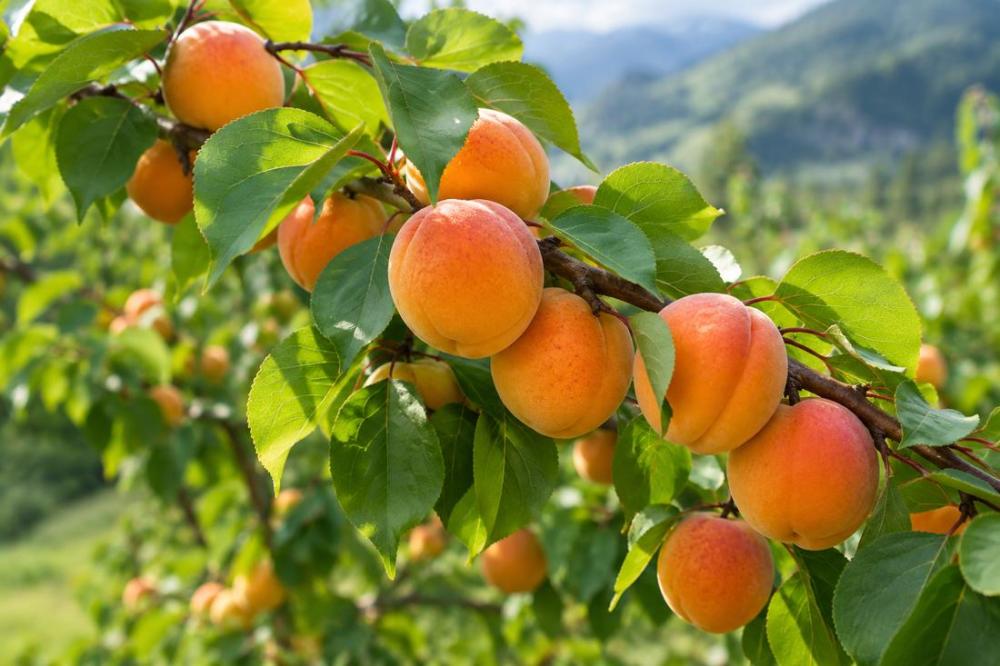

Apricot is a tree people love on farms and in homes in mild and highland areas, but it is more sensitive than most. Its best-known problems are a gummy substance oozing from the trunk and branches, curled leaves with insects inside, white powder, and in some years lots of flowers but no fruit.
In this article we explain how to care for an apricot tree, how to treat gummosis, aphids and powdery mildew, and why fruit can be scarce, with rates.
A quick look at apricot
- It needs winter chill to flower properly, so in hot areas choose low-chill varieties.
- It flowers early at the end of winter, so frost or strong wind during flowering reduces fruit set.
- It does not like standing water around the trunk, as this causes root rot and gummosis.
- It fruits on short spurs one to three years old.
Gummosis in apricot (gum on the trunk)
- The sign: a clear or brown gummy substance oozing from the trunk or branches, sometimes with dead bark underneath.
- The causes: pruning or machinery wounds, overwatering around the trunk, fungi entering through wounds, and stress from drought or heat.
Treating gummosis
- Clean the affected area: remove the gum and dead bark until you reach healthy tissue.
- Spray a copper fungicide, Armitel C at 2.5 g per litre of water, on the trunk and branches after cleaning and after pruning.
- Keep water away from the trunk and make the watering basin under the outer edge of the branches.
- Disinfect the shears between trees.
Aphids on apricot
- The sign: curled, crinkled new leaves with small green or black insects inside, and sticky honeydew.
- Treatment: Imidaprid 200 SL at 1 ml per litre of water (100 ml per 100 litres) as soon as curling starts.
Powdery mildew
- The sign: white powder on the leaves, tips and young fruit.
- Treatment: micronized sulfur at 2 g per litre of water, in mild temperatures.
Why does apricot flower but not fruit?
- Not enough winter chill for the variety planted.
- Frost or strong wind during flowering.
- Spraying during flowering drives away the bees that help with pollination.
- Drought or a lack of calcium and boron at fruit set.
Fertilizing and pruning
- Well-rotted organic manure in winter: 5 to 15 kg per tree.
- Phosphoric acid before flowering: 100 ml per tree with irrigation water every two weeks, to strengthen roots and flowering.
- Pruning: in winter, remove dead, infected and crossing branches, and open the centre so sun can get in.
- Thin the fruit if the set is very heavy, so the rest grows bigger and branches do not break.
Products from Orkida
- Armitel C copper fungicide: for gummosis and after pruning, 2.5 g per litre.
- Imidaprid 200 SL, 250 ml: for aphids, 1 ml per litre.
- Cosavet micronized sulfur, 1 kg: for powdery mildew, 2 g per litre.
- Al Takamol phosphoric acid 85%: 100 ml per tree with irrigation every two weeks.
- Black Cow organic cow manure, 25 kg: 5 to 15 kg per tree.
- Samurai pruning shears, model 1002: for clean branch cuts.
Frequently Asked Questions
What is the gum coming out of my apricot tree?
That is gummosis, caused by wounds, overwatering around the trunk or fungi. Clean the area, spray a copper fungicide and keep water away from the trunk.
Why are my apricot leaves curling?
Usually aphids, treated with a systemic spray as soon as curling starts.
Why does my apricot flower but not fruit?
Not enough winter chill for the variety, frost and wind during flowering, or drought at fruit set.
When should I prune apricot?
In winter while the tree is dormant.