
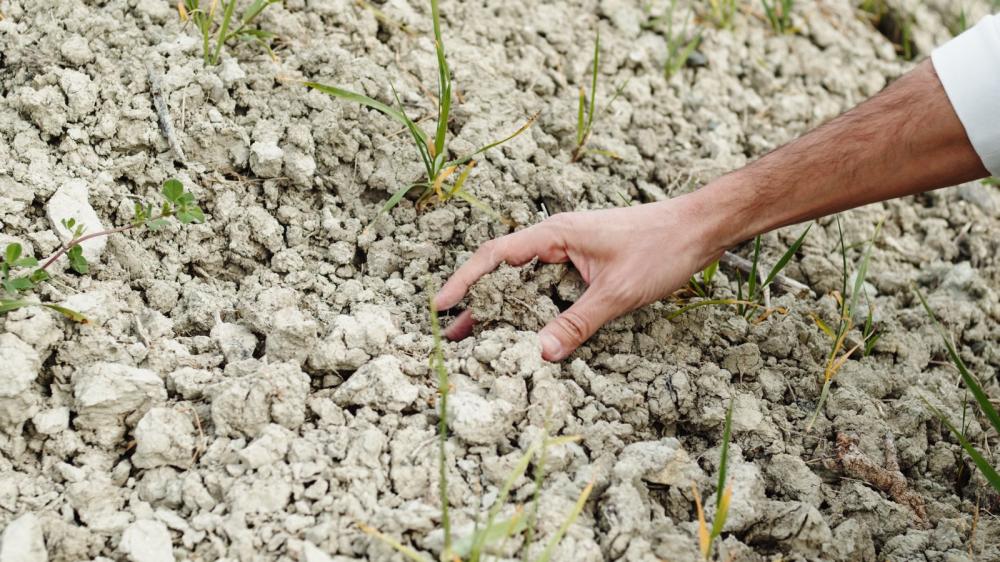

Agricultural gypsum is one of the most important soil improvers in our region, because much of the land and irrigation water carries salts and high sodium. Sodium makes soil compact and seals its pores, so water cannot reach the roots and plants struggle even when well fertilised.
Agricultural gypsum is calcium sulphate, and the idea is simple: calcium pushes sodium off the soil particles, and water then washes it away from the roots.
Benefits of agricultural gypsum
- Treats sodic and saline soil: calcium replaces sodium, which is leached down with irrigation.
- Improves water and air infiltration: the soil loosens instead of forming a hard surface crust.
- Reduces hardening of heavy clay soils.
- Supplies calcium and sulphur: two nutrients important for strong roots and fruit quality.
- Makes fertilisers work better: because roots grow in healthier soil.
When do you need gypsum?
- When water pools on the surface and drains slowly.
- When a white or black crust forms on the soil surface.
- When irrigation water is saline or high in sodium, or you use well water.
- When a soil test shows high exchangeable sodium.
- With trees and palms whose leaf tips are scorched by salinity.
The most accurate way to know is a soil and water test, especially on larger plots.
How much gypsum to apply
From the Global Gypsum agricultural gypsum label:
- Rate: 0.8 to 2 kg per square metre depending on salinity and soil type.
- Very saline land: split the dose into two applications with an irrigation between them.
- Repeat: every 4 to 6 months on salt-affected land.
How to apply agricultural gypsum
- Spread it evenly over the soil surface.
- Work it into the topsoil to a suitable depth.
- Irrigate straight after so it dissolves and moves into the soil.
- Best timing: before planting or during land preparation, or after planting if salinity symptoms appear.
- Regular irrigation afterwards is essential: gypsum releases sodium, and water carries it away from the roots.
Gypsum vs agricultural sulphur
- Gypsum: treats sodium and salinity and improves soil structure, with little effect on pH.
- Sulphur: slowly lowers pH in alkaline soil and helps release iron, zinc and phosphorus.
On land that is both alkaline and saline, growers often use both in one programme based on a soil test.
Common gypsum mistakes
- Applying it without enough irrigation: sodium is released but stays around the roots.
- Mixing it directly with phosphate fertilisers: calcium binds phosphorus and reduces its availability. Apply them separately.
- Relying on it alone: poor sandy soils also need organic matter such as cow manure and humic acid.
- Light irrigation with saline water afterwards: it re-concentrates salts instead of leaching them.
Products from Orkida
- Agricultural gypsum for soil salinity, 25 kg
- Humic Total potassium humate, 25 kg
- Codasal soil salinity treatment by Coda
- Granular agricultural sulphur, 25 kg
Agricultural gypsum FAQs
Does gypsum increase salinity?
No. Gypsum itself dissolves slowly, and its role is to displace sodium so irrigation can wash it out, so the soil improves.
Is gypsum suitable for date palms?
Yes, especially on farms irrigated with saline well water, followed by regular irrigation.
Is gypsum a fertiliser?
It is more a soil improver than a fertiliser, though it does supply calcium and sulphur.
How soon does gypsum work?
Better drainage shows within weeks of application and irrigation; full improvement needs repeat treatments depending on salinity.