
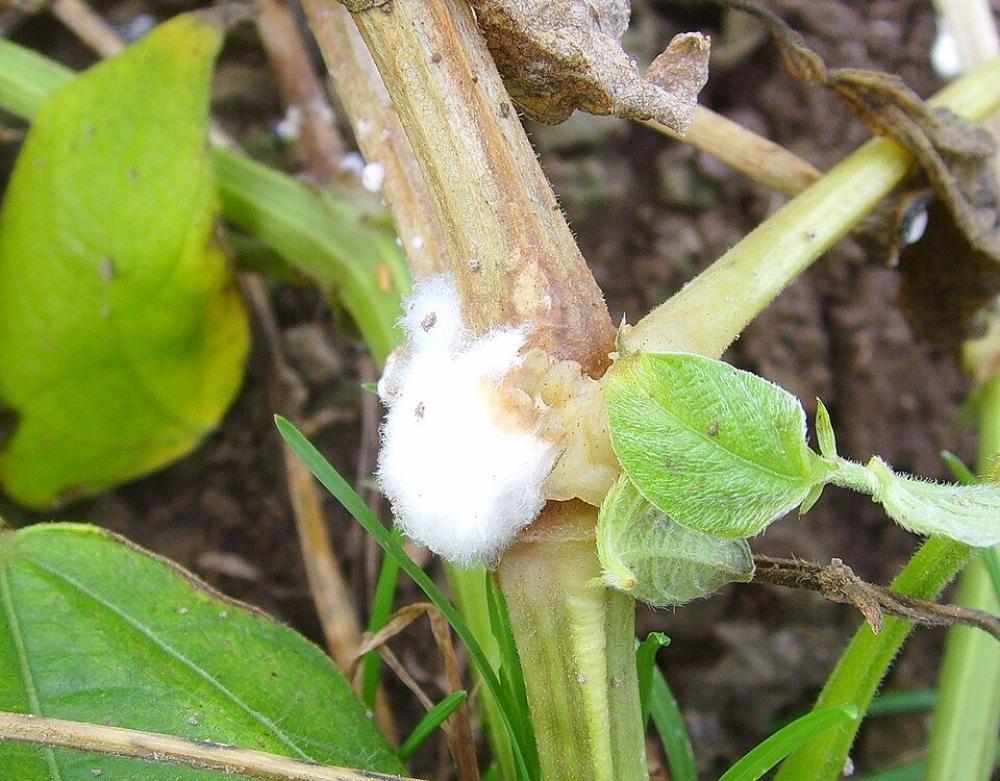

You walk into the greenhouse in the morning and find a whole lettuce collapsed on the soil surface, and on the nearby tomato stem a water-soaked spot covered in dense white cotton. You split the stem and find hard black grains inside that look like mouse droppings. This is not gray mold, as many people assume at first glance, but white mold, caused by the fungus Sclerotinia, and it is harder to control because it leaves behind in the soil what brings it back season after season.
The difference is not only in appearance. White mold lives in the ground and needs moisture, cool weather and dense shade from the plant's own foliage, while gray mold lives on plant debris and spreads through the air as gray dust. Each has a different fungicide and a different cycle. In this article we show how to tell them apart, and how to break the white mold cycle before it becomes a permanent problem.
Appearance: Dense white cottony growth on stems and fruit, with hard black bodies beneath it called sclerotia.
Difference: White mold is cottony and relatively dry to the touch, while gray mold is a fine gray dust that flies off when touched.
Fungus: It persists in the soil as sclerotia for years, and becomes active with high humidity and mild cool weather.
Spread: It starts from dead tissue or wounds, then moves to the neighboring healthy plant by contact.
Rule: Remove infected parts and take them away from the field, improve ventilation and reduce humidity, since chemical treatment alone is not enough.
How does white mold appear on the plant?
The disease attacks the stem and crown more than the leaf, and usually starts from the parts touching the soil or from wilted flowers fallen onto the leaves. The following signs repeat in most crops.
- Water-soaked spots on the stem: They start at a node, a wound or the base of the plant, then expand and girdle the stem like a belt.
- Dense white cotton: Bright white fungal growth covering the spot, clearly visible in high humidity and in the early morning.
- Bleached, fibrous stem: As the disease advances, the infected tissue turns pale and bleached and shreds like fibers.
- Hard black grains: These are the resting bodies (sclerotia), which form on the stem, inside the cavity and on the fruit.
- Wilting and collapse: Above the infection the plant wilts and collapses, and infections often show up as scattered patches in the field.
On fruit touching the ground, a soft, watery rot appears covered with white cottony growth, then black grains form on its surface or inside.
White or gray mold? A quick way to tell
Both are molds that love humidity and appear in cool greenhouses, which is why they are so often confused. The easiest way is to look at the color of the fungal growth and at whether black grains are present inside the stem.
- Color: White mold is a bright white cottony growth, while gray mold gives a gray to brown dust that flies off when touched.
- Black grains: Only white mold forms them, and they are found inside the stem or on its surface, ranging in size from a rice grain to a chickpea. Gray mold's grains are small and flat, form on debris, and are not found inside a living stem.
- Where it starts: White mold starts from the soil and crown, while gray mold starts from flowers, wounds and fallen leaves and climbs onto the fruit.
- Tissue feel: White mold is watery and soft with a bleached, fibrous stem and no dust, while gray mold covers infected tissue with a velvety layer that scatters on touch.
- Persistence in soil: White mold stays for years as buried black grains, while gray mold mostly lives on plant debris and renews itself with airborne spores.
And if the signs are mixed, which happens in humid fields, both fungi may be present together, and the preventive program must cover both.
The life cycle of the Sclerotinia fungus
The causal agent is Sclerotinia sclerotiorum, along with a smaller species called Sclerotinia minor that causes lettuce drop in particular. The fungus survives winter and summer as hard black grains in the soil that can stay viable for at least eight years, and more than three years if buried deep.
When cool, humid conditions develop under the shade of dense foliage, the grains near the surface germinate. Some produce threads that attack roots and crown directly, and some produce small brown cup-shaped bodies, each releasing hundreds of airborne spores. These spores land on wilted flowers and dead leaves, feed on them, and then move to the stem.
Extension studies indicate that infection needs intermittent moisture from dew, fog or continuous spraying for several hours, and mild temperatures between 15 and 25°C. Infection is more severe in fields where the canopy closed early and the air beneath it stayed still.
The most susceptible crops
The fungus has a wide host range; it attacks hundreds of plant species, mostly broadleaf. Grasses, however, are not hosts, which is why we rely on them in rotation.
- Lettuce and leafy greens: Lettuce drop is the best-known form of the disease, and the plant collapses from the crown.
- Tomato, pepper and eggplant: Stem rot at the crown or at pruning sites.
- Cucumber and cucurbits: Rot of fruit touching the ground, and stem rot.
- Beans and legumes: White spots on the stem and pods after the canopy closes.
- Cabbage, cauliflower, carrot and potato: Crown, root and tuber rot in storage.
- Broadleaf weeds: They carry the fungus without symptoms and become a reservoir of infection.
White mold in lettuce, carrot and after harvest
The picture of the disease differs by crop, which is why some growers do not connect scattered problems in the field and in storage.
- Lettuce: The plant collapses at the crown, its outer leaves wilt first and then fall to the ground, white cotton covers the base, and small black grains appear between the leaves.
- Carrot and celery: A watery rot at the top and crown, which in storage spreads to neighboring roots and covers them in white cotton.
- Beans: Spots on the stem and pods after canopy closure, and black grains inside the stem when it is opened.
- Tomato: Rot at the crown or pruning site, and the plant wilts above the point of infection.
In cold storage, the rot can pass between fruit and roots by contact even at low temperatures, so we sort the crop before storage and discard any piece with a watery spot or white mycelium.
How do you prevent white mold?
Soil-dwelling fungi like this one are hard to eradicate by spraying alone. The most successful programs combine cultural prevention with timed spraying. The fungicide acts as an added line of defense in the critical stage: flowering, then fruit formation.
- Bring in a non-host crop: Make the rotation for infested land wheat, barley or corn for at least two to three years, and avoid broadleaf vegetables and legumes.
- Thin the planting density: Use wider spacing and remove the lower leaves when pruning so air and light enter and dew dries faster.
- Adjust irrigation: Less frequent, deeper watering is better than frequent light watering that leaves the soil surface wet, and do not spray the leaves in the evening.
- Remove wilted flowers and fallen leaves: They are the spores' first food.
- Do not go easy on the first infection: Cut out the infected plant carefully into a closed bag before black grains form, otherwise you add to the soil's reserve.
- Watch the source of organic fertilizers: Poorly decomposed compost and residue from infected fields may carry the black grains.
- Use biological control where available: The fungus Coniothyrium minitans attacks the black grains and reduces their reserve if added to the soil months before the season.
Solarization helps in the surface layer, but does not eliminate deep grains, so it is not relied on as the only solution.
What spraying does and does not do
Some growers think a strong spray will save the field after white cotton appears. University trials say fungicides are part of an integrated program and do not give complete control, and that their results vary with timing, canopy density and crop.
- Works best before infection: The first spray at the start of flowering covers the wilted flowers through which the fungus enters.
- Needs good coverage: Spores land on flowers and lower leaves, so direct the spray inward, not only at the top.
- Does not save a bleached stem: If diseased tissue has girdled the stem, spraying is useless, and you should cut out the plant.
- Needs rotation: Do not repeat one fungicide group again and again in a season.
The products we rely on
We spray preventively at the start of flowering in fields with a disease history, because fungicide efficacy drops considerably once the fungus has spread inside the stem. We always follow the dose on the label and the pre-harvest interval.
- Switch 62.5 WG: Cyprodinil with fludioxonil from Syngenta, with two different mechanisms, and we rely on it in lettuce, leafy greens and tomato at the start of infection or just before cool, humid conditions, since it covers white mold in lettuce as well as gray mold.
- Bostak 38% WG: Boscalid with pyraclostrobin, a systemic formulation with two sites of action. We start with it in fields known for a white mold history at flowering, and alternate it with another fungicide to reduce the risk of resistance.
- Teldor 50 SC: Fenhexamid, specialized against gray mold. We recommend it when the infection turns out to be gray or mixed, and we do not rely on it alone against white mold because its stronger effect is on gray mold.
The comparison also helps with bacterial soft rot, to distinguish a collapse caused by bacteria when the crown is mushy with a foul smell and no white mycelium.
Frequently asked questions
Why is it called Sclerotinia white mold?
The name comes from the fungus Sclerotinia, and from the hard black bodies it forms, called sclerotia, which keep the fungus in the soil for years.
Does white mold spread from one plant to another?
Yes, through contacting mycelium, through airborne spores, and through infected leaves touching healthy ones. That is why infection is isolated and removed as soon as it is discovered.
Do sulfur or copper sprays help?
We do not rely on them against white mold. This fungus needs specialized fungicides sprayed at the right time, in addition to cultural practices that reduce humidity.
How long does the fungus stay in the ground?
Its black grains can stay alive more than eight years, and their viability declines the deeper they are buried or the more they decompose. So waiting a single season is not enough.
Can I eat the healthy fruit from an infected plant?
Fruit with no rot and no black grains is practically sound, but it is better to pick early and sort out any doubtful fruit, because the rot continues to develop in storage.
How do I rid my greenhouse of white mold?
Combine removal of residue, good ventilation, deeper and less frequent irrigation, rotation with a non-host crop, and timed preventive spraying at flowering. The result does not show in a single season, but the reserve declines season after season.
Image source: Jymm, Wikimedia Commons (public domain)