

A patch of lawn turns yellow and dries out even though you water it every day. A tomato or strawberry seedling wilts at midday for no clear reason, and when you pull it, it comes out with almost no roots. A small offshoot or ornamental shrub in a pot declines month after month.
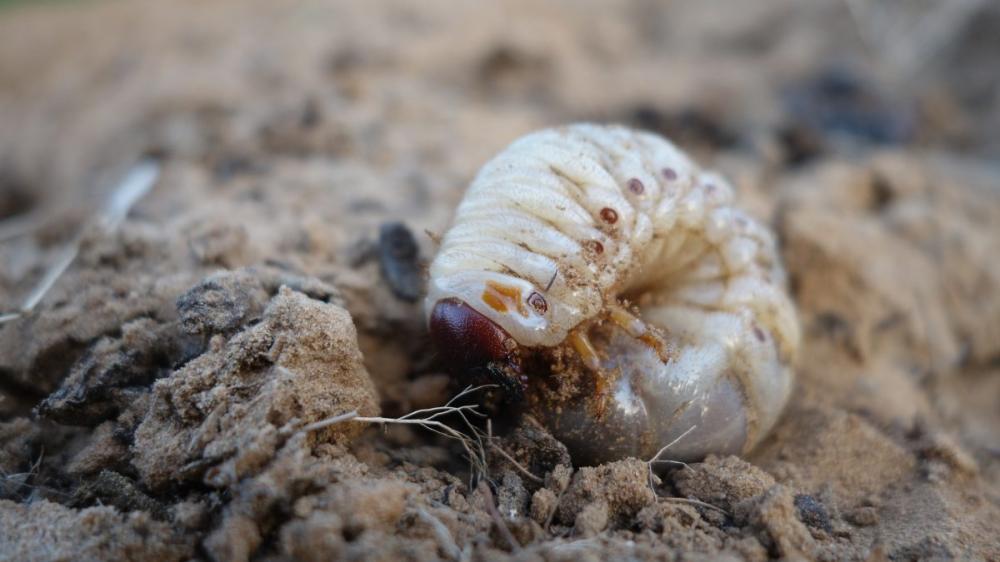
In all these cases, when you dig down a little, you find a fat white larva curled into a C shape with a brown head. These are white grubs, the larvae of scarab beetles, sometimes called "white worms" or "white beetle grubs in the soil".
The larva: A thick white grub with a brown head, curled into a C shape, that lives in the soil and feeds on plant and grass roots.
Symptom: Yellow or dry patches in the lawn that lift like a carpet because the roots have been cut, and birds or animals may dig up the turf looking for grubs.
Detection: Dig a small square at the edge of the patch and count the grubs; a certain number per square meter justifies action.
Common mistake: Only fertilizing and watering more. The problem is roots damaged by the grubs, not a lack of nutrients.
Rule: Act during the grubs' active season after confirming the count, and treat the soil with enough irrigation to carry the product down to the grubs.
An overview of white grubs
The name does not refer to a single species but to the larvae of many beetles in the scarab family (Scarabaeidae), including May and June beetles (Phyllophaga and Melolontha), masked chafers (Cyclocephala), the Japanese beetle (Popillia japonica), Anomala beetles, and the Pentodon species known in the Mediterranean and Middle East.
What they have in common is that they live in the soil and feed on roots, so the damage stays hidden until it becomes very obvious.
Not every white grub is an enemy
This is the most important point before you buy any pesticide: some grubs do not eat living roots at all but feed on decaying organic matter, and are common in manure, compost and rotting palm trunks.
The best known are flower chafer grubs (Cetoniinae) and rhinoceros beetle grubs (Oryctes), which grow very large in palm debris and manure. Finding them in a compost pile is normal and even useful, as they help break down organic matter.
There is an interesting tell: if you place a flower chafer grub on a flat surface, it crawls on its back with its legs up, while root-feeding grubs crawl on their side or stay curled. Exact identification depends on the arrangement of hairs and spines on the underside of the tip of the abdomen (the raster pattern), checked with a magnifying lens.
The plants and sites most affected by root-feeding grubs are:
- Lawns: Turfgrass, sports fields and gardens, where grub problems are most visible.
- Vegetables and strawberries: Especially in soil fertilized with unfermented manure or previously planted to turf.
- Field crops: Corn, wheat, sugarcane, potatoes (holes in tubers) and peanuts.
- Young trees and seedlings: In nurseries and pots, and newly planted offshoots.
Signs of damage: what to look for
Because the damage happens underground, the symptoms above ground look like thirst or general weakness. They differ between lawns, vegetables and pots:
In lawns
- Patches that do not respond to watering: Irregular patches of yellow then brown grass that look like drought but do not recover with irrigation.
- Spongy feel: Underfoot when you walk over the affected area.
- Grass with no roots: In severe infestations you can lift the turf by hand "like a carpet" because it has lost its roots.
- Animal digging: Birds, cats and wild animals digging up the turf in search of grubs, which is often the first thing people notice.
In vegetables, seedlings and pots
- Wilting in the heat: Even though the soil is moist, followed by stunted growth and general yellowing.
- Easily pulled plants: They come out of the soil easily with roots chewed or cut.
- Potatoes and carrots: Wide, shallow holes and cavities in tubers and roots.
- Pots: A plant that declines gradually, and when you tip out the pot you find several grubs around the root ball.
The size of the damage depends on the age of the grub:
- First stage: A small grub feeding on fine root hairs and organic matter; damage is usually limited.
- Second and third stages: This is where most damage happens, as the large grub eats large amounts of root.
To tell grub damage from other root problems: cutworms sever the stem at the soil surface and do not eat deep roots, and nematodes cause swellings, galls or lesions on roots and cannot be seen with the naked eye. White grubs, by contrast, are clearly visible in the soil around the chewed roots.
How to check the soil
- Cut a square: With a spade, cut a square of soil or turf about 30 cm on a side and 8 to 10 cm deep.
- Choose the right spot: At the edge of the affected area (between the dead and healthy parts, where the active grubs are).
- Break up the soil and count the grubs: Then repeat in several locations.
For lawns, US university guidelines treat about 5 to 10 grubs in this area as the threshold that calls for treatment; for vegetables and seedlings the threshold is lower because each plant has value.
Life cycle and appearance
White grubs go through complete metamorphosis: egg, then larva, then pupa, then beetle. Most species have one generation a year, while May and June beetles need two to three years to complete their cycle, so you find grubs of different sizes in the soil at the same time.
The grubs move deeper into the soil in cold or dry conditions and rise near the roots when conditions moderate.
The egg
- Appearance: Pearly white, oval, then growing and rounding as it absorbs moisture, about 1.5 to 3 mm long depending on species.
- Where laid: The female lays them in the soil a few centimeters deep, singly or in small groups, with dozens of eggs per female.
- Preferred soil: Females prefer moist soil rich in organic matter and well-irrigated lawns.
- Hatching: They hatch in about two to three weeks.
The larva
- Size: It passes through three larval stages, and the full-grown larva is about 2.5 to 4 cm long in most root-feeding species (and much larger in organic-matter species such as Oryctes).
- Appearance: A fat creamy-white body curled into a C, with a hard brown or orange head.
- Identifying marks: Three pairs of clear thoracic legs near the head, no abdominal legs (unlike moth and butterfly caterpillars), and a swollen gray or bluish tip of the abdomen, filled with soil and food.
- Duration: Months in species with one generation a year, and years in May and June beetles.
The pupa
- Where it pupates: The full-grown larva makes an earthen cell in the soil and pupates inside.
- Appearance: A yellowish-white pupa that darkens, shaped like a beetle with legs and wings held against the body.
- Duration: About two to three weeks.
The adult beetle
- Appearance: About 1 to 2.5 cm long depending on species, reddish brown, light brown or shiny black, and some species are metallic green.
- Emergence season: They usually emerge at the start of summer or as temperatures rise, and many are active at night and strongly attracted to lights.
- Feeding and lifespan: Some adult species feed on tree leaves and flowers and some barely feed, living a few weeks during which they lay eggs.
This sequence gives you the key to timing: swarms of beetles around lights in the evening mean eggs will be laid soon and young grubs will be in the soil within a few weeks, which is the easiest stage to control.
Biological and cultural control first
Before pesticides, there are biological and cultural solutions that reduce grub numbers and protect their natural enemies. One of the most successful biological options for soil grubs is entomopathogenic nematodes: species such as Heterorhabditis bacteriophora and Steinernema are sold commercially, and they enter the grub's body and kill it. Conditions for success:
- Young grubs: They give the best results on them.
- Moisture: They need moist soil before application, good irrigation straight after, and continued moisture for several days.
- Timing: Apply in early morning or evening, not in scorching sun.
Other natural enemies: birds, parasitic wasps that specialize in white grubs, some parasitic flies, and insect-killing fungi such as Metarhizium and Beauveria, all of which are harmed by overuse of broad-spectrum pesticides in the soil.
Cultural and mechanical measures complete the effort:
- Tilling and turning the soil: Before planting, this exposes grubs to sun and birds, and on small areas you can pick them up by hand behind the plow.
- In pots: Take the plant out, remove the grubs from around the roots, and replace the infested soil.
- Light traps: To attract adult beetles during their flight season and reduce their numbers.
Chemical control: timing is everything
For white grub control there are two kinds of treatment, and the difference is timing and the size of the grub being targeted:
- Preventive treatment: Systemic pesticides with residual activity in the soil, such as neonicotinoids (group 4A: imidacloprid and thiamethoxam) and diamides (group 28: chlorantraniliprole). Applied before egg hatch or at its start, after beetle flight has ended, they kill young grubs as soon as they begin feeding.
- Duration of residual effect: Ohio State University guidance indicates residual activity lasts up to about 8 weeks for imidacloprid and thiamethoxam, and about 12 weeks for chlorantraniliprole.
- Curative treatment: When you find large grubs already in the soil. Here you need fast-acting, short-residual pesticides, and results are often weaker because large grubs are more tolerant.
One rule not to neglect: irrigate after treatment. The pesticide must reach the root zone where the grubs live, so water immediately after application (about 0.5 to 1.5 cm of water on lawns according to US guidance).
If the soil is very dry, water the day before treatment so the grubs rise near the surface. Avoid treating when flowering plants that bees visit are present, especially with neonicotinoids.
On rotation: if you rely on preventive treatment every year, alternate between group 4A and group 28 from one year to the next instead of repeating the same active ingredient.
Suitable products from our store
At Orkida Agri we suggest a systemic pesticide for preventive treatment, a sprayer to distribute it evenly, and a stimulant that helps the plant replace its roots after the infestation is under control:
- Actara 25 WG: Systemic thiamethoxam (group 4A) that roots absorb and carry through the plant, suitable for spraying and soil treatment, and one of the materials used worldwide for preventive white grub treatment. We apply it with irrigation water or as a soil spray followed by irrigation, at the label dose for the crop concerned, and away from flowering plants.
- Eco Spray 20-liter backpack sprayer, Ultra model: For distributing the solution evenly over lawn areas and around the bases of seedlings before irrigation.
- Kelpak seaweed extract: Not a pesticide but a root growth stimulant that promotes main and lateral root growth and activates the roots of palm offshoots. Useful after the grubs are under control to help lawns and seedlings replace lost roots.
Doses, application method and pre-harvest intervals follow each product's label.
Prevention and good practices
Most grub infestations start with unfermented manure, over-irrigation or lighting that attracts beetles. These practices reduce egg-laying opportunities in the first place:
- Do not use unfermented manure: In vegetable beds and pots; fresh manure attracts beetles to lay eggs and may carry grubs with it. Use well-composted manure from a reliable source.
- Check the soil of pots and seedlings: Before buying or bringing them in.
- Moderate irrigation in beetle flight season: Waterlogged lawns attract more egg-laying, while deep, infrequent irrigation gives turf deeper roots and more tolerance.
- Reduce night lighting: Near lawns during the flight season, because it draws beetles to your garden.
- Balanced lawn fertilization: Helps it replace lost roots.
- Rotate crops: And avoid planting vegetables directly into ground that was turf or pasture for years without tilling and inspecting.
- Keep compost away: From planting beds, and know that its grubs are usually the beneficial kinds.
Frequently asked questions
Is every white grub in the soil harmful?
No. Some grubs feed on decaying organic matter in compost, manure and dead palm trunks and do not attack living roots. The harmful ones are those you find around the roots of wilting plants.
Why is my lawn turning yellow despite regular watering?
If it does not respond to watering and separates from the soil easily, white grubs may have eaten its roots. Cut a square from the edge of the patch and inspect the soil.
When should I treat my lawn for white grubs?
Preventive treatment comes after beetle flight ends and before or at egg hatch, when the grubs are small. Treating large grubs is possible but harder.
Should I water the soil after spraying the pesticide?
Yes, because the grubs live below the surface around the roots, and irrigation carries the pesticide to where they are.
What is the difference between a white grub and a cutworm?
A white grub is creamy white, C-shaped, with a brown head and three pairs of thoracic legs, and eats roots. A cutworm is a gray or dark moth caterpillar that cuts the stem at the soil surface.
Where do white grubs in pots come from?
Usually from unfermented manure or contaminated soil, or from beetles that laid eggs in an exposed pot at night, especially if it is near a light source.