
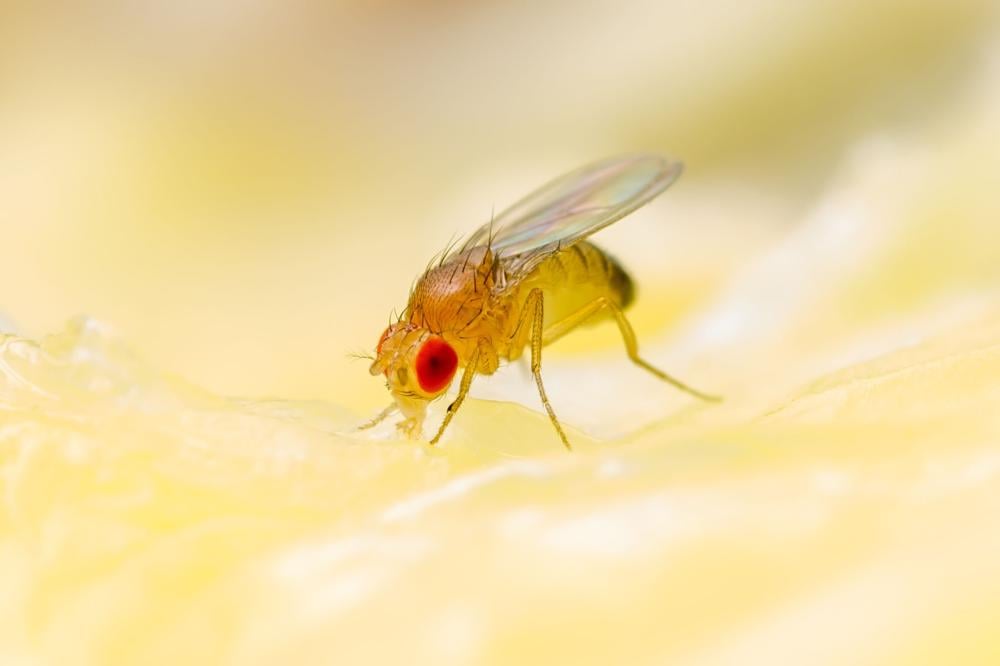

You leave a fruit basket two days and find a small cloud of flies around it, you clean the kitchen and they return hours later. This is the fruit fly, a small insect with red eyes attracted to everything fermenting, whose cycle completes in a week to ten days so numbers multiply quickly. On farms it is not just a nuisance but among the most dangerous fruit pests, because the larva feeds inside the fruit so infestation shows only when it is too late, and it is under quarantine control. In this guide we explain the difference between the household fruit fly and the orchard fruit pest, its life cycle, where its source is, and how to get rid of it in the kitchen and protect the crop with a plan combining hygiene, traps and attractant bait.
The fruit fly is one of the most dangerous economic pests affecting fruit at the color-change stage and before harvest. The danger is that infestation starts inside the fruit with no obvious symptoms at first, then fruit quality deteriorates quickly and becomes unfit for marketing or export.
It spreads strongly in warm weather and causes major losses in mango, citrus, guava, pomegranate, peach, and apricot, so it is among the pests subject to strict plant quarantine control.
Size: A small insect about 3 mm long with red eyes, attracted to ripe and fermenting fruit.
Breeding speed: Its life cycle completes in about 8 to 10 days in warm weather, and the female lays hundreds of eggs.
Source of the problem: Usually forgotten fruit, peels, or dirty drains, and not only a lack of general cleanliness.
First step: Remove the source of fermentation. Traps alone do not end the problem if the source remains.
Important: Successful control combines cleanliness, traps, and drain cleaning, supplemented by suitable products when needed.
About the Fruit Fly
- The fruit fly is a small insect with several traits that let it spread and reproduce quickly:
- Shape: Oval and small, with a length of 3 to 4 mm.
- Color: Light brown or yellow with prominent red eyes.
- Activity: Active during the day and fast-moving, which makes it easy to notice.
- Feeding: It relies on rotting fruit and organic matter as its main food source, where it finds an environment suitable for breeding.
Fruit Fly Life Cycle
- The fruit fly has a short, fast life cycle, which makes its numbers grow quickly:
- Eggs: The female lays about 500 eggs during her life, usually on rotting fruit or organic matter. The eggs hatch within two to four days.
- Larvae: Larvae feed on the pulp of rotting fruit for 5 to 7 days, which speeds up fruit decay.
- Pupae: Larvae turn into pupae in the soil or on nearby surfaces and stay inactive for two to three days.
- Adult: The adult fly emerges from the pupa and begins to breed within a few hours, restarting the cycle quickly.
The Damage Fruit Flies Cause
- Despite its small size, the fruit fly causes a great deal of damage:
- Food contamination: It carries bacteria such as Salmonella from rotting places to exposed food.
- Spoiled fruits and vegetables: It causes household produce to rot, leading to financial losses.
- Nuisance: Its numbers and fast breeding make it an annoying presence in the home.
Prevention and Control Methods
- First: Cultural (preventive) control
- Collect infested fruit and fallen fruit daily.
- Destroy the fruit by burning or deep burial.
- Clean up crop residues after the season ends.
- Till the soil surface to expose the pupae to the sun.
- Manage irrigation and reduce high humidity.
- Do not leave ripe fruit on the trees after the harvest date.
Second: Traps and Attractant Baits
- Install pheromone traps to monitor the pest population.
- Use protein attractant baits with a partial (spot) spraying system.
- It is recommended to place 1 trap for every 10 to 20 trees depending on the severity of infestation.
Third: Chemical Control (Done Properly)
- Always rely on spot spraying with an attractant bait and not full-coverage spraying, to reduce the environmental impact and increase efficiency:
- Spinosad is used with the protein bait for spot spraying.
- It is effective against the adult insect and relatively safe for natural enemies.
- Deltamethrin, lambda-cyhalothrin, or bifenthrin
- They are used with the attractant bait when infestation severity is high.
- They have a fast and strong effect on the adult fly.
Spray repeat: every 7 to 10 days depending on infestation density.
When Should Control Start, and When Is It Too Late?
- Best time for control: from the fruit set stage.
- Late control: when larvae have entered the fruit, so the loss is almost certain.
- Common mistakes farmers make
- Spraying insecticide without an attractant bait: weak efficacy.
- Leaving infested fruit on the ground: infestation multiplies several times over.
- Spraying at midday: the bait evaporates and does not attract the insect.
- Relying on spraying alone without traps: partial or complete control failure.
Fourth: Biological Control
- Use natural parasites that attack larvae and pupae.
- Maintain ecological balance and reduce indiscriminate spraying.
- Support the presence of natural enemies inside the farm.
Tips for Getting Rid of Fruit Flies
- Clean the kitchen regularly: Throw away ripe or rotting fruits and vegetables immediately. Wash kitchen surfaces and utensils daily.
- Store food properly: Keep fruits and vegetables in the refrigerator or in airtight containers. Make sure the trash is tightly covered and emptied regularly.
- Use natural traps: Make a trap with apple cider vinegar and a little dish soap in a container covered with perforated plastic wrap.
- Clean the drains: Pour boiling water or use pipe cleaners to remove accumulated organic matter.
- Use insecticides when necessary: If the problem continues, you can use products designed for flies to get rid of them for good.
Household Fruit Fly vs Orchard Fruit Fly: What Is the Difference?
The small flies hovering around fruit in the kitchen are usually vinegar flies (Drosophila) that feed and breed in fermenting fruit; treatment is removing the source, simple traps and cleaning drains. Orchard fruit flies (like the Mediterranean fruit fly) pierce healthy fruit and lay eggs inside it, spoiling it before harvest; treatment uses monitoring traps and attractant bait with spot spraying and farm hygiene.
Where to Look for the Source at Home
- Fruit left in the basket or an open fridge.
- The waste bin, fruit peel and spilled juice.
- Empty drink bottles and unwashed containers.
- Kitchen drains and dishes with sugary residue.
Remove the source first, then place the trap, because the trap alone does not end the problem. If you do not know the fly type or its source, visit one of our branches with a photo or sample and we will guide you to the right product.
Fruit Fly Control Products at Orkida
You will find suitable insecticides and traps for fruit flies in the fruit fly insecticides section. Follow the dose and the pre-harvest interval written on the label.
Orkida Tip for Farmers
- The fruit fly does not attack all fruit at once. It prefers fruit that has begun to change color or soften at the skin, so control must continue even after the first partial harvest.
- Integrated control (preventive measures + traps + baits + spot spraying) is the safest and most successful way to protect the crop.
Conclusion
The fruit fly may seem like a minor problem, but it can become a real nuisance if it is not dealt with. By understanding its life cycle and why it spreads, you can apply effective measures to get rid of it and keep your home clean and free of flies. If the problem persists, do not hesitate to consult an expert in pest control for specialized solutions.
Frequently Asked Questions About Fruit Flies
Why do fruit flies appear in the kitchen?
They are attracted to ripe and fermenting fruit, leftover juice, and the trash can, and they quickly lay eggs on any damp sugary source.
How long is their life cycle?
It can be completed in about a week in warm weather, so their numbers multiply quickly if the source of attraction is not removed.
Does a vinegar trap work?
Yes, a bowl with apple cider vinegar and a drop of soap attracts and traps flies. It is a helpful solution, but the basis is getting rid of forgotten fruit and cleaning the drains.
How do I protect my farm from fruit flies?
Collect fallen fruit and dispose of it properly, use pheromone traps for monitoring, and spray at the right time according to the advice of an agricultural specialist.